
When you picture an entrepreneur, what comes to mind? Is it a lone genius having a “eureka!” moment in a garage? That stereotype is mostly a myth. True entrepreneurship is less about a single brilliant idea and more about a mindset—a persistent drive to solve problems and create value.
This journey isn't just for start-up founders. It’s for anyone who drives change, whether in a brand-new company or a well-established organisation. The essential traits aren't things you're born with; they're skills you can build, turning raw ambition into real-world action. Think of this guide as your map for that expedition.
What It Really Means to Be an Entrepreneur
At its core, entrepreneurship is about spotting an opportunity and pulling together the resources to make something of it. It’s problem-solving on a grand scale. While we often link it to launching a business, that entrepreneurial spirit shows up everywhere.
You see it in different forms:
- The Intrapreneur: This is the person inside a big company who champions a new idea, taking risks and pushing it forward until it becomes a profitable reality. They’re a change-maker from within.
- The Social Entrepreneur: Their focus is on tackling social, cultural, or environmental problems. For them, positive impact is the real bottom line, not just profit.
- The Creative Entrepreneur: Think of the artist, designer, or writer who turns their creative talent into a sustainable business, merging passion with sharp commercial instincts.
This just goes to show how valuable these core traits are, no matter where you apply them. If you want to explore this mindset further, our blog has more on entrepreneurship and personal growth.
Entrepreneurship is not a lightning strike of genius. It's the patient, relentless process of chipping away at a problem, learning from every misstep, and maintaining the conviction that a better solution is possible.
Ultimately, being an entrepreneur means looking at uncertainty and seeing opportunity where others see a threat. It’s about building something from scratch, whether that’s a product, a service, or a movement. In the next few sections, we’ll break down exactly what these traits look like in the real world and give you practical steps to start building them yourself.
The Three Pillars: Risk, Resilience, and Vision
If you want to get to the heart of what makes an entrepreneur tick, you have to look past the business jargon. It really boils down to three core traits that every successful founder has in their DNA: a stomach for calculated risks, an almost stubborn resilience, and a crystal-clear vision.
These aren’t just abstract ideas; they're active skills that feed into each other every single day.

As you can see, risk, resilience, and vision aren't separate qualities. Think of them as spokes on a wheel, all held together by that central entrepreneurial drive.
Embracing Calculated Risk
First up is risk tolerance, and it’s probably the most misunderstood trait of the lot. This isn’t about being a daredevil or jumping into the deep end without knowing how to swim. Real entrepreneurial risk-taking is more like a seasoned rock climber mapping out their ascent. They size up the cliff face, check every piece of gear, and anticipate the dangers long before making that first move.
In other words, great entrepreneurs are masters of managing the downside. They’re constantly asking themselves the tough questions:
- What’s the absolute worst that could happen here, and could we survive it?
- What data is telling us this is a good idea, and where are we just guessing?
- How can we dip our toe in the water with a small test before we commit everything?
An entrepreneur's relationship with risk isn't about ignoring fear; it's about respecting it enough to prepare meticulously. They don't gamble—they make educated decisions where the potential reward justifies the carefully managed danger.
This measured approach is what turns a terrifying leap of faith into a series of smart, manageable steps. It’s the difference between crossing your fingers and hoping for the best versus strategically putting the odds in your favour.
Building Unshakeable Resilience
Next, we have resilience. This is the mental grit that lets you take a punch, shake it off, and get right back in the fight. The road to building a business is paved with setbacks—failed product launches, funding rejections, and market shifts that turn your brilliant idea into yesterday’s news.
Without resilience, those moments are fatal. With it, failure becomes nothing more than feedback. It’s the ability to dissect what went wrong without letting it break your spirit. We know that a huge number of businesses don’t make it past their first few years, which makes the ability to bounce back completely non-negotiable.
You can see this spirit alive and well in Ireland’s business scene. The Global Entrepreneurship Monitor found that in 2021, one in eight adults was involved in starting a new business. This 12.5% rate of early-stage activity stayed strong even through massive economic turbulence, which just goes to show how resilient that innovative drive truly is.
That kind of mental toughness is absolutely vital. The constant pressure can take a serious toll, which is why honestly addressing the mental health hurdles for entrepreneurs is every bit as important as nailing your pitch deck.
Crafting a Compelling Vision
The final pillar is vision. This is your North Star—that vivid, unshakeable picture of a future you’re trying to build. It’s seeing what could be long before anyone else does. And a powerful vision does so much more than just point you in the right direction; it’s the fuel for the entire journey.
A compelling vision is what makes all the risk and struggle feel worthwhile. It’s the fundamental "why" that gets you and your team out of bed on the tough days. When you can paint that future so clearly that others can see it and feel it too, it becomes your most powerful asset for:
- Inspiring Your Team: A shared goal turns a collection of employees into a unified team pulling in the same direction.
- Attracting Investors: People don't just invest in an idea; they invest in a founder who can sell them on a credible and exciting future.
- Guiding Decisions: When you hit a fork in the road, your vision is the filter that helps you choose the path that gets you closer to your ultimate goal.
Put them all together, and you have a powerful engine for success. A clear vision gives you the courage to take calculated risks, and the resilience to weather the storms ensures you never lose sight of that vision, no matter what obstacles get in your way.
Mastering the Art of the Pivot with Adaptability
Beyond having a grand vision and the grit to stick it out, there are a couple of hands-on traits that truly separate the entrepreneurs who make it from those who don't: adaptability and resourcefulness. In business, standing still is the fastest way to get left behind. The real winners aren't the ones with a perfect plan from day one; they're the ones who can adjust their sails the second the wind changes.
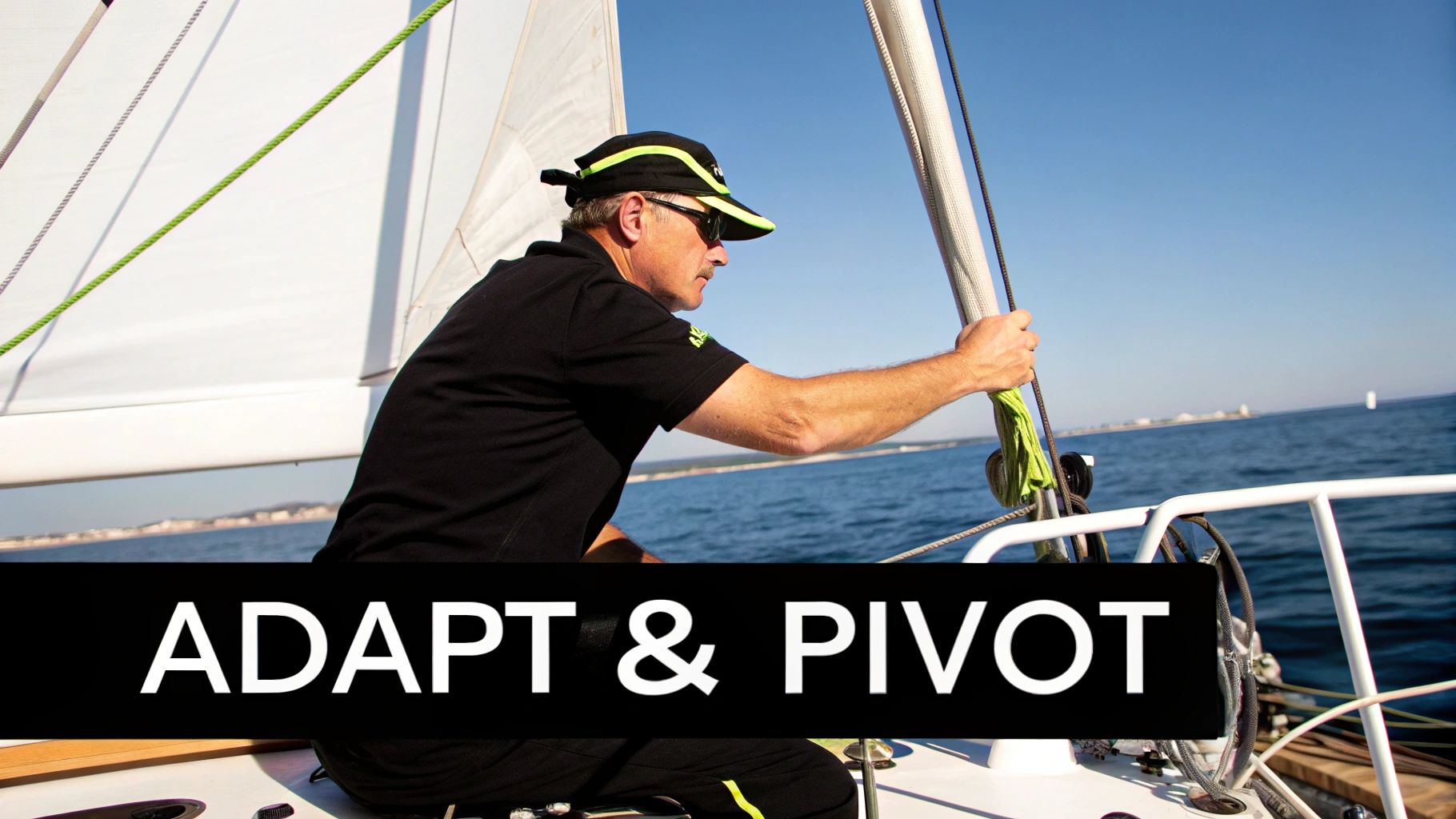
This knack for pivoting isn't about being indecisive. It's about making smart, strategic moves based on new information. Think of yourself as the captain of a ship. You have a destination in mind—that's your vision—but you're constantly dealing with the weather, the currents, and the tides. A captain who stubbornly sticks to the original course during a storm is going to sink, simple as that.
An adaptable founder does the same thing, using customer feedback, market data, and performance metrics as their navigation tools. They’re never afraid to question their own assumptions and make tough calls for the long-term health of the business.
The Power of Resourcefulness
Going hand-in-hand with adaptability is resourcefulness, which is really the art of making big things happen with very little. It’s that classic "start-up garage" mentality, where clever thinking and pure hustle mean more than a fat budget. A resourceful entrepreneur doesn't see limitations as roadblocks; they see them as a challenge to get creative.
This mindset is all about looking past the obvious to find an answer. Instead of just saying, "We can't afford that," a resourceful leader asks, "Okay, how can we get the same result with what we've got?" This often leads to brilliant, efficient solutions that bigger, more comfortable competitors would never even think of.
Resourcefulness is the entrepreneur's superpower. It’s the ability to see a solution where others see a dead end and to build momentum from nothing more than ingenuity and determination.
It's about doing more with less and turning those constraints into an advantage through smart networking, bootstrapping, and sheer willpower.
Cultivating Adaptability in Practice
Here's the thing: you aren't just born with these traits. Developing them takes real, conscious effort. Being adaptable isn't just a passive willingness to change; it's an active process of listening, learning, and then doing something about it.
Here are a few practical ways to build this crucial muscle:
- Embrace Feedback Loops: Don't just wait for feedback—go out and get it. Actively seek out customer opinions, even the harsh ones. Use surveys, reviews, and one-on-one chats to figure out what's working and what isn't, and be ready to act on it fast.
- Run Small Experiments: Before you bet the farm on a big change, test your idea on a small scale. This could be as simple as A/B testing a new feature on your website, running a pilot programme with a handful of users, or launching a bare-bones version of a new service to see if anyone bites.
- Stay Informed: Keep your finger on the pulse of your industry. Watch what your competitors are doing, keep up with new tech, and pay attention to market trends. An adaptable leader can see a shift coming and get ahead of it, rather than just reacting when it's too late.
To truly handle whatever gets thrown your way, you need to master creative problem-solving techniques. This skill is the foundation for turning unexpected problems into genuine opportunities for growth.
A Practical Tool: The Five Ways Technique
Ever hit a wall where a problem feels completely impossible? It's easy to get tunnel vision. The "Five Ways" technique is a simple but surprisingly powerful exercise to break through that mental block and kickstart your resourcefulness.
Here’s how it works:
- Define the Obstacle: Write down the exact problem you're facing. For example: "We need to generate 100 new leads but have zero marketing budget."
- Brainstorm Five Solutions: Now, force yourself to come up with five different ways to solve it. Don't censor yourself—get weird, get unconventional. The goal is just to generate ideas.
- Evaluate and Select: Look at your five options. Which ones are most feasible? What's the potential impact? Often, the best path forward is a combination of a few ideas, or a totally new one that pops up during the process.
This little exercise trains your brain to stop seeing dead ends and start seeing multiple paths forward. It reinforces the resourceful mindset that limitations are really just puzzles waiting for a clever solution. By making these practices a habit, you can turn adaptability and resourcefulness from buzzwords into the core tools that help you build something that lasts.
Leading with Purpose, Integrity, and Empathy
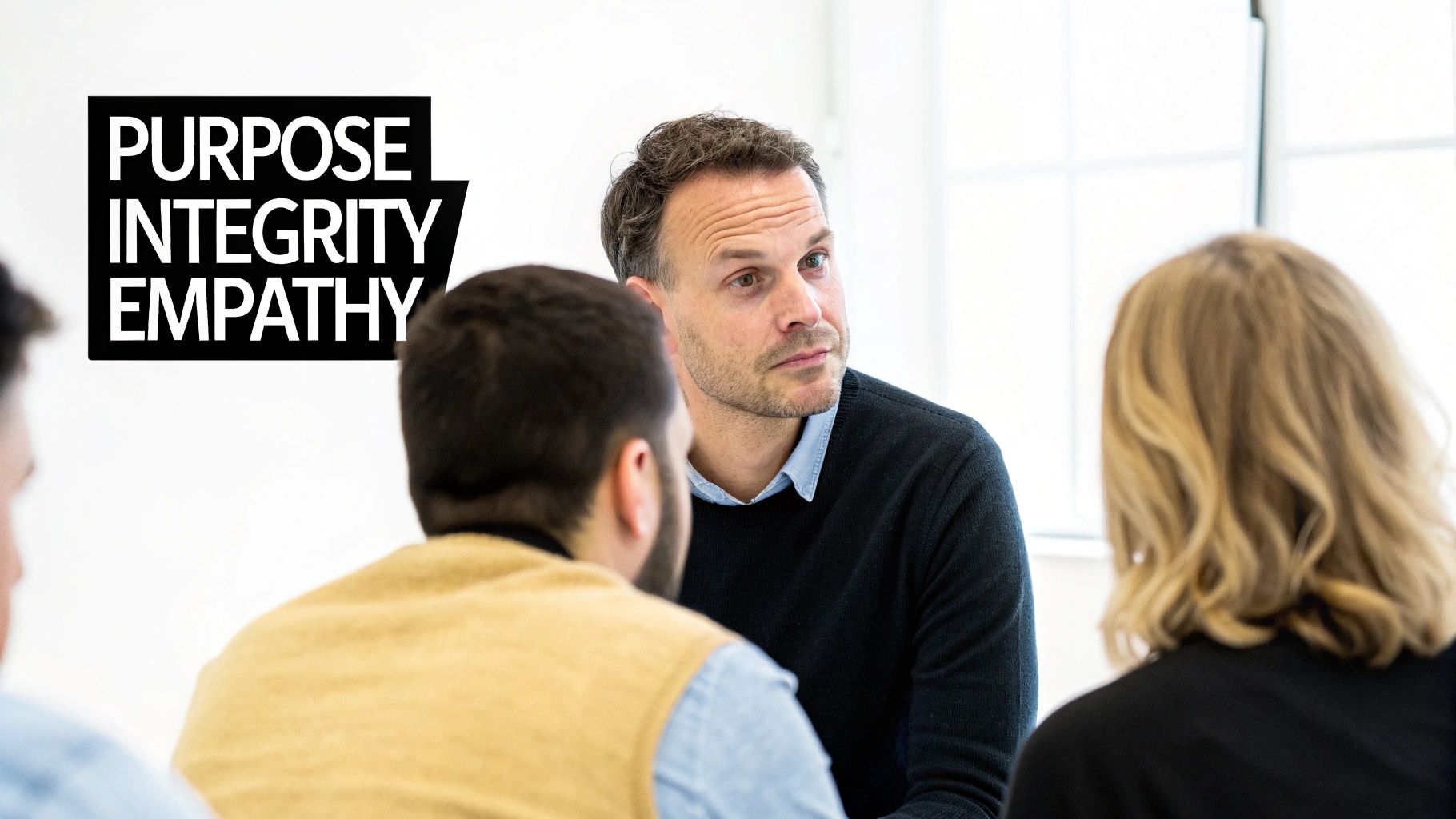
The companies that truly last aren't just built on a clever product or a big market opportunity. Dig a little deeper, and you'll find they’re built on something far more solid: trust, connection, and a crystal-clear sense of purpose. This is where ethical leadership and empathy come into play, two of the most powerful characteristics an entrepreneur can have. They aren't just fluffy nice-to-haves; they are serious strategic assets that build loyalty and create real, long-term value.
Great entrepreneurs quickly realise they're not just building a business. They're building a culture, a community. And that all starts with leading from a place of integrity.
Ethical Leadership as a Strategic Advantage
Ethical leadership isn't about grand gestures. It's about creating a simple framework of values that guides every single decision, from who you hire to how you handle customer service. It’s the quiet commitment to doing the right thing, even when it’s the much harder path.
When a leader operates with genuine integrity, it sends ripples across the entire company. It fosters a culture where people feel safe enough to take risks and speak their minds, knowing they won’t be penalised for it. This kind of psychological safety is a huge driver of creativity and innovative problem-solving.
This focus on collaboration is a real standout feature of Ireland's business scene. The country's innovation performance is well above the EU average, and a huge part of that is down to how well its small and medium-sized businesses work together—a strength measured at an impressive 172.5% of the EU average. This spirit is backed by a high enterprise birth rate of 1.6%, double the EU figure, which shows just how much a collaborative, ethical foundation helps new ventures get off the ground. You can dig into the specifics of these Irish innovation trends and data.
An entrepreneur's integrity is their brand's true north. It guides every choice, builds unbreakable trust with stakeholders, and ultimately becomes the bedrock of a legacy that outlasts any single product or market trend.
A business built on strong ethical principles isn’t just more resilient; it’s more attractive to everyone. Customers are increasingly voting with their wallets, choosing to support brands that align with their own values. At the same time, top talent is actively looking for workplaces with a positive and principled culture.
Empathy: The Dual-Action Superpower
Working hand-in-hand with integrity is empathy—the ability to genuinely understand and share what another person is feeling. For an entrepreneur, this skill is a dual-action superpower, working its magic both externally with customers and internally with your team.
Customer Empathy: This goes way beyond market research or staring at data points on a spreadsheet. It’s about getting such a deep, intuitive feel for your customers’ lives, frustrations, and dreams that you can anticipate what they need before they even know how to ask for it.
When you lead with empathy, you stop just selling products and start solving real human problems. That connection is what turns a one-time buyer into a lifelong champion for your brand.
Team Empathy: Inside your organisation, empathy is the glue that holds everything together. An empathetic leader creates a supportive culture where people feel seen, heard, and genuinely valued. They get that their team members are whole people, with lives and challenges outside the office walls. This is absolutely critical for keeping morale high, preventing burnout, and inspiring real loyalty.
This human-first approach proves that modern, sustainable success is built on connection, not a ruthless, win-at-all-costs attitude. The strongest businesses are always the ones where both customers and employees feel truly understood and respected.
How Entrepreneurial Traits Look in Different Industries
The core traits of an entrepreneur aren't a one-size-fits-all checklist. Think of them more like a musician’s scales—you learn the fundamentals, but the real magic happens when you adapt them to fit a specific song. A founder’s vision, resilience, or empathy will look entirely different depending on the challenges of their industry.
Let's look at how this plays out in the real world. From the thorny ethics of artificial intelligence to the deeply human demands of healthcare, the entrepreneurial mindset is constantly being tested and reshaped. Each sector calls for a unique blend of these core skills to turn a big idea into a business that actually lasts.
Vision and Ethics in Artificial Intelligence
In the AI world, having a powerful vision is just the price of entry. An entrepreneur in this space has to see a future that goes beyond simply automating tasks; they need to imagine a completely new way of solving problems. It’s about looking past the code and algorithms to see how society itself might operate differently.
But here, vision is welded to ethical foresight. AI has the potential for both immense good and catastrophic harm, which means founders have to build their companies on solid ethical ground from day one. It’s not enough to ask, "Can we build this?" The real questions are, "Should we build this?" and "How do we build it responsibly?" This fusion of bold vision and genuine integrity is what separates a fleeting tech trend from a true innovation that helps people.
Empathy and Resilience in Healthcare
For a healthcare start-up, the road is a marathon, not a sprint. It’s paved with regulatory hurdles, painfully long development cycles, and outcomes that are deeply personal. This is where empathy isn't just a nice-to-have; it's a core business asset. A successful health-tech founder has to understand the patient’s world on a profound level—their fears, their frustrations, and their hopes.
That deep empathy is what fuels the other critical trait here: resilience. Navigating the maze of clinical trials, data privacy laws, and entrenched healthcare systems is a gruelling, soul-testing process full of setbacks. Founders in this field need the mental fortitude to push through years of development, driven by the belief that their work will one day ease someone's suffering or even save their life. It’s a powerful mix of human connection and pure grit.
The most impactful entrepreneurs don't just solve business problems; they address human needs. Their success is measured not only in profit, but in the positive change they bring to people's lives, whether through technology, healthcare, or creative expression.
This drive is alive and well in Ireland. The country's IE04 region, for instance, has seen the highest national growth in employed ICT specialists and innovative small businesses that collaborate. A remarkable 63% of 25 to 34-year-olds in this region hold tertiary education degrees, creating a fantastic talent pool for skilled, forward-thinking entrepreneurship. You can dig into more data on Ireland's regional innovation performance.
Resourcefulness and Adaptability in Logistics
The logistics industry is a massive, complicated puzzle of supply chains, timing, and countless moving parts. Success isn't usually about one revolutionary idea; it's about a relentless, grinding pursuit of efficiency. For entrepreneurs in this game, resourcefulness is everything. It's the knack for finding smarter, faster, and cheaper ways to get something from A to B, often by using existing infrastructure in a clever new way.
This goes hand-in-hand with adaptability. A sudden port closure, a spike in fuel costs, or a new trade tariff can bring the whole system to a shuddering halt. A logistics founder has to be able to pivot in an instant, re-routing shipments and redesigning processes on the fly to keep goods moving. Their success is built on clever problem-solving and an almost preternatural ability to react to constant chaos.
Creative Risk-Taking in Creative Tech
Finally, let's look at the creative tech space—think gaming, digital art, or immersive media. Here, success hangs on a unique mix of artistic vision and calculated guts. An entrepreneur needs a distinct creative point of view and the courage to bet the farm on it, even when it flies in the face of current trends. This is vision meeting risk tolerance in its purest form.
These founders aren't just building a product; they're crafting an experience, an emotion. That requires taking bold creative leaps that don't have a clear, data-backed path to success. It’s about trusting your creative instincts and having the conviction to bring something utterly new into the world, inspiring a team and an audience to believe in a vision that, at first, only you can see.
Building Your Entrepreneurial Toolkit
Knowing the theory is great, but putting it into practice is where the magic really happens. This is your roadmap for growth—a practical guide to turn those abstract concepts into tangible skills. Entrepreneurship isn’t some innate talent you’re born with; it’s a muscle you build over time, and your journey starts with that first small, intentional step.
So, where do you begin? Start with an honest look in the mirror. Think about the traits we've covered—resilience, adaptability, vision. Which ones are already in your wheelhouse? And which ones could use a bit of work? This isn’t about being hard on yourself; it’s about creating a personal game plan for what comes next.
Charting Your Course for Growth
Once you’ve pinpointed your focus areas, it’s time to get your hands dirty. Developing these skills isn't a solo mission. It's all about connection, learning, and putting in the reps, day after day.
Here are a few ways to get the ball rolling:
- Find a Mentor: Don't just look for a successful person; find someone who’s walked the path you're on. A great mentor offers more than just advice. They provide perspective, helping you sidestep common mistakes and reframe challenges you thought were insurmountable.
- Network with Purpose: Forget the old-school approach of just collecting business cards. Aim to build real, authentic relationships. Ask thoughtful questions, listen more than you speak, and always look for ways to add value before you ever think about asking for something.
- Embrace Lifelong Learning: The business world never stands still, and neither should you. Stay curious. Read voraciously, take a short course, or dive into new tools. For example, getting a solid grasp of AI and data analytics is quickly becoming non-negotiable for founders in just about every industry.
Remember, beyond your own skills, your biggest asset will be your people. True success comes from mastering the art of building and leading high-performing teams. Your vision is only as strong as the team you empower to bring it to life.
Entrepreneurship is the relentless practice of turning uncertainty into opportunity. It's a continuous cycle of learning, building, and refining—not just your business, but yourself.
The goal here is simple: to leave you with a clear plan and the spark you need to get started. Your journey starts right now.
Your Questions on Entrepreneurship, Answered
Let's dive into some of the questions that pop up time and again when we talk about the entrepreneurial mindset. I want to give you some straight answers here, cut through the noise, and bust a few myths while we're at it.
Are Entrepreneurs Born or Made?
This is the big one, isn't it? The classic nature vs. nurture debate. While it's true some people seem naturally wired for risk-taking, the overwhelming evidence—and my own experience—points to one conclusion: entrepreneurs are made.
Think about it. The skills we've been discussing—resilience, adaptability, vision, empathy—aren't fixed traits you're born with. They're like muscles. You develop them through practice, mentorship, and getting your hands dirty. Every time something goes wrong, you're getting a masterclass in resilience. Every chat with a customer is a chance to sharpen your empathy.
What Is the Single Most Important Trait for Success?
If I had to bet on just one trait, it would be resilience. A brilliant idea is a fantastic start, but the road from that lightbulb moment to a real, breathing business is never a straight line. It’s littered with potholes, detours, and plenty of moments where you'll question everything.
Resilience is what keeps the engine running when you feel like you're out of fuel. It’s the grit that allows you to see failure not as a stop sign, but as a signpost pointing you in a better direction. Without that bounce-back ability, even the most visionary founder will burn out under the pressure of building something from scratch.
The entrepreneurial journey isn’t about avoiding the hits; it’s about mastering the art of getting back up. Resilience ensures you’re always ready for the next round.
Can I Develop These Skills Without Starting a Company?
Absolutely. You don't need to hand in your notice and dive headfirst into a start-up to build this mindset. In fact, these skills are gold in any career.
You can start training right where you are.
- Put your hand up for tough projects that stretch you beyond your comfort zone.
- Lead a small initiative or team, which is a fantastic way to build leadership and empathy.
- Make a habit of asking for feedback and actually using it to get better.
Treat it like you're in training. By building this toolkit now, you’re preparing yourself for whatever comes next—whether that's launching your own venture or becoming the person everyone relies on to make things happen inside a larger company.
Discover more from Scott Dylan
Subscribe to get the latest posts sent to your email.