

A career in cyber security isn't just another job; it's about being on the front lines of digital defence. You’re the one protecting everything from a company's sensitive data to the critical infrastructure we all rely on. It’s a field built on safeguarding our digital lives, making it one of the most vital and genuinely rewarding professions out there today.
So, You're Thinking About a Career in Cyber Security?
Welcome to the world of cyber security—easily one of the most important and fastest-growing sectors right now. Think of this guide as your personal roadmap to breaking into the field. This isn't your typical 9-to-5; it's a mission-driven career where you're actively working to keep the digital world safe.
The need for skilled professionals is absolutely exploding. Why? Because cyber threats are getting smarter and businesses are more reliant on technology than ever. One recent report found that global cyberattacks shot up by 38% in just a single year, which tells you everything you need to know about the urgent need for digital defenders. For a bigger picture, you can find great resources within the Cyber Security industry.
What We're Going to Cover
I've designed this guide to be a practical playbook, not a dry textbook. It doesn't matter if you're fresh out of university, a tech enthusiast tinkering in your spare time, or looking to pivot into a career with real impact—the advice here is for you. My goal is to cut through the noise and give you a clear, actionable path forward.
At its core, cyber security is about showing up every day to protect sensitive information from those with bad intentions. That sense of purpose is a powerful motivator and a constant throughout your entire career.
This guide will walk you through the whole journey, breaking it down into simple, manageable steps. We'll get into:
- The current job market and how the massive talent shortage is actually a huge opportunity for you.
- The most popular roles in the field, explained in plain English to help you find where you fit.
- The key skills and qualifications that will actually get you noticed by hiring managers.
- What you can realistically expect to earn at different points in your career.
- Real-world tips for putting together a standout application and nailing the interview.
By the time you've finished reading, you’ll have a solid plan for getting from where you are now to getting hired. Let’s start building your future in this exciting field.
Getting to Grips with the Cyber Security Job Market
Thinking about a career in cyber security? Let me put it this way: you’ve picked a great time. The industry is absolutely booming. Every time a new app launches, a business moves online, or another smart device connects to the internet, the need for someone to protect it grows. This isn’t a small blip in hiring; it’s a massive, industry-wide scramble for talent.
Think of it like a gold rush. A huge new territory (the digital world) has opened up, and businesses are rushing in to stake their claim. But this territory is full of risks, and every single one of those businesses needs security to guard their assets. Right now, there are far more claims to protect than there are guards to go around, which creates a huge opportunity for anyone willing to learn the ropes.
And this isn't just about stopping shadowy hackers in hoodies. It's now a core part of business strategy. Industries like finance, healthcare, and retail are built on a foundation of trust. If that trust is broken by a data breach, the consequences can be devastating. That’s why skilled cyber security pros are no longer a 'nice to have'—they're essential.
What's Fuelling This Unprecedented Growth?
So, what's behind this incredible demand for cyber security experts? It's a perfect storm of factors. Threats are constantly getting more sophisticated, which means the people defending against them need to be even smarter and faster. We need a constant flow of fresh talent with new ideas to stay ahead.
The image below breaks down the main forces driving the boom.
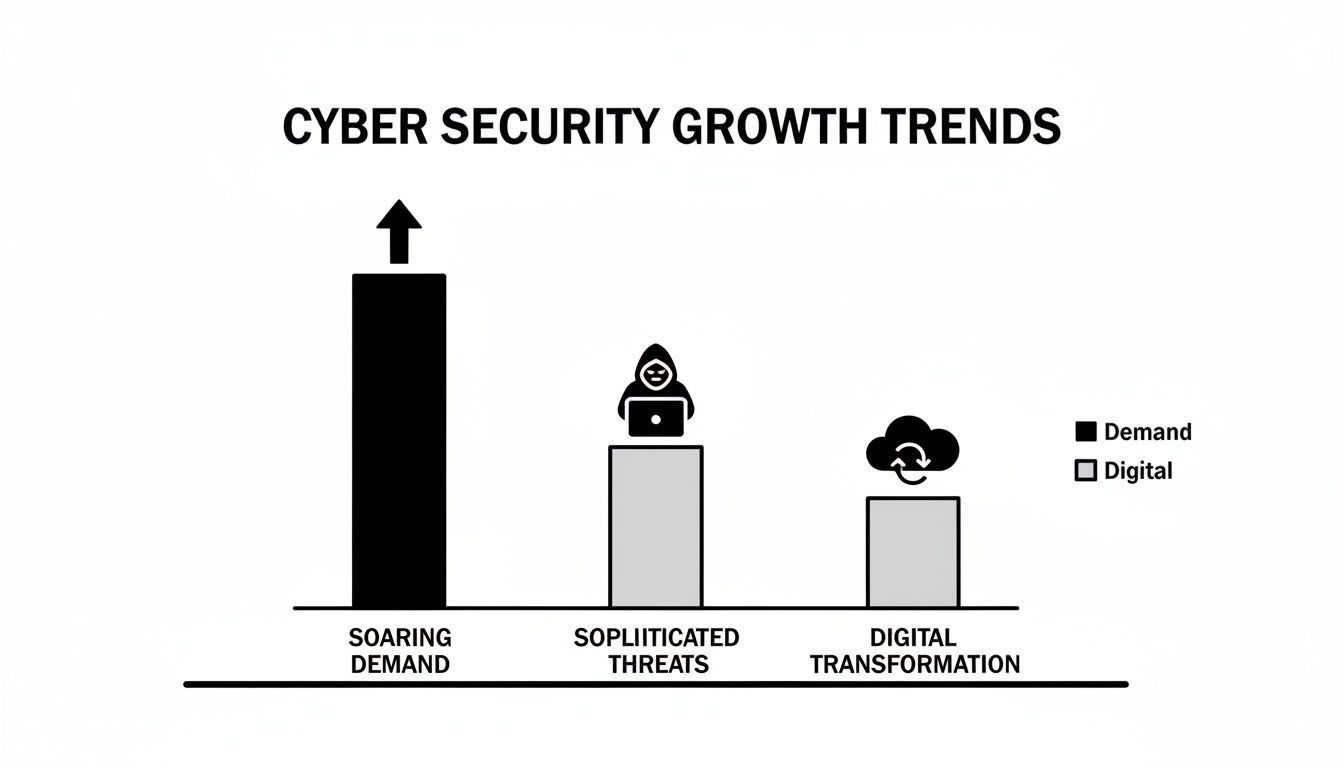
As you can see, it's a combination of soaring demand, more advanced threats, and the simple fact that almost every business is now a digital business.
A Closer Look at the UK and Ireland
While this trend is happening worldwide, the UK and Ireland have become real hotbeds for cyber security careers. London is a global financial powerhouse with a massive appetite for security talent, and Dublin has cemented itself as Europe’s tech hub, drawing in big international names that all need strong security teams on the ground.
Ireland's growth, in particular, has been explosive. The country's cyber security job market is set to expand at an annual rate of 7.91% through to 2025. This is largely thanks to the major tech companies setting up shop in Dublin, which are expected to create over 5,000 new jobs and pump €1 billion into the economy by 2025.
To give you an idea of the scale, the number of cyber security roles in Ireland jumped from just 2,000 in 2019 to 6,700 in 2022. It's a massive leap. Looking ahead, the market is projected to add a cool €2.5 billion to Ireland's economy by 2030, which shows just how vital this field has become.
And it’s not slowing down. With 66% of Irish companies planning to increase their cyber security budget in 2025, the need for skilled professionals is only going to get more intense.
Why This Is Your Golden Ticket
If there’s one thing to take away from all this, it’s the enormous skills gap. Simply put, there are not enough qualified people to fill all the open roles for a job in cyber security.
The global cyber security workforce is short by about four million professionals. That’s not just a number on a report; it's a wide-open door for anyone looking to get into the industry.
For people thinking about a career change, or even just starting out, this gap means job security and incredible potential for growth. Companies are getting more creative with hiring, offering to train people up and valuing transferable skills like problem-solving and critical thinking more than ever before.
Cyber security is a fantastic example of the growing demand for digital skills in the job market, offering a career path that's both stable and genuinely rewarding. If you want to dig into more of the specifics, our guide on https://scottdylan.com/blog/business/computer-security-jobs/ offers some extra insight. At the end of the day, the market isn’t just looking for new people—it’s shouting for them.
Popular Cyber Security Roles Explained
Trying to get your head around the world of cyber security can feel like learning a new language. You're hit with a dizzying number of job titles and acronyms. But let's simplify things. Think of any organisation as a medieval castle. To defend it properly, you can't just have one type of soldier; you need a whole team with different skills, all working together to protect the kingdom's valuables (in this case, your data).

This simple analogy helps break down the most common jobs in cyber security into roles that actually make sense. Let's take a look at the key players you'll find on any digital defence team and see where you might fit in.
The Security Analyst: The Watchful Lookout
The Security Analyst is your lookout on the castle watchtower. Their whole job is to keep a close eye on the entire digital kingdom—networks, servers, and devices—and spot any sign of trouble. They are the first line of defence. Using specialised tools, they hunt for suspicious activity, dig into potential threats, and are the first to sound the alarm when an attack might be happening.
This role is a natural fit for people who are deeply curious, love analysing things, and have a sharp eye for detail. You need to be the kind of person who can spot a pattern others might miss and stay cool under pressure while figuring out a potential breach. A good analyst gets a real kick out of solving puzzles and connecting the dots.
Honestly, analysts are the heartbeat of any security operation. Without them, a company would be completely blind to threats, which makes them absolutely essential.
The Penetration Tester: The Friendly Invader
Next up is the Penetration Tester, often called a 'pen tester'. Think of them as the castle’s own team of friendly invaders, hired specifically to test the defences. Their job is to get inside a hacker's head and actively try to break into the system. They're looking for every weak spot in the walls, gates, and internal security before a real attacker finds them.
These professionals, also known as ethical hackers, run simulated cyberattacks to uncover vulnerabilities. Afterwards, they report everything they found back to the organisation, giving clear, actionable advice on how to shore up the defences. It's a proactive way to plug security holes before they get exploited.
A Penetration Tester's mindset is everything. They mix serious technical skill with a creative, almost mischievous approach to problem-solving, always asking, "What if I tried this?"
This role is perfect for anyone who loves a good challenge and gets a thrill from the chase. If you're persistent, naturally inquisitive, and enjoy taking things apart just to see how they work, you’d probably make a great pen tester.
The Security Architect: The Master Builder
The Security Architect is the master builder who designs the castle’s entire defence strategy from the ground up. They aren't just worried about a single wall or gate; they create the blueprint for the whole fortress. Their goal is to make sure every single component works together perfectly to create layers of robust protection.
Their work starts long before any attack ever happens. Architects are responsible for designing, building, and looking after an organisation's security infrastructure. They make the big-picture decisions about what security technologies to use and how to implement them, ensuring the entire design can stand up to both current and future threats.
This is a strategic role that suits people who can see the big picture but also have deep technical knowledge and excellent planning skills. If you enjoy designing complex systems and making sure every piece fits just right, a career as a Security Architect could be for you. The principles they use are crucial everywhere, from corporate networks to safeguarding patient data with AI in healthcare security.
Comparison of Common Cyber Security Roles
While these are just three of the many jobs out there, they represent the core functions you'll find in most security teams. To give you an even clearer idea of how they stack up, here’s a quick comparison table breaking down what each role involves, the skills you’ll need, and what you might expect to earn starting out here in Ireland.
| Role Title | Primary Responsibilities | Key Skills | Typical Entry-Level Salary (Ireland) |
|---|---|---|---|
| Security Analyst | Monitoring networks for threats, investigating security alerts, and managing initial incident response. | Threat detection, data analysis, knowledge of security tools (SIEM). | €40,000 – €55,000 |
| Penetration Tester | Simulating cyberattacks to find and exploit vulnerabilities in systems and applications. | Ethical hacking, network protocols, scripting, creative problem-solving. | €45,000 – €60,000 |
| Security Architect | Designing and implementing the overall security structure and strategy for an organisation. | System design, risk assessment, deep knowledge of security frameworks. | €75,000 – €90,000+ (Mid-to-Senior Level) |
Understanding these key differences is the first real step towards finding your place in the industry. Whether you see yourself as the vigilant guard on the wall, a clever strategist testing the gates, or the master builder designing the fortress, there’s a role in cyber security that will play to your strengths.
Building Your Skills and Qualifications
Getting a job in cyber security isn’t about finding one single, magic-bullet qualification. It’s more about building a solid, well-rounded foundation of skills. There's no single "right" way to do this. Think of it like building a house – you can use different materials and follow slightly different blueprints, but the goal is always a strong, reliable structure.
Your journey will be a mix of technical know-how and crucial soft skills. Let’s break down the three main pathways you can take to build this foundation, each with its own pros and cons, so you can figure out what works best for you.
Choosing Your Learning Path
Your first big decision is how you want to learn. The three most common routes are getting a degree, earning professional certifications, or going the self-taught route. The truth is, most successful pros end up blending all three over the course of their careers.
-
Formal Education (University Degrees): A university degree in computer science or a dedicated cyber security field gives you a deep, theoretical understanding of why things work the way they do. This path is fantastic for building a strong conceptual base and is often a big plus for larger, more traditional companies.
-
Professional Certifications: Think of these as a professional stamp of approval. They're specific qualifications that prove you have the practical, hands-on skills for a particular job, telling employers you're ready to hit the ground running.
-
Self-Study and Bootcamps: This is all about using online courses, intensive coding bootcamps, and your own personal projects to build skills fast. It's a much more flexible and often quicker route, perfect for career changers or anyone who wants to focus purely on job-ready abilities.
The best approach is rarely just one of these. A degree paired with a key certification, or a bootcamp followed by self-study to deepen your knowledge, often creates the most compelling profile for a hiring manager.
The Power of Certifications
For a lot of people trying to land their first cyber security job, certifications are the most direct way to get a foot in the door. They act as a common language that recruiters immediately understand and trust. When they see a certification like the CompTIA Security+ on your CV, it instantly signals a baseline level of competence.
Here’s why they’re so effective:
- Industry Recognition: Certifications are standardised, so an employer in Dublin knows exactly what a CompTIA-certified candidate in Cork has been tested on.
- Practical Focus: They’re designed to test the hands-on skills needed for real-world roles, making you a much more attractive hire.
- Structured Learning: Studying for a cert gives you a clear roadmap, guiding you through all the essential topics you need to master. No guesswork involved.
Popular entry-level certifications like the CompTIA Security+ or the (ISC)² Certified in Cybersecurity (CC) are brilliant starting points. As you get more experience, you can aim for more specialised ones like the Certified Ethical Hacker (CEH) for pen testing roles or the highly respected CISSP for management tracks.
Blending Hard and Soft Skills
While technical chops are absolutely essential, they’re only half the story. The best cyber security professionals aren’t just tech wizards; they’re also fantastic communicators, problem-solvers, and critical thinkers. After all, what good are your technical findings if you can't explain the risk to a non-technical manager?
Think of it this way: your hard skills are the tools in your toolkit, but your soft skills determine how effectively you can use them with your team. This balance is a core part of what information communication technology is all about, and you can learn more about this crucial concept in our ICT guide.
Here’s a look at the skills you need to be working on:
| Skill Type | Examples | Why It's Important |
|---|---|---|
| Hard Skills | Network Security, Cloud Computing (AWS/Azure), Python Scripting, Threat Analysis | These are the practical, technical abilities you need to do the core security work. |
| Soft Skills | Problem-Solving, Communication, Attention to Detail, Collaboration | These skills let you work well in a team, report findings clearly, and think on your feet under pressure. |
Ultimately, building your qualifications is an ongoing process. Start with one path—whether it’s a degree, a cert, or a bootcamp—and focus on developing that mix of technical and personal skills from day one. This balanced approach will make you a much stronger and more adaptable candidate in the long run.
What to Expect for Your Cyber Security Salary
Alright, let's get to the question on everyone's mind: what does a cyber security job actually pay? It's great to do work you find interesting, but you also need to know it provides a solid financial future. The good news is, thanks to that huge market demand we talked about, this field delivers.
Money talks, and you need a clear picture of what's realistic. Because companies are all fighting for the same pool of skilled people, they're putting competitive salaries and good benefits on the table, even for those just starting out.
A Look at Typical Salary Ranges
In the UK and Ireland, the pay packets for cyber security roles are pretty attractive right across the board. While the exact numbers will always shift based on the company, location, and your specific skills, you can definitely see a clear path for salary growth.
-
Entry-Level (0-2 years): When you're new to the game, you'll likely be looking at roles like SOC Analyst or Junior Security Consultant. In the UK, you can expect to start somewhere between £25,000 and £40,000. Over in Ireland, that starting point is typically between €40,000 and €55,000.
-
Mid-Level (3-6 years): A few years of real-world experience under your belt changes everything. Your earning potential jumps significantly. For roles like Penetration Tester or Security Engineer, you're looking at £45,000 to £70,000 in the UK. In Ireland, that same experience level often pulls in €60,000 to €80,000.
-
Senior-Level (6+ years): Once you've become a seasoned pro, the rewards get serious. Senior professionals—think Security Architects or Managers—can earn a substantial income. In the UK, this can be anywhere from £70,000 to well over £100,000. Senior roles in Ireland often pay between €80,000 and €120,000, and the top specialists can command even more.
Factors That Push Your Pay Up
Your salary isn't just a fixed number; think of it more like a starting point. There are a few key things that can give it a serious boost, and these are the levers you can pull to increase your market value.
The real magic formula for a top-tier salary is combining specialised skills with a high-demand location. If you can solve a very specific, urgent problem for a company in a major tech hub, you’ll have all the negotiating power.
Location is a massive one. It's no surprise that a job in London or Dublin will almost always pay more than the same role in a smaller town. This is partly down to the higher cost of living, but it's also where the big companies are concentrated.
Your specialisation is the other huge piece of the puzzle. Niche skills in booming areas like cloud security (think AWS or Azure), threat intelligence, or data privacy are gold dust right now. On top of that, having advanced certifications like the CISSP or OSCP acts as a clear signal of your expertise and can add a healthy bump to your pay.
Diving into the Irish Market
The salary situation in Ireland is a perfect example of how a talent shortage drives compensation sky-high. The pay is incredibly competitive, making it a fantastic place to build a career in this field.
The latest data paints a really clear picture. A Junior IT Security Analyst (1-3 years' experience) in Ireland can expect to bring in between €45,000 and €60,000. Mid-level pros (3-6 years) are typically seeing salaries in the €60,000 to €75,000 bracket, while senior experts with over six years of experience are commanding €75,000 to €90,000. And for the absolute top-tier specialists in fields like incident response, it’s not unheard of to push past €150,000. For a more detailed breakdown, check out the IT Search Cyber Security Salary Guide 2025.
And this isn't a trend that's slowing down. With an estimated 1,000 new roles needed every single year just to meet demand, and with 66% of organisations planning to increase their security budgets, the pressure on salaries is only going one way: up. This means you're not just looking at a good salary, but genuine, long-term job stability in a field that modern business simply can't function without.
Crafting Your Application and Acing the Interview
You've built up your skills and have a solid handle on the market—now for the final push. Getting a job in cyber security isn't just about what you know; it's about proving you have the right mindset to apply it. Your application is the first test, and the interview is where you really get to shine.

Let's walk through how to put together an application that actually gets you noticed, and then dive into how to handle the interview with confidence. This is the part where all that hard work pays off with a job offer.
Making Your CV Stand Out
Your CV is your foot in the door, so it has to be sharp and to the point. Recruiters spend only a few seconds on each one, which means you have to grab their attention almost instantly. A generic CV is a one-way ticket to the "no" pile.
The trick is to put yourself in the hiring manager's shoes. What problem are they hoping this new hire will solve? Scour the job description, pick out the key phrases, and make sure your CV reflects that language, highlighting the exact skills and experience they're asking for.
- Lead with Projects and Labs: If you're short on formal experience, your personal projects are your best evidence. Go into detail about your home lab, mention any Capture The Flag (CTF) results, or talk about contributions to open-source tools. Explain what you built or found, the tools you used, and why it was a valuable exercise.
- Use Numbers to Show Impact: Don't just list what you did; show the result. Instead of saying you "Monitored network traffic," try something like, "Analysed network traffic using Wireshark to identify and flag an average of 3 potential anomalies per week." It’s so much more powerful.
- Weave in Keywords Naturally: Sprinkle in terms directly from the job description, like "threat detection," "incident response," or "risk assessment." This helps you get past the automated CV screeners (the ATS bots) and signals to the human reader that you know what the role involves.
Preparing for the Interview
Cyber security interviews are usually a mix of two things: behavioural questions to see how you think, and technical challenges to test what you know. You absolutely cannot wing it.
When it comes to the behavioural side, interviewers are trying to gauge your problem-solving process and your genuine interest in the field. They want to see that you're curious, you don't give up easily, and you can explain complicated stuff clearly.
The candidates who really impress don't just answer questions; they tell a story. They connect their experiences, even small wins from a personal project, to the real-world challenges the company is facing. It shows they're not just looking for any job—they're genuinely enthusiastic about this job.
Get ready for questions like:
- "Tell me about a tricky technical problem you had to solve."
- "How do you keep up with the latest security threats and news?"
- "What got you interested in a cyber security career in the first place?"
On the technical front, expect to get your hands dirty. You might be asked to analyse a log file, explain how a specific attack works, or talk through your step-by-step response to a security breach. If you get stumped, don't panic. It's perfectly okay to say, “I’m not 100% sure, but here’s how I’d figure it out.” That honesty and a clear thought process can be more impressive than knowing every answer off the top of your head.
Got Questions About Cyber Security Jobs? We’ve Got Answers
Stepping into the world of cyber security can feel like you've got a million questions and no one to ask. It's completely normal. Let's tackle some of the most common queries I hear from people just starting out, so you can move forward with confidence.
Think of this as our final chat before you start hitting 'apply'.
Do I Really Need a Computer Science Degree to Get a Job in Cyber Security?
Honestly? No, you don't. While a CS degree can give you a great foundation, it's far from the only path into the field. I've met brilliant security pros who started their careers in marketing, history, and even music.
These days, what you can do often matters more than what you studied. Practical, hands-on skills are king. A solid portfolio, respected industry certifications, and experience from a bootcamp can easily catch an employer's eye, sometimes even more than a traditional degree. The demand for talent is just too high to be that rigid.
What's the Best First Job in Cyber Security?
If you're looking for the best all-around starting point, my money is on a Security Analyst role, especially in a Security Operations Centre (SOC). It’s like being thrown into the deep end, but in the best possible way.
You're right on the front lines, learning to spot real-world threats, monitor networks, and react when things go wrong. It’s a trial by fire that gives you an incredible grounding in defensive security. From there, you can figure out what you love and specialise in anything from ethical hacking to threat intelligence.
The best entry-level job is one that exposes you to the widest range of security challenges. A SOC Analyst role is like a boot camp for your career, teaching you more in your first year than you could ever learn from a textbook alone.
How Can I Get Experience When I Have No Experience?
Ah, the classic chicken-and-egg problem. This is where you have to get creative and prove you've got the drive. Building your own experience is the single best way to show a hiring manager you're serious.
Here are a few things you can start doing right now:
- Build a Home Lab: Get some virtual machines running and create your own mini-network. It’s the perfect sandbox to practise your skills safely.
- Play CTFs: Jump into Capture The Flag competitions on sites like Hack The Box. They’re a fun, gamified way to solve real security puzzles.
- Contribute to Open Source: Find a security project you find interesting and get involved. You could help with code, find bugs, or even just improve the documentation.
- Write About It: Start a simple blog about what you're learning. Explaining a concept to others is the best way to prove you truly understand it yourself.
Is Coding a Must-Have for Every Cyber Security Job?
Not at all. While knowing how to code is a massive advantage, it’s not a strict requirement for every single role.
Scripting, particularly with a language like Python, is incredibly useful for automating repetitive tasks and is a huge plus for many technical roles. However, if you're leaning towards areas like Governance, Risk, and Compliance (GRC), security awareness, or policy, your communication and analytical skills are far more important than your ability to write a script.
That said, even a basic grasp of coding logic will help you understand the tech you're protecting, giving you an edge no matter what you do.
Discover more from Scott Dylan
Subscribe to get the latest posts sent to your email.