
Forget the tired clichés you've heard a thousand times. In today's high-stakes startup world, effective leadership isn't about having all the answers. It’s about asking the right questions, building resilient teams, and leading with a clear sense of purpose.
The traditional top-down, command-and-control model is obsolete. Modern leaders, especially in disruptive fields like AI and tech, must cultivate a specific set of skills that blend strategic foresight with deep human empathy. These are the best characteristics of a leader that truly move the needle, transforming good ideas into great, sustainable businesses. This isn’t just about theory; it’s about practical application that fosters innovation and trust.
Drawing on insights from figures like investor Scott Dylan, who champions a blend of resilience and ethical clarity, we’re diving deep into the actionable qualities that separate the good from the truly exceptional. This isn't just another list. It's a blueprint for building organisations that not only succeed but also make a meaningful impact. We will explore each characteristic with concrete examples, practical steps for development, and common pitfalls to avoid.
We’ll cover the headline traits you expect, but also delve into the nuances that often get overlooked. To truly understand the essence of effective leadership, it's worth exploring even the less obvious, yet crucial, aspects, such as the most underrated leadership skills. This guide is designed to help you move from abstract concepts to impactful practice, equipping you with the tools to become the kind of leader your team and your mission deserve. Let's get started.
1. Visionary Strategic Thinking
Being a leader isn't just about managing the day-to-day; it's about seeing the horizon before anyone else does. This is the essence of visionary strategic thinking. It’s the ability to peer beyond current market noise and identify game-changing opportunities, especially in transformative fields like AI and deep technology. Truly great leaders don't just react to the future; they actively build it.

This trait combines sharp business acumen with a deep technical understanding, allowing a leader to articulate a compelling future and map out the steps to get there. It’s one of the best characteristics of a leader because it provides the "why" that inspires a team to push through challenges.
Real-World Vision in Action
Think of how Scott Dylan recognised the untapped potential at the intersection of AI with sectors like healthcare and logistics. He didn't just see AI as a tool; he saw it as the foundation for a new ecosystem, leading to the creation of Nexatech Ventures and its £100M fund. Similarly, early healthcare tech founders who anticipated data privacy regulations and built compliant-first platforms secured a massive competitive advantage. They saw the regulatory storm coming and built an ark, not just an umbrella.
How to Cultivate Your Vision
Becoming a visionary strategist is an active process, not a passive trait.
- Become a Perpetual Student: Invest time every week in learning about your industry and adjacent sectors. What’s happening in biotech that could impact fintech?
- Translate the Vision: Your grand vision must be understood by everyone, from investors to junior developers. Learn to communicate it clearly and consistently for different audiences.
- Balance Ambition with Reality: A vision without a plan is just a dream. Pair your bold thinking with realistic, measurable milestones to track progress and maintain momentum.
- Create Feedback Loops: Your vision shouldn't exist in a vacuum. Regularly refine it based on feedback from your team, trusted advisors, and, most importantly, your customers.
2. Authentic Empathy, Emotional Intelligence, and Radical Candour
Effective leadership isn't a choice between being kind or being demanding; it’s the synthesis of both. This powerful combination brings together genuine empathy and emotional intelligence with the courage to communicate directly and honestly. Leaders who master this balance create environments of high psychological safety where teams feel cared for and are simultaneously pushed to achieve their best.
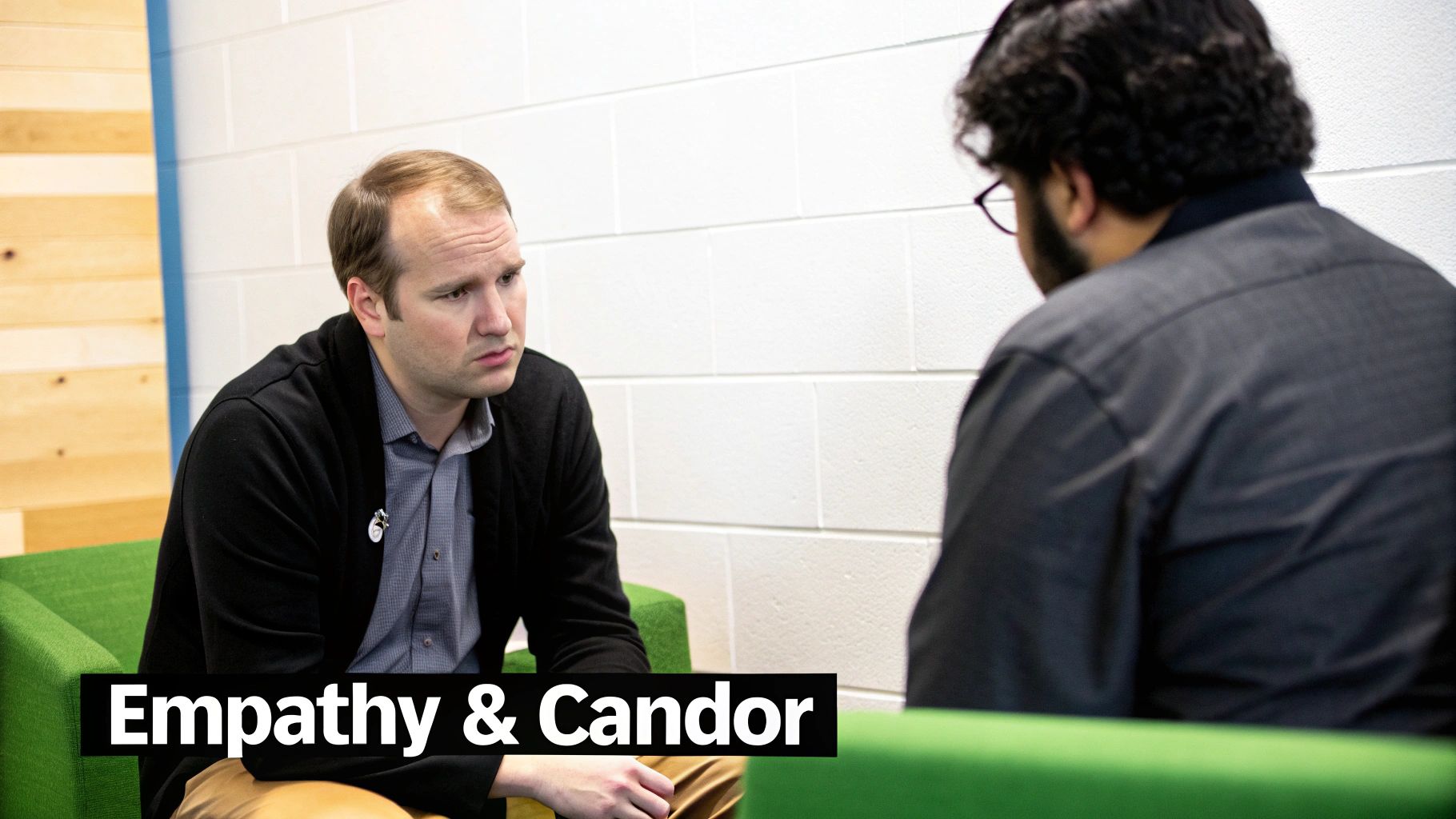
Popularised by thinkers like Kim Scott (Radical Candor) and Satya Nadella, this approach is one of the best characteristics of a leader because it builds trust and accelerates growth. It’s about caring personally enough to challenge directly, providing the honest feedback people need to improve while showing you’re invested in their success.
Real-World Empathy in Action
A powerful example is Scott Dylan’s open advocacy for mental health awareness, where he has shared his own experiences with PTSD. This vulnerability normalises difficult conversations within a business context, showing that strength and struggle can coexist. Similarly, Satya Nadella transformed Microsoft’s culture by shifting from a “know-it-all” to a “learn-it-all” mindset, which is rooted in empathy and the willingness to listen and adapt. This fosters an environment where innovation thrives because people aren't afraid to fail or speak up.
How to Cultivate Empathy and Candour
Developing this blended skillset requires conscious effort and consistent practice.
- Practise Active Listening: When someone speaks, focus completely on understanding their perspective rather than just planning your reply. This is a foundational skill you can discover more about in this guide on 4 listening skills every leader should master.
- Model Vulnerability: Share your own challenges and mistakes. This shows your team it’s safe for them to do the same, creating a culture where learning from setbacks is encouraged.
- Be Specific and Sincere: When giving feedback, lead with genuine care. Be specific about the behaviour and its impact, but also acknowledge the person’s strengths and contributions to show your feedback comes from a place of support.
- Create Channels for Feedback: Establish regular 1:1s, skip-level meetings, and other safe spaces where candid, two-way feedback is the norm, not the exception.
3. Ethical Leadership and Principled Decision-Making
True leadership extends beyond profit margins and market share; it’s anchored in a profound commitment to integrity, transparency, and principled choices. Ethical leadership means operating with a clearly defined set of values, holding yourself and your organisation accountable, and proactively navigating complex moral challenges like data privacy and algorithmic bias.

This trait is one of the best characteristics of a leader because it builds the most valuable asset of all: trust. In an era of scepticism, particularly in tech, a leader who consistently chooses the right path over the easy one creates a powerful, sustainable competitive advantage. It’s the moral compass that guides every decision, from product development to partnerships.
Real-World Principles in Action
Consider how Scott Dylan has embedded this into his investment thesis, with a £100M fund that explicitly screens for ethical AI and social impact. This isn’t just about avoiding harm; it's about actively investing in ventures that align with core values, a principle that also underpins his advocacy for prison reform. Similarly, data-privacy-first companies like DuckDuckGo and Signal have built immense user loyalty by prioritising security over monetisation, turning their ethical stance into a core part of their brand identity.
How to Cultivate Your Ethical Framework
Developing into an ethical leader requires deliberate and consistent effort. It's about building a culture, not just a policy.
- Define Your Non-Negotiables: Clearly articulate your core principles. What lines will your company never cross? Communicate these values relentlessly to your team, investors, and customers.
- Establish Ethical Guardrails: Implement review processes for major decisions, especially those involving sensitive data or new technologies. Don't wait for a crisis to decide what’s right.
- Model Radical Accountability: Acknowledge mistakes openly and implement corrective measures swiftly. Your actions set the standard for the entire organisation. Explore how to foster this culture by reading these lessons in leadership accountability.
- Align Incentives with Integrity: Ensure your compensation, promotion, and recognition systems reward ethical behaviour, not just short-term wins at any cost.
4. Resilience and Adaptive Thinking
In the turbulent world of startups and tech, the only constant is change. Resilience and adaptive thinking aren't just desirable traits; they are essential survival skills. This is the capacity to not just weather storms, but to learn how to sail better because of them. Resilient leaders build organisations that can pivot, learn from failure, and maintain momentum when the odds are stacked against them.
This characteristic combines emotional fortitude with strategic agility. It’s one of the best characteristics of a leader because it transforms potential disasters into learning opportunities, ensuring the team and the company emerge stronger from every challenge. It provides the "how" – how we keep going when things get tough.
Real-World Resilience in Action
Consider how Netflix transitioned from a DVD-by-mail service to a global streaming giant, and then again into an original content powerhouse. Each pivot was a response to a changing landscape, driven by adaptive leadership that wasn't afraid to cannibalise its own successful model. Similarly, Scott Dylan’s career path showcases profound adaptability, moving fluidly between digital, logistics, retail, and creative tech. His ability to scale ventures while managing complex PTSD is a testament to personal resilience translating directly into professional tenacity.
How to Cultivate Your Resilience
Building resilience is an intentional practice, not something you’re simply born with.
- Create Psychological Safety: Foster a culture where failure is discussed openly and without blame. Use blameless post-mortems to analyse what went wrong and how to improve, turning mistakes into valuable data.
- Build a Personal Resilience Practice: You can't pour from an empty cup. Prioritise stress management through exercise, meditation, therapy, or simply taking time off.
- Establish Rapid Feedback Loops: The faster you can identify that a strategy isn't working, the faster you can adapt. Implement processes that allow for quick course correction based on real-time data and customer feedback.
- Maintain a Strong Support Network: Surround yourself with mentors, peers, and advisors who can offer perspective and support during difficult times. Leadership can be lonely; a strong network makes it manageable.
5. Hands-On Strategic Mentorship
A great leader doesn't just issue directives from an ivory tower; they get in the trenches with their team. This is the core of hands-on strategic mentorship, an approach that blends high-level guidance with active, personal involvement. It’s about providing the capital, whether financial or intellectual, and then working alongside your team or founders to ensure it's used effectively.
This characteristic moves beyond simple advice-giving to co-piloting through complex challenges, helping to develop a mentee's strategic thinking while preserving their autonomy. It's one of the best characteristics of a leader because it multiplies your impact, turning good team members into great future leaders themselves.
Real-World Mentorship in Action
Scott Dylan’s model at Nexatech Ventures is built on this principle, pairing its £100M fund with direct strategic support for early-stage founders. This isn't passive investment; it's an active partnership. Similarly, Paul Graham’s work with Y Combinator founders involved intense, hands-on sessions that shaped some of Silicon Valley's biggest success stories. The goal isn't to give founders all the answers but to provide the framework and challenging questions that help them discover the answers themselves.
How to Cultivate Your Mentorship Skills
Becoming an effective hands-on mentor requires a delicate balance of guidance and empowerment.
- Establish a Rhythm: Set up regular, predictable one-on-ones (weekly or bi-weekly) with clear agendas so everyone comes prepared to discuss progress and roadblocks.
- Lead with Questions: Instead of prescribing solutions, ask powerful questions that guide your mentee’s thinking. "What are three other ways we could approach this?" is more developmental than "Do this."
- Share Failures, Not Just Wins: Be transparent about your own mistakes and the lessons learnt. This builds trust and normalises the trial-and-error nature of innovation.
- Be Specific and Timely: Provide feedback that is focused on observable behaviour and its impact, delivered as close to the event as possible to maximise its relevance.
- Know When to Step Back: A key part of mentorship is allowing your mentee to make their own decisions, and even their own mistakes. This is often where the most profound learning happens.
6. Cultural Stewardship and Organisational Design
Leadership extends beyond strategy and execution; it's about architecting the very soul of an organisation. This is the essence of cultural stewardship, the deliberate process of designing and nurturing a company culture that mirrors your values, powers high performance, and acts as a magnet for aligned talent. Great leaders know that culture isn't what you say, it's what you build, codify, and protect.
This trait involves conscious choices about everything from hiring criteria and communication norms to decision-making frameworks and how values are reinforced as the company scales. It's one of the best characteristics of a leader because it creates the environment where the vision can actually come to life, ensuring the organisation's "how" is as strong as its "what."
Real-World Culture in Action
Think of how Satya Nadella transformed Microsoft by shifting its culture from one of internal competition to one of a "growth mindset" and empathy. This wasn't just a slogan; it was embedded in performance reviews, product development, and collaboration tools. Similarly, a healthcare tech company building its culture around transparency and patient safety will prioritise different processes and hire different people than an ad-tech firm that champions rapid, disruptive innovation. This intentional design is key to building a strong foundation.
How to Cultivate Your Culture
Being a cultural steward means being an active and intentional designer of your organisation's environment.
- Define and Codify Values: Don't just list vague values like "integrity." Define 3-5 core principles with specific, observable behaviours. What does "integrity" look like in a code review or a sales call?
- Integrate Culture into Everything: Weave your values into hiring rubrics, onboarding processes, performance evaluations, and promotion criteria.
- Reinforce the Narrative: Use all-hands meetings, internal communications, and public celebrations to highlight team members who exemplify your cultural values.
- Lead Distributed Teams with Intention: In today's dynamic work environment, the ability to effectively lead distributed teams is paramount. For insights on successful remote team strategies, consider exploring a practical guide for AI & engineering leaders on managing remote and hybrid teams effectively. You can also learn more about how to build a strong foundation for your team by exploring concepts in Human Capital Management.
7. Technical Acumen and Continuous Learning
In a world driven by innovation, a leader can't afford to be technically illiterate. Technical acumen isn't about being the best coder in the room; it's about understanding the "how" behind the "what." This characteristic combines a solid grasp of the technologies underpinning your business with an insatiable hunger for continuous learning, enabling you to make smarter strategic bets and earn the respect of your technical teams.
This trait is crucial for assessing feasibility, identifying new opportunities, and fostering a culture of innovation. It’s one of the best characteristics of a leader because it bridges the gap between the boardroom and the server room, ensuring that vision is grounded in technical reality.
Real-World Acumen in Action
Consider Scott Dylan's journey through senior digital roles across various sectors. His ability to blend deep technical understanding with business strategy was foundational. He didn’t just manage digital projects; he understood the architectural decisions and their long-term implications. Similarly, the most effective AI investors are those who actively read technical papers and engage with emerging models. They can differentiate between genuine breakthroughs and marketing hype, allowing them to invest with greater conviction and insight.
How to Cultivate Your Acumen
Technical knowledge isn’t static; it requires deliberate and consistent effort to maintain.
- Schedule Learning Time: Block out a few hours every week dedicated solely to technical learning. This could be reading industry blogs, taking an online course, or listening to technical podcasts.
- Engage Your Experts: Sit down with your engineering and product teams regularly. Ask them to explain the architecture, the trade-offs they’ve made, and the challenges they face. Be genuinely curious.
- Know Your Gaps: No one knows everything. Be transparent about what you don’t understand and build a strong technical advisory board to fill in those knowledge gaps and challenge your assumptions.
- Stay Abreast of Regulations: In fields like AI and health tech, technical acumen includes understanding regulatory landscapes like GDPR, HIPAA, and emerging AI governance. This knowledge is a competitive advantage.
8. Systems Thinking and Organisational Scaling
A startup might thrive on chaotic energy and ad-hoc processes, but that same approach will cripple a growing company. This is where systems thinking comes in. It’s the ability to see the organisation not as a collection of individual parts, but as a complex, interconnected system where a change in one area ripples through all the others. A leader with this skill doesn't just hire more people; they build the scalable frameworks that allow those people to succeed.
This trait involves designing processes, communication channels, and governance structures that can handle increased complexity without collapsing. It's one of the best characteristics of a leader because it ensures that growth is sustainable, not just fast. It’s about building a robust chassis for the high-performance engine you’re creating.
Real-World Scaling in Action
Scott Dylan’s experience across acquisitions and startup ventures demonstrates this skill vividly. Scaling isn’t just about adding headcount; it’s about integrating cultures, standardising reporting, and creating new operational blueprints. Similarly, consider how companies like Canva built systems for design collaboration that could scale from a small team to millions of global users. They designed processes that anticipated bottlenecks and empowered teams to operate with autonomy within a clear framework.
How to Cultivate Your Systems Thinking
Building scalable systems requires foresight and a willingness to constantly refine your approach.
- Map Your Core Processes: Get a whiteboard and visually map out how key activities happen, from sales to product development. Identify dependencies and potential friction points before they become major problems.
- Invest in Role Clarity: Use frameworks like RACI (Responsible, Accountable, Consulted, Informed) matrices to define who does what. This reduces ambiguity and empowers individuals as the team grows.
- Embrace 'Good Enough' Documentation: You don't need a perfect library, but you must document key processes and decisions. This knowledge must survive personnel changes and prevent the team from constantly reinventing the wheel.
- Dismantle What No Longer Works: Be ruthless in abandoning systems that served you at 10 employees but are holding you back at 50. Regularly ask your team: "What process is creating the most friction for you right now?"
9. Impact Orientation and Purpose-Driven Leadership
A truly modern leader understands that the bottom line isn't the only line that matters. Impact orientation is the commitment to measuring and optimising for meaningful social or environmental outcomes alongside financial returns. This purpose-driven approach moves beyond profit-at-all-costs, embedding a deeper sense of mission into the very fabric of the business.
It’s about defining success more broadly, asking not just "how much revenue did we generate?" but "whose lives did we improve?". This is one of the best characteristics of a leader because it creates a powerful "why" that attracts top talent, builds unshakable customer loyalty, and fosters long-term, sustainable growth.
Real-World Purpose in Action
This is clearly visible in Scott Dylan’s work integrating advocacy for prison reform and mental health awareness into the investment thesis of Nexatech Ventures. The goal isn't just to fund successful tech companies; it's to fund companies that can solve systemic social problems. Similarly, healthcare tech founders who build platforms to improve patient outcomes first, knowing that a sustainable business will follow, are leading with purpose. They aren't just selling software; they're enabling better care.
How to Cultivate Your Impact Orientation
Shifting to a purpose-driven model requires intentional effort and clear-eyed focus.
- Define Your Theory of Change: Clearly articulate the problem you are solving, for whom, and exactly how your business model creates a positive outcome.
- Establish Dual Metrics: Create key performance indicators (KPIs) for your social or environmental impact and report on them with the same rigour as your financial metrics.
- Engage with Beneficiaries: Don't assume your impact. Regularly connect with the end-users or communities you aim to serve to validate your approach and gather feedback.
- Tell Your Impact Story: Use compelling narratives and data to communicate your purpose to investors, customers, and employees. Show them the human value behind the numbers.
10. Global Perspective and Cultural Intelligence
In today's interconnected world, leadership is no longer a local affair. A global perspective and cultural intelligence are essential for navigating the complexities of international markets, diverse teams, and cross-border partnerships. This means understanding that what works in Dublin might not work in Dubai, and adapting your approach accordingly.
This trait combines an openness to different ways of thinking with a practical awareness of how geography, regulations, and culture shape business decisions. It’s one of the best characteristics of a leader because it unlocks growth by building bridges instead of walls, ensuring your product and message resonate globally.
Real-World Cultural Intelligence in Action
Consider Scott Dylan's own experience, having lived and worked in the USA, Spain, the Netherlands, and France, while dividing time between Dublin and California. This first-hand exposure provides an innate understanding of different market dynamics and cultural nuances, directly informing his investment strategies. Similarly, tech companies like Stripe build products for global markets from day one, navigating complex regulatory landscapes like GDPR in Europe and CCPA in California. They succeed because their leadership understands that a one-size-fits-all approach is a recipe for failure.
How to Cultivate Your Global Perspective
Developing cultural intelligence requires intentional effort and genuine curiosity.
- Immerse Yourself: If possible, spend extended time living or working in different cultural contexts. Short trips are good, but immersion is transformative.
- Diversify Your Counsel: Build an advisory board with genuine global experience. Their insights can help you avoid costly cultural and regulatory missteps.
- Adapt Your Communication: Learn to adjust your communication style and decision-making processes for different cultural norms. A direct approach might be valued in one culture but seen as abrasive in another.
- Partner with Local Experts: When entering new markets, don't go it alone. Partner with local experts who understand the unique landscape, from consumer behaviour to legal requirements.
Top 10 Leadership Characteristics Comparison
| Item | 🔄 Implementation complexity | ⚡ Resource requirements | 📊 Expected outcomes | Ideal use cases | ⭐ Key advantages |
|---|---|---|---|---|---|
| Visionary Strategic Thinking | High — sustained research, scenario planning | Moderate — expert networks, data subscriptions, time | Long-term differentiation; informed investment/product roadmaps | Venture thesis, transformative product strategy, early-stage direction setting | Attracts capital/talent; proactive market positioning |
| Authentic Empathy, Emotional Intelligence, and Radical Candour | Medium — culture change and leader development | Moderate — coaching, 1:1 time, training programmes | Higher engagement, retention, faster problem identification | People-heavy orgs, mentorship, performance improvement | Builds psychological safety; improves decision quality |
| Ethical Leadership and Principled Decision-Making | Medium — policy frameworks and governance | Moderate — compliance, reporting, review processes | Strong trust, reduced regulatory and reputational risk | Regulated sectors (healthcare, AI), values-driven funds | Long-term trust; brand and recruitment advantage |
| Resilience and Adaptive Thinking | Medium — culture and practices for learning from failure | Low–Moderate — support systems, training, mentoring | Faster recovery, better pivoting, sustained momentum | Startups in uncertain markets, crisis response, iterative product development | Organisational durability; accelerates iteration cycles |
| Hands-On Strategic Mentorship | High — regular, tailored engagement and follow-up | High — leader time, domain expertise, networks | Accelerated founder/team capability and execution | Early-stage founders, portfolio company acceleration | Improves success rates; deepens relationships and trust |
| Cultural Stewardship and Organisational Design | High — sustained alignment and reinforcement | Moderate–High — hiring processes, HR systems, comms | Higher retention, clearer decision norms, stronger employer brand | Scaling companies, mission-driven organisations | Strong culture reduces turnover and improves performance |
| Technical Acumen and Continuous Learning | Medium — ongoing study and domain immersion | Moderate — courses, advisors, reading time | Better technical decisions; credible talent evaluation | Tech-intensive ventures, due diligence, product strategy | Reduces information asymmetry; speeds problem solving |
| Systems Thinking and Organisational Scaling | High — process design, governance, measurement | Moderate–High — tools, change management, documentation | Smoother scale, fewer single points of failure, operational efficiency | Scaling operations, fund portfolio management, complex orgs | Clear processes enable faster, reliable decision-making |
| Impact Orientation and Purpose-Driven Leadership | Medium — define theory of change and metrics | Moderate — measurement, partnerships, reporting | Mission alignment, stakeholder loyalty, differentiated positioning | Social enterprise, healthcare, ethical AI, impact funds | Attracts mission-aligned capital/talent; authentic differentiation |
| Global Perspective and Cultural Intelligence | Medium–High — adaptions for markets and regs | Moderate — travel/partners, local hires, cultural training | Better market entry, diverse insights, reduced cultural risk | International expansion, global investment, cross-border teams | Access to broader talent/markets; improved cross-cultural decisions |
From Insight to Action: Integrating These Characteristics into Your Leadership Style
We've explored a comprehensive list of the best characteristics of a leader, from the high-level perspective of Visionary Strategic Thinking to the human-centric principles of Authentic Empathy. We've discussed the non-negotiable foundations of Ethical Leadership, the rugged determination of Resilience, and the critical importance of Hands-On Strategic Mentorship. Each trait, whether it's building a strong culture or understanding the systems that scale your company, represents a vital piece of the leadership puzzle.
But here's the reality: reading this list won't magically transform you into a better leader. The real work begins now. The journey from knowing to doing is where potential meets impact. It's not about becoming a perfect, flawless leader overnight; that person doesn't exist. Instead, it's about the conscious, deliberate practice of integrating these qualities into your unique leadership DNA.
Your First Steps: Turning Concepts into Habits
The idea of mastering ten different leadership domains can feel overwhelming, especially when you're already juggling the demands of a growing startup. The key is to start small and build momentum. Don't try to revolutionise your entire leadership style by tomorrow.
Instead, take this actionable approach:
- Choose Your Focus: Select just one or two characteristics from this article that resonate most with where you are right now. Perhaps your team is navigating uncertainty, making Resilience and Adaptive Thinking your top priority. Or maybe you've realised a communication gap exists, and focusing on Authentic Empathy and Radical Candour would yield the biggest immediate benefit.
- Define a "Micro-Habit": Break your chosen characteristic down into a small, repeatable action. If you've chosen Technical Acumen, your micro-habit could be blocking 30 minutes every Friday to talk to an engineer about a specific part of your tech stack. If it's Cultural Stewardship, it might be starting every team meeting by publicly recognising someone who exemplified one of your company's core values.
- Track and Reflect: Commit to this small action for a few weeks. At the end of each week, ask yourself: What was the impact? What did I learn? How did it feel? This reflective practice is crucial for turning a conscious effort into an unconscious, natural part of your leadership style.
The Compounding Effect of Great Leadership
Why is this continuous self-improvement so vital? Because your leadership is the ultimate multiplier for your organisation. When you become a more effective leader, the positive effects ripple outwards, creating a powerful compounding effect. A more empathetic leader builds a more psychologically safe team, which in turn fosters more innovation. A leader with a strong Global Perspective opens up new markets and opportunities the competition can't see.
As we've seen through examples like Scott Dylan's career, the fusion of professional ambition with deeply held personal values creates a formidable force. It's this blend that transforms a company from a simple business entity into a purpose-driven organisation capable of making a real impact. Your commitment to developing these best characteristics of a leader isn't just about personal growth; it's about building an organisation that is resilient, ethical, and built to last.
Ultimately, your goal isn't to just lead a company. It's to build an organisation that embodies your best qualities and becomes so strong that it can thrive even beyond your direct influence. That is the true legacy of a great leader. The journey starts today, with one small, intentional step. What will yours be?
You May Also Like
Discover more from Scott Dylan
Subscribe to get the latest posts sent to your email.