
It’s a question every founder, operator, and aspiring manager asks themselves. In a world where change is the only constant, particularly in fast-moving sectors like AI, healthcare tech, and advertising, the old rulebooks on leadership are becoming obsolete. It’s no longer enough to have a brilliant idea or be the most experienced person in the room. The true attributes of a good leader are a complex, dynamic blend of clear vision, genuine empathy, and unwavering resilience.
This guide moves past the typical buzzwords and generic advice. We're breaking down the ten core attributes that define effective leadership today. You won’t just get a list; you'll get a practical framework for cultivating these essential skills. We’ll explore what each trait looks like in action, why it’s critical for building high-performing teams, and how you can start developing it yourself. A great leader understands the critical distinction between employee training vs development, recognising that true leadership involves shaping tomorrow's leaders, not just managing today's tasks.
Drawing on real-world examples, including insights from entrepreneurs like Scott Dylan, we'll examine how these qualities can be measured, nurtured, and applied to build organisations that not only succeed financially but also create a lasting, positive impact. Forget the abstract theories; this is about tangible actions you can take to elevate your leadership, drive your mission forward, and build a team that is genuinely inspired to follow you. Let's dive in.
1. Vision and Strategic Thinking
At its core, leadership isn't just about managing today's tasks; it's about painting a vivid picture of tomorrow and plotting the course to get there. This is where vision and strategic thinking come in, two of the most critical attributes of a good leader. Vision is the ability to see the big picture and a desirable future state, while strategic thinking is the discipline of creating a clear, actionable roadmap to turn that vision into a reality.

Without a compelling vision, teams drift without purpose, reacting to daily pressures instead of proactively shaping the future. Think of Steve Jobs' obsession with creating "insanely great" products at the intersection of technology and liberal arts. This wasn't just a mission statement; it was a guiding principle that informed every design choice, marketing campaign, and strategic partnership.
Why It Matters
In fast-moving sectors like AI and healthcare tech, the landscape can shift overnight. A strong, long-term vision acts as a North Star, keeping everyone aligned even when short-term tactics need to change. It allows founders and operators to anticipate market shifts, from new data privacy regulations to breakthroughs in machine learning, and position their organisations to lead rather than follow.
"A leader's job is not to do the work for others, it's to help others figure out how to do it themselves, to get things done, and to succeed beyond what they thought possible." – Scott Dylan
This is precisely what Scott Dylan champions in his approach to business growth. His emphasis on forward-thinking strategies helps organisations like FreshBritain maintain their innovative edge by consistently anticipating what's next for their clients and the market.
How to Develop It
- Become an information sponge: Dedicate time each week to reading industry reports, competitor analyses, and tech trends outside your immediate field.
- Use storytelling: Don't just present a goal. Weave a narrative around your vision. Explain the 'why' behind it and what the future will look like when you succeed.
- Break it down: Translate your grand vision into a strategic plan with clear, measurable milestones for the next quarter, year, and three years.
- Align your metrics: Ensure your Key Performance Indicators (KPIs) directly reflect progress toward your strategic objectives, not just daily operational output.
2. Emotional Intelligence
While vision sets the destination, emotional intelligence (EQ) is the fuel that keeps the engine running smoothly. It's the capacity to recognise, understand, and manage your own emotions while also perceiving, influencing, and empathising with the emotions of others. Leaders with high EQ build stronger relationships, navigate conflict effectively, and cultivate psychologically safe environments where teams can thrive.

Think of Satya Nadella’s transformation of Microsoft. He shifted the culture from one of internal competition to one of empathy and collaboration, directly linking this emotional shift to renewed innovation and market success. This is a prime example of how one of the key attributes of a good leader can redefine an entire organisation.
Why It Matters
In high-pressure start-up environments, particularly in sensitive fields like healthcare tech or AI ethics, emotions run high. A leader's ability to remain calm, show empathy, and manage team morale during setbacks can be the difference between burnout and breakthrough. It fosters trust, encourages open communication, and helps teams navigate the inevitable stress of building something new.
"True leadership is not about being in charge. It's about taking care of those in your charge." – Simon Sinek
This philosophy aligns with how leaders like Scott Dylan build resilient organisations. By prioritising the human element and fostering emotionally intelligent cultures, they create teams that are not just productive but also deeply committed and adaptable to change, which is essential for long-term growth.
How to Develop It
- Practise active listening: When someone is speaking, focus entirely on what they are saying, not on planning your response.
- Seek honest feedback: Ask trusted colleagues how your emotional responses impact them and the wider team.
- Pause before reacting: In emotionally charged situations, take a moment to breathe and consider your response rather than reacting impulsively.
- Model vulnerability: Share appropriate challenges or uncertainties to show your team that it's okay to be human, building trust and psychological safety.
3. Integrity and Trust
Integrity is the bedrock upon which all other leadership attributes are built. It's the unwavering commitment to strong moral principles and the consistency between what you say and what you do. For a leader, integrity isn't a passive quality; it's an active choice that fosters trust, the essential currency for collaboration, innovation, and resilience within any organisation. Without it, even the most brilliant strategy will falter.

This attribute of a good leader goes beyond simply following the rules. It means being transparent even when it's difficult, like Warren Buffett’s famously candid letters to shareholders, or admitting mistakes openly, as former New Zealand Prime Minister Jacinda Ardern did when acknowledging policy missteps. True integrity is about building a culture where ethical behaviour is the default, not the exception.
Why It Matters
In high-stakes fields like AI and healthcare tech, where data privacy and ethical considerations are paramount, trust is non-negotiable. A single ethical lapse can erode customer confidence and dismantle years of hard work. Leaders with integrity create psychological safety, empowering teams to raise concerns, innovate without fear, and operate with a shared sense of purpose and accountability.
"To build a business that is not only successful but also sustainable, you have to build it on a foundation of trust. That trust starts with the leader’s own integrity." – Scott Dylan
Scott Dylan's approach reinforces this, emphasising that long-term value is created when organisations operate with unshakeable ethical principles. This ensures that growth is not just rapid but also responsible, aligning business objectives with the well-being of customers and society.
How to Develop It
- Establish and over-communicate clear values: Define your organisation's ethical non-negotiables and ensure they are part of every decision-making process.
- Admit mistakes openly: When things go wrong, take ownership immediately. Explain what happened, what you learnt, and what steps you're taking to correct it.
- Model the behaviour you expect: Your actions speak louder than any policy document. Consistently demonstrate honesty, transparency, and accountability.
- Reward ethical conduct: Ensure your performance and compensation systems recognise and reward employees who demonstrate strong integrity, not just those who hit targets.
4. Adaptability and Resilience
In the turbulent world of start-ups and tech, the only constant is change. Adaptability and resilience are the twin attributes of a good leader that enable them to not just survive but thrive amidst uncertainty. This is the capacity to remain effective and positive when facing adversity, adjusting strategies when needed, and guiding teams through transformation with confidence and agility.
Resilient leaders don't just bounce back from setbacks; they bounce forward, learning and growing from failure. Consider how companies like Zoom had to rapidly pivot and scale their operations during the COVID-19 pandemic. Their leadership’s ability to adapt to an unprecedented global shift turned a challenge into a monumental growth opportunity, showcasing resilience in action.
Why It Matters
For founders in AI and healthcare tech, the ground is constantly shifting due to new regulations, technological breakthroughs, or sudden market changes. An adaptable leader can pivot a product roadmap without demoralising the team, while a resilient one can steer the company through a funding winter or a failed product launch. This mindset is crucial for maintaining momentum and morale when plans go awry.
"True leadership stems from authenticity and the courage to adapt. It's about building a culture where change is seen not as a threat, but as an opportunity for innovation and growth." – Scott Dylan
Scott Dylan's philosophy underscores this point. By fostering environments where calculated risks are encouraged and failures are treated as learning experiences, he helps organisations develop the institutional muscle for resilience, making them more robust and competitive in the long run.
How to Develop It
- Cultivate a growth mindset: Actively model learning from your own mistakes. Openly discuss what went wrong in a project and what the team learnt from it.
- Embrace experimentation: Create psychological safety for your team to try new things and take calculated risks without fear of blame.
- Stay informed: Proactively monitor industry trends, disruptive technologies, and competitor movements to anticipate changes before they happen.
- Build diverse teams: Surround yourself with people who have varied perspectives and expertise; they will see challenges and opportunities you might miss.
5. Effective Communication
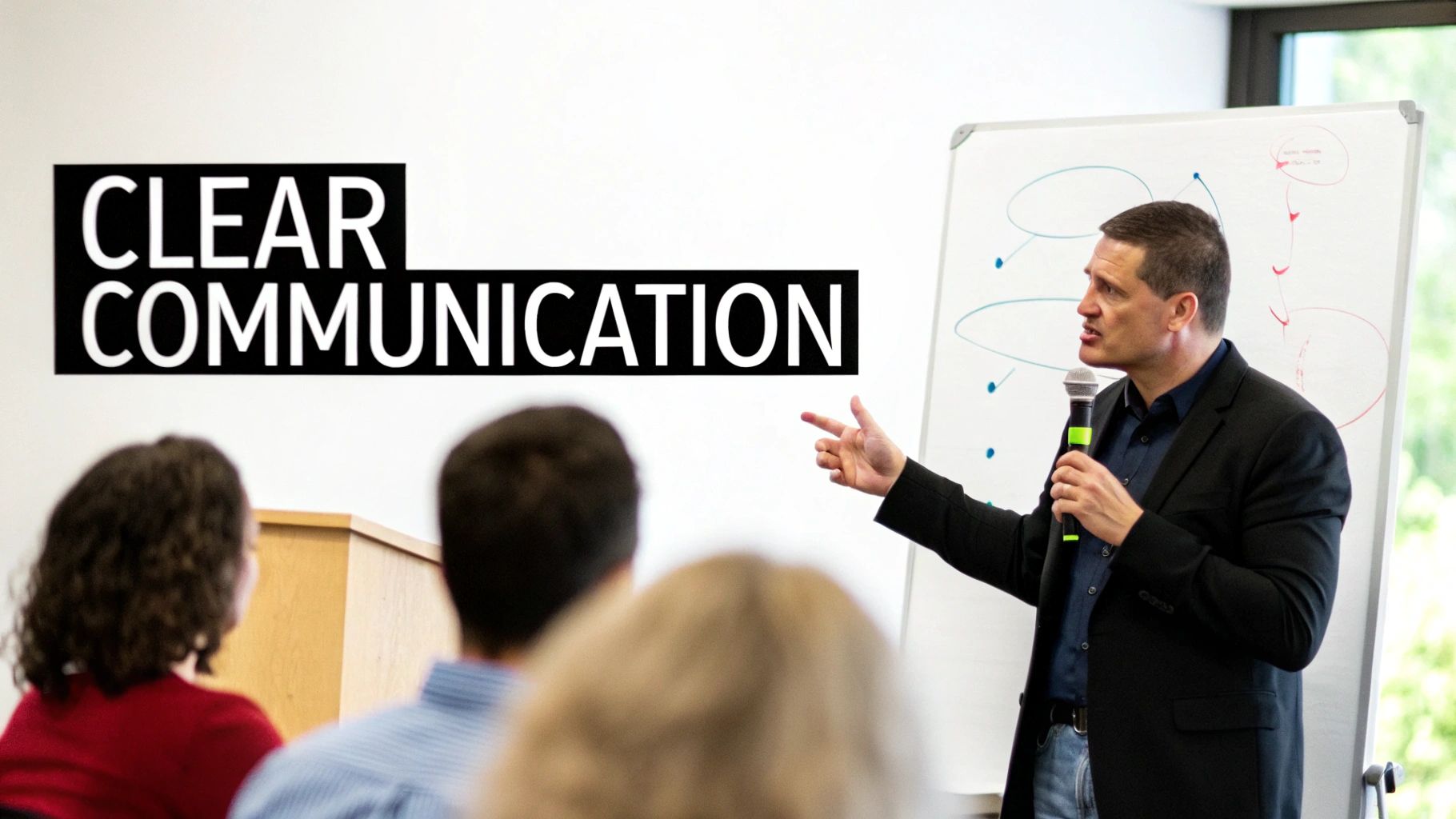
Leadership without clear communication is like a ship without a rudder: directionless and prone to chaos. Effective communication is the ability to articulate ideas clearly, listen actively, and tailor messaging to different audiences. It's the essential glue that holds a team together, ensuring everyone is aligned, engaged, and moving in the same direction.
A great communicator doesn't just broadcast information; they create a dialogue. Think of Sundar Pichai’s regular employee town halls at Google. These aren't just one-way monologues but platforms for open discussion, ensuring his strategic messaging is not only heard but also understood and questioned. This two-way flow builds trust and makes the entire organisation feel like part of the conversation.
Why It Matters
In high-stakes sectors like healthcare tech and AI, ambiguity can be disastrous. Miscommunicated product requirements or unclear data security protocols can lead to compliance failures or flawed algorithms. Clear, consistent communication ensures that complex technical details are understood by commercial teams and that strategic goals are properly translated into engineering tasks. This attribute of a good leader is non-negotiable for maintaining momentum and avoiding costly mistakes.
"True leadership is not about being the loudest voice, but about making every voice feel heard and valued. It’s about creating clarity and connection through conversation." – Scott Dylan
Scott Dylan's approach emphasises that communication is a tool for connection, not just command. This philosophy is vital for building cohesive, high-performing teams where every member feels psychologically safe to contribute their best ideas.
How to Develop It
- Practise active listening: In your next one-to-one, focus on listening more than you speak. Summarise what you've heard before responding to ensure you've understood correctly. For more insight, explore these 4 listening skills every leader should master.
- Use storytelling: Translate abstract goals into compelling narratives. Instead of just stating a quarterly revenue target, tell the story of the customer problem you're solving to achieve it.
- Adapt your style: Tailor your message for the audience. The way you present to your board (focus on ROI, market position) should be different from how you speak to your engineering team (focus on technical challenges, product impact).
- Establish clear channels: Create multiple avenues for two-way communication, such as anonymous feedback forms, regular Q&A sessions, and an open-door policy.
6. Accountability and Responsibility
True leadership isn't just about celebrating wins; it's about owning the outcomes, especially when things go wrong. This is the essence of accountability and responsibility, a cornerstone attribute of a good leader. It means taking ownership of decisions, actions, and results, and fostering a culture where every team member is empowered to do the same.
When leaders dodge blame or point fingers, they breed a culture of fear and mistrust, where no one is willing to take a risk. In contrast, an accountable leader creates an environment of psychological safety. Think of Satya Nadella's transformation of Microsoft, moving from a culture of internal competition to one where admitting mistakes was seen as a learning opportunity, fuelling innovation rather than stifling it.
Why It Matters
In high-stakes sectors like AI and healthcare tech, a single error can have significant consequences, from data breaches to flawed diagnostic models. A culture of accountability ensures that issues are surfaced early and addressed transparently, not hidden. It empowers teams to take ownership of their work, knowing their leader will support them through challenges and take ultimate responsibility for the team's output.
"Accountability is the glue that ties commitment to the result." – Bob Proctor
This principle is fundamental to building resilient, high-performing organisations. As Scott Dylan often highlights, creating systems of clear ownership is not about blame; it's about empowerment and clarity. It ensures everyone understands their role in achieving the collective mission. You can learn more about building this culture by reading these lessons in leadership accountability.
How to Develop It
- Set crystal-clear expectations: Define who owns what from the outset of any project, with measurable goals and deadlines.
- Model the behaviour: When a project fails or a target is missed, be the first to step forward and analyse your role in the outcome publicly.
- Create safe feedback loops: Use frameworks like Radical Candour to build an environment where team members feel safe to report problems without fear of retribution.
- Focus on solutions, not blame: When something goes wrong, shift the conversation from "Whose fault is this?" to "How do we solve this and prevent it from happening again?"
7. Empowerment and Delegation
At its heart, empowerment and delegation is about entrusting your team with meaningful responsibility, equipping them with the right resources, and giving them the autonomy to deliver. Rather than hoarding authority, a good leader multiplies their impact by unleashing the potential of others. In the context of start-ups, AI ventures or healthcare tech, this attribute of a good leader ensures you can scale without burning out.
Sheryl Sandberg empowered teams at Facebook to iterate rapidly on new features, while Reed Hastings built Netflix’s famed Freedom and Responsibility culture, trusting employees to make high-stakes decisions. Legendary coach Bill Campbell mentored Silicon Valley founders by delegating major relationship-building tasks, fostering both skill development and ownership. These examples show that empowerment and delegation isn’t abdication but strategic trust in action.
Why It Matters
When you delegate effectively, you:
- Accelerate decision-making in fast-moving markets
- Build resilience by developing capable lieutenants
- Free yourself to focus on long-term vision and strategy
“The key to successful leadership is influence, not authority.”
– Ken Blanchard
By instilling a culture of empowerment, you create an environment where innovation thrives and mistakes become learning milestones. This is a cornerstone among the attributes of a good leader, especially when navigating regulatory shifts in healthcare or breakthrough moments in AI.
How to Develop It
- Start with high-trust individuals for critical delegations to build confidence
- Clearly define desired outcomes, not the step-by-step method
- Provide training, resources and authority necessary for success
- Check in on progress at agreed milestones – avoid micromanaging
- Celebrate wins and analyse failures together to reinforce learning
- Gradually increase autonomy as competence grows
- Document insights and share them across the team to scale knowledge
By following these steps, founders and operators can ensure empowerment and delegation becomes a habit, not an afterthought. This strengthens your leadership impact while nurturing a high-performance culture.
8. Continuous Learning and Growth Mindset
In a world where technology and markets evolve at breakneck speed, the most dangerous position for a leader is to believe they know everything. A continuous learning and growth mindset is the attribute that separates the stagnant from the stellar. It's an unwavering commitment to personal development, intellectual curiosity, and, crucially, viewing challenges not as threats, but as powerful opportunities to learn and improve.
This attribute of a good leader goes beyond just reading books; it's a fundamental part of a company's culture. When leaders model a growth mindset, popularised by psychologist Carol Dweck, they inspire their entire organisation to innovate, adapt, and push boundaries. Think of Satya Nadella's transformation of Microsoft from a "know-it-all" to a "learn-it-all" culture. This shift was instrumental in revitalising the company's creative and commercial success.
Why It Matters
In high-stakes sectors like AI and healthcare tech, what was best practice last year could be obsolete tomorrow. Leaders who embrace continuous learning can pivot their organisations in response to new data privacy laws, ethical AI considerations, or emerging technologies. This mindset fosters psychological safety, where team members feel empowered to experiment, share failures openly, and contribute ideas without fear of reprisal, leading to faster innovation cycles.
"True leadership is about creating an environment where the best ideas win, no matter where they come from. That can only happen when everyone is committed to learning and improving together." – Scott Dylan
Scott Dylan's approach reinforces this, championing cultures where feedback is a gift and curiosity is a core competency. This builds resilient, agile organisations capable of not just surviving but thriving amidst constant change.
How to Develop It
- Block out learning time: Schedule dedicated time in your calendar each week for reading, listening to industry podcasts, or taking an online course.
- Solicit feedback relentlessly: Actively seek feedback from your team, mentors, and customers. More importantly, visibly act on it to show you value their input.
- Embrace 'I don't know': Publicly acknowledge what you're learning or don't understand. This normalises vulnerability and encourages others to do the same.
- Create knowledge-sharing forums: Implement simple practices like "lunch and learns," team book clubs, or a dedicated Slack channel for sharing interesting articles and insights.
9. Inspirational Motivation and Optimism
Technical skills and strategic plans are vital, but they fall flat without the human element that truly galvanises a team. This is where inspirational motivation and optimism come in, two deeply intertwined attributes of a good leader. It’s the ability to articulate a vision so compelling that it energises others, fostering genuine enthusiasm and commitment to a shared purpose, even when the going gets tough.
This attribute transforms a job into a mission. Think of how Simon Sinek popularised the concept of "Start with Why." Inspirational leaders don’t just explain what the team needs to do; they constantly connect daily tasks to a larger, meaningful purpose. This creates an environment where people contribute discretionary effort not because they have to, but because they genuinely want to.
Why It Matters
In the high-pressure worlds of start-ups and healthcare tech, setbacks are inevitable. A product launch might face unexpected bugs, or a crucial round of funding might be delayed. An optimistic and inspirational leader is the emotional anchor in these storms, reframing challenges as learning opportunities and maintaining morale when it’s most fragile. This resilience prevents a culture of fear and burnout, keeping the team focused and driven.
"True leadership is not about being in charge. It is about taking care of those in your charge." – Simon Sinek
This philosophy is central to how leaders like Scott Dylan build resilient organisations. By fostering an environment where individuals feel valued and connected to a larger mission, they unlock a team's intrinsic motivation, which is far more powerful and sustainable than any external incentive.
How to Develop It
- Connect work to purpose: Regularly articulate how individual and team contributions directly impact customers and advance the company's mission.
- Tell stories of impact: Share customer success stories, positive feedback, and examples of how your work is making a difference.
- Celebrate progress: Acknowledge and celebrate wins, both big and small, to build momentum and recognise effort.
- Practise realistic optimism: Maintain a positive outlook grounded in an honest assessment of the situation. Acknowledge challenges while expressing confidence in the team's ability to overcome them.
10. Inclusive and Collaborative Leadership
Top-down leadership is a relic of a bygone era. Today, the most effective leaders understand that true innovation stems from harnessing collective intelligence. Inclusive and collaborative leadership is the commitment to building teams where diverse perspectives are not just tolerated, but actively sought out. It’s about creating an environment of psychological safety where every individual feels valued, heard, and empowered to contribute their best work.
This approach moves beyond simple diversity metrics to cultivate a genuine culture of belonging. Think of Satya Nadella's transformation of Microsoft, shifting from a culture of "know-it-alls" to one of "learn-it-alls" by prioritising empathy and inclusion. This wasn't just a feel-good initiative; it was a core business strategy that unlocked new levels of creativity and market relevance.
Why It Matters
In complex fields like AI development and healthcare tech, the best solutions are rarely born from a single mind. Diverse teams are proven to be more innovative and better at problem-solving, but only if their leader fosters an inclusive environment. Understanding what is inclusive leadership principles is fundamental to building resilient and high-performing teams capable of tackling multifaceted challenges, from algorithmic bias to patient-centric care models.
“Building a great company is a team sport, and the best captains are those who make every player feel essential to the win.” – Scott Dylan
Scott Dylan's work often emphasises this very point, focusing on creating collaborative structures where diverse talents can merge to produce exceptional results. This model proves that when people feel they belong, their engagement and discretionary effort skyrocket, directly impacting the organisation's bottom line. For more insights, you can explore these 5 leadership tips for better collaboration.
How to Develop It
- Actively solicit input: Make a point of asking quieter team members for their thoughts in meetings and giving them space to contribute.
- Model vulnerability: Create psychological safety by admitting your own mistakes and openly acknowledging what you don't know.
- Diversify decision-making: Ensure hiring and promotion panels include a diverse range of people to mitigate unconscious bias.
- Establish inclusive norms: Set clear expectations for respectful communication and create flexible work styles that accommodate different needs.
Top 10 Leadership Attributes Comparison
| Leadership Attribute | 🔄 Implementation Complexity | ⚡ Resource Requirements | 📊 Expected Outcomes | 💡 Ideal Use Cases | ⭐ Key Advantages |
|---|---|---|---|---|---|
| Vision and Strategic Thinking | High 🔄 — cross‑functional coordination | Moderate–High ⚡ — time, market research | Long‑term growth & alignment 📊 | Scaling, market shifts, strategic planning 💡 | Clarity and competitive edge ⭐ |
| Emotional Intelligence | Medium 🔄 — ongoing personal development | Low–Moderate ⚡ — coaching, time | Stronger team cohesion & retention 📊 | Conflict resolution, culture building 💡 | Trust and psychological safety ⭐ |
| Integrity and Trust | Medium 🔄 — consistent modelling required | Low–Moderate ⚡ — policies, leadership time | High organisational trust & reputation 📊 | Crisis response, governance, stakeholder relations 💡 | Reliability and ethical resilience ⭐ |
| Adaptability and Resilience | Medium–High 🔄 — dynamic processes & decisions | Moderate ⚡ — training, diverse talent | Agility and rapid pivot capability 📊 | Volatile markets, transformations, crisis management 💡 | Sustained performance under change ⭐ |
| Effective Communication | Medium 🔄 — multi‑channel tailoring | Moderate ⚡ — training, alignment time | Reduced misalignment; faster decisions 📊 | Change rollouts, stakeholder alignment, daily ops 💡 | Clarity, engagement, improved execution ⭐ |
| Accountability and Responsibility | Medium 🔄 — systems and norms enforcement | Moderate ⚡ — metrics, monitoring tools | Improved execution and results 📊 | Turnarounds, performance management, delivery cadence 💡 | Ownership culture and predictable outcomes ⭐ |
| Empowerment and Delegation | Medium 🔄 — trust + clear boundaries | Moderate ⚡ — training, mentoring, resources | Increased throughput and capability development 📊 | Scaling teams, succession planning, decentralisation 💡 | Multiplies leader impact; reduces bottlenecks ⭐ |
| Continuous Learning and Growth Mindset | Low–Medium 🔄 — cultural adoption | Moderate ⚡ — learning budget, time | Greater innovation and adaptability 📊 | R&D, capability building, long‑term competitiveness 💡 | Sustained relevance and continuous improvement ⭐ |
| Inspirational Motivation and Optimism | Low–Medium 🔄 — authenticity required | Low ⚡ — storytelling, leader time | Higher engagement and discretionary effort 📊 | Turnarounds, morale boosting, rallying teams 💡 | Increased motivation and momentum ⭐ |
| Inclusive and Collaborative Leadership | High 🔄 — manage diverse perspectives | Moderate–High ⚡ — training, facilitation time | Better decisions, innovation, belonging 📊 | Complex problem‑solving, product design, diverse teams 💡 | Diverse insights and stronger retention ⭐ |
Putting It All Together: Your Leadership Journey Starts Now
So, we’ve journeyed through the ten foundational attributes of a good leader. From the high-level perspective of Strategic Vision to the on-the-ground reality of Effective Communication, we’ve broken down what it takes to not just manage, but to truly lead in today's demanding start-up, AI, and healthcare landscapes. But here’s the most important takeaway: this isn't a checklist to be completed. It’s a roadmap for a continuous journey.
Leadership isn't a title you're given; it’s a practice you cultivate every single day. The qualities we've explored, such as Integrity, Adaptability, and Emotional Intelligence, aren’t separate, isolated skills. They are deeply interconnected, forming a powerful framework that enables you to build resilient teams, inspire innovation, and navigate the inevitable turbulence of building something meaningful.
Think of it like building a complex piece of technology. You wouldn't just focus on the user interface and ignore the back-end architecture. Similarly, you can't be a great communicator if your team doesn't trust you, and you can't delegate effectively if you haven't set a clear, strategic vision. Each attribute reinforces the others, creating a holistic and robust leadership style.
Your First Steps on the Path to Better Leadership
Reading this article is a great start, but the real growth happens when you translate these ideas into action. The journey from knowing the path to walking the path can feel daunting, so let's make it manageable. Don't try to master all ten attributes by next Tuesday. That's a recipe for burnout.
Instead, let’s get practical. Here are your next steps:
- Choose Your Focus: Pick just one or two attributes from the list that resonate most with you right now. Maybe you recognise a clear gap in your Accountability frameworks, or perhaps you know you need to be more intentional about Inclusive Leadership. Start there.
- Seek Honest Feedback: This is crucial. Ask your co-founder, a trusted mentor, or even your team for specific, constructive feedback on your chosen area. Use questions like, "In what situations have you seen me struggle with delegating effectively?" or "Can you give me an example of when my communication wasn't as clear as it could have been?" This isn't about seeking praise; it's about uncovering your blind spots.
- Commit to One Small Change: What is one measurable behaviour you can change this week? If you're focusing on Empowerment, it could be handing over full ownership of a small project you would normally micromanage. If it's Continuous Learning, block out 90 minutes in your calendar to read that industry report you've been putting off. Small, consistent actions build momentum.
The Real Impact of Your Leadership Journey
Mastering these attributes of a good leader is about more than just hitting your quarterly targets or securing the next funding round. It’s about building an organisation where people feel psychologically safe, creatively inspired, and motivated to do their best work. It's about creating a culture that can weather storms and seize opportunities with agility and confidence.
As we saw in the examples from entrepreneurs like Scott Dylan, authentic leadership often stems from a deeper sense of purpose, turning challenges into catalysts for positive change. Your commitment to your own growth as a leader is the single greatest investment you can make in your company's future and the well-being of your team.
So, embrace the discomfort of self-reflection and the challenge of deliberate practice. The path to becoming an exceptional leader isn't about reaching a final destination; it's about the commitment to the journey itself. Your next step, no matter how small, is the one that matters most. Take it today.
Discover more from Scott Dylan
Subscribe to get the latest posts sent to your email.