

Think of computer security jobs as your ticket to becoming a digital guardian, protecting crucial information from a constant barrage of online threats. This isn't some cliché about coding in a dark room; it’s a dynamic, fast-moving field with a whole spectrum of roles for sharp problem-solvers who want to make a genuine difference. Frankly, it's one of the most vital and rapidly growing career paths out there today.
Your Start in the World of Computer Security

Ever stop to think about who’s actually standing guard over our digital lives? From your online banking app to the confidential data held by massive corporations, there's an invisible frontline of professionals working 24/7. These are the computer security experts, and their job has never been more important.
Forget the Hollywood image of a lone wolf hacker. A modern computer security team is a lot more like the crew running security for a massive concert.
You’ve got the bouncers at the gates (network security), the technicians double-checking the stage equipment for any weaknesses (system engineers), and the undercover staff scanning the crowd for any signs of trouble (threat analysts). Everyone has their own specialised job, but they're all working together with one clear goal: making sure the show goes on safely.
Why the Demand Is Soaring
The hunger for skilled security pros is exploding. Every single business, whether it's the local coffee shop or a global bank, depends on technology to function. That dependency creates weak spots, and you can bet that cybercriminals are constantly poking and prodding to find a way in.
Because of this, companies are finally investing serious money into building teams that can actually defend them.
Ireland's situation is a perfect snapshot of this global trend. A few years ago, the country had about 7,300 cybersecurity professionals. But look ahead, and the forecasts are startling: Ireland could need as many as 17,000 experts by 2030. That leaves a massive potential gap of nearly 10,000 skilled people if the talent pool doesn’t grow fast enough.
This shortfall between what companies need and who’s available to hire creates a golden opportunity for anyone looking to get into the field or take their career to the next level.
Understanding the Core Mission
At its heart, computer security is really about one thing: managing risk. It’s the art and science of protecting systems, networks, and software from digital attacks.
These attacks are usually designed to steal, change, or destroy sensitive information, hold data for ransom, or just bring a business to a grinding halt. A career in this space means you'll be on the front lines, tasked with:
- Protecting data from anyone who shouldn’t have it.
- Ensuring systems are always up and running for the people who need them.
- Maintaining the integrity of information so that it remains accurate and trustworthy.
The entire goal of a computer security professional boils down to upholding confidentiality, integrity, and availability—often called the "CIA triad." This simple framework drives every single decision, whether it's configuring a new firewall or teaching staff how to spot a phishing email.
This field is a massive and critical part of the wider world of Information and Communication Technology (ICT). To see how it all fits together, check out our guide on https://scottdylan.com/blog/technology-innovation/what-is-information-communication-technology-ict/.
And for a much deeper dive into related topics and career paths, our dedicated cyber security category page is the perfect place to explore.
Exploring the Core Computer Security Roles
When you pull back the curtain on computer security, you don’t find one person doing everything. You find a whole team of specialists, each playing a crucial part in the defence. Think of it less like a single job and more like a collection of careers, each with its own focus, challenges, and rewards.
Getting to know these core roles is the first step towards figuring out where you might fit in. Let’s walk through the key players on any solid security team, from the front-line defenders watching the gates to the strategists planning the battle.
The SOC Analyst: The Digital Watchtower
Imagine an air traffic controller, but instead of planes, they’re watching every bit of data flowing through a company’s network. That’s a Security Operations Centre (SOC) Analyst. They are the first line of defence, constantly scanning for anything that looks suspicious or downright malicious.
A SOC Analyst lives in a world of alerts from security tools. Their day is spent triaging these signals, figuring out if an alarm is just noise or a real incident that needs to be dealt with right now. They are the eyes and ears of the security team, often working around the clock to spot trouble before it spirals.
Day-to-day, they're usually:
- Monitoring security alerts from firewalls, intrusion detection systems, and other gear.
- Doing the initial analysis to figure out what a potential threat is and how bad it might be.
- Escalating serious incidents to the next level of responders for a deeper dive.
This gig is a perfect fit for someone who’s incredibly detail-oriented, loves analysing puzzles, and can keep a cool head when things get hectic. It's also one of the most common entry points into the field, offering a crash course in how cyber attacks actually work in the real world.
The Penetration Tester: The Ethical Hacker
If the SOC Analyst is the defender, the Penetration Tester—or 'pen tester'—is the professional attacker. It's their job to think like a cybercriminal and actively try to break into their own company’s systems. It might sound strange, but it’s a critical way to find weaknesses before the real bad guys do.
Pen testers use the exact same tools and tricks as malicious hackers. They'll probe networks, hammer web applications, and even try to fool employees with fake phishing emails. Afterwards, they write up a detailed report on every security hole they found and, most importantly, explain how to fix them.
A pen tester’s whole philosophy is "to know your enemy, you must become your enemy." They give a company the invaluable chance to strengthen its defences based on what works in the real world, not just in theory.
This is a role for the endlessly curious, the creative problem-solvers who just can't resist a challenge. It takes deep technical know-how and a stubborn refusal to give up.
The Security Engineer: The Digital Architect
While others are busy spotting or finding existing threats, the Security Engineer is the one who designs and builds the secure systems in the first place. Their entire focus is on making the company's infrastructure a tough nut to crack right from the start.
A Security Engineer gets involved in everything from setting up firewalls and encryption to designing secure networks and automating security tasks. They're the builders, creating the digital fortresses that everyone else defends. They work hand-in-glove with IT and software developers to make sure security is baked in, not just bolted on as an afterthought.
For example, a security engineer might be tasked with:
- Designing and rolling out a new security setup for the company's cloud services.
- Implementing and running the system that controls who can access what (Identity and Access Management).
- Writing scripts to automate routine security checks and responses.
This position is ideal for someone with a strong tech background who enjoys building robust solutions. It's a blend of deep system knowledge and a forward-thinking security mindset. The need for this role is exploding, especially in fields handling sensitive information. You can read more about how this applies to safeguarding patient data and the role of AI in our article.
The CISO: The Strategic Leader
Right at the top of the ladder, you'll find the Chief Information Security Officer (CISO). This is a senior leadership role that requires a mix of technical expertise and sharp business sense. The CISO isn't usually in the weeds of the day-to-day technical work; they're responsible for the organisation's entire security strategy.
A CISO’s mission is to make sure the security team's goals line up perfectly with the company's business goals. They manage the budget, build the team, and are responsible for explaining security risks to the board of directors. They are the translator between the tech world of cybersecurity and the strategic world of the C-suite. For many, it's the ultimate destination in a computer security career.
The Essential Skills and Certifications You Need
So, what does it actually take to land a job in computer security? It’s not just about being a whizz with computers. Getting hired means building a specific toolkit of skills—a blend of deep technical knowledge and the kind of human skills that separate the good analysts from the great ones.
Think of it like being a detective. You need to know how to pick a lock, which is your technical expertise. But you also need the intuition to know which door to check first and the ability to explain what you found in plain English. Both are absolutely critical.
Mastering the Technical Toolkit
Technical skills are the bedrock of any security career. These are the hands-on abilities you’ll use every single day to analyse threats, defend networks, and strengthen digital fortresses. While the full list can look intimidating, most roles really just build on a few core competencies.
Here’s what you absolutely must have a handle on:
- Network Security: You’ve got to understand how data moves. That means getting comfortable with networking fundamentals like TCP/IP, DNS, routing, and firewalls. If you don't get this, you’ll never be able to spot suspicious traffic or lock down the pathways into a company’s systems.
- Operating System Knowledge: Whether it's Windows, Linux, or macOS, you need to know the operating systems you're protecting inside and out. Understanding how they handle permissions, processes, and logs is fundamental to finding and stopping attackers.
- Scripting and Automation: You don’t need to be a full-blown software developer, but knowing your way around a scripting language like Python or PowerShell is a massive leg up. It lets you automate the boring stuff, sift through huge piles of data, and even build your own simple security tools.
Of course, once you get past the basics, you'll need to specialise. For anyone eyeing roles in application security or DevSecOps, getting to grips with modern security code review practices is a non-negotiable skill for catching flaws before software ever goes live.
The Power of Soft Skills
Technical chops will get your foot in the door, but it’s the soft skills that will define your career trajectory. In a field where you’re constantly dealing with high-pressure problems and talking to non-technical folks, these abilities are your secret weapon.
You can have all the technical wizardry in the world, but if you can't explain a risk to an executive or keep a cool head during a crisis, you become a liability. Soft skills are the glue that holds a security team together.
Here are the ones that matter most:
- Analytical Thinking: At its heart, security is all about solving complex puzzles with incomplete information. You need a curious, methodical mind to connect the dots that everyone else misses.
- Clear Communication: You’ll have to explain incredibly complex technical issues to people who don’t know the jargon—from junior employees right up to the CEO. The ability to translate technical risk into real business impact is priceless.
- Grace Under Pressure: When an incident hits, panic is not an option. Staying calm, thinking logically, and sticking to the plan is what separates a successful response from an absolute catastrophe.
Navigating the World of Certifications
Certifications are the industry's way of rubber-stamping your knowledge. For hiring managers drowning in CVs, they act as a trusted shorthand, proving you have a baseline of competence in a specific area. They're especially handy when you're just starting out or trying to pivot into a new specialisation.
Here’s a quick look at some of the most recognised certs, broken down by career stage:
Foundational (Entry-Level)
- CompTIA Security+: This is widely seen as the gold standard for anyone breaking into the field. It gives you a solid, broad overview of everything from threats and vulnerabilities to risk management. It’s the perfect first step for aspiring analysts.
- Certified Ethical Hacker (CEH): If the idea of thinking like a hacker gets you excited, the CEH is your ticket. It teaches you the attacker's mindset and tools, laying a great foundation for jobs like penetration testing.
Advanced (Mid-Career and Senior Roles)
- Certified Information Systems Security Professional (CISSP): This one is the big league. The CISSP is one of the most respected credentials out there because it's not just technical; it's a management-level cert covering everything from security architecture to governance. You'll often see it listed as a must-have for senior and leadership positions.
Ultimately, the right certification depends entirely on where you want to go. The Security+ builds a wide foundation, the CEH signals a passion for ethical hacking, and the CISSP marks you as a leader in the making.
Mapping Your Career Path and Salary Expectations
Getting into computer security isn't just about finding a job; it's about kicking off a career with some serious growth potential. The path isn't a straight line. Think of it more like a branching tree, where you can move from a general role into a niche specialism or climb the ladder towards a leadership position.
A career in this field is a long-term game where every skill you pick up builds on the last. Getting a handle on the likely career paths and the money that comes with them is crucial for planning your next move.
From Junior Analyst to Senior Leader
For many, the journey starts in a Security Operations Centre (SOC). Landing a junior SOC Analyst role is the perfect way to learn the ropes of threat detection and response in a live environment. It’s the ultimate training ground, throwing you right into the day-to-day realities of cyber defence.
From there, your path really depends on what you enjoy and where your talents lie. A pretty standard progression looks a bit like this:
-
Entry-Level (0-2 Years): You'll likely start as a Junior SOC Analyst or maybe a Helpdesk Technician with a security focus. The main goal here is to be a sponge—soak up as much hands-on knowledge as you can, learn the security tools inside and out, and get comfortable with incident response.
-
Mid-Level (3-5 Years): Once you’ve got some experience under your belt, you can start to specialise. You might find yourself drawn to a Security Engineer role, where you build and maintain the company's defences. Or maybe you'll become a Penetration Tester, actively trying to find and exploit vulnerabilities. This is where you really start to sharpen your expertise.
-
Senior-Level (6+ Years): With a good few years of experience, you could be a Senior Security Engineer, leading complex technical projects, or a specialist consultant advising different clients. The other main route is management, stepping into a Security Manager role where you lead a team of analysts and engineers.
-
Leadership (10+ Years): For those who have a great mix of deep technical know-how and solid business sense, the top of the mountain is often the Chief Information Security Officer (CISO) role. A CISO is a senior executive who's in charge of the entire organisation’s security strategy and posture.
This infographic breaks down the core skills you'll need at every stage of the journey.
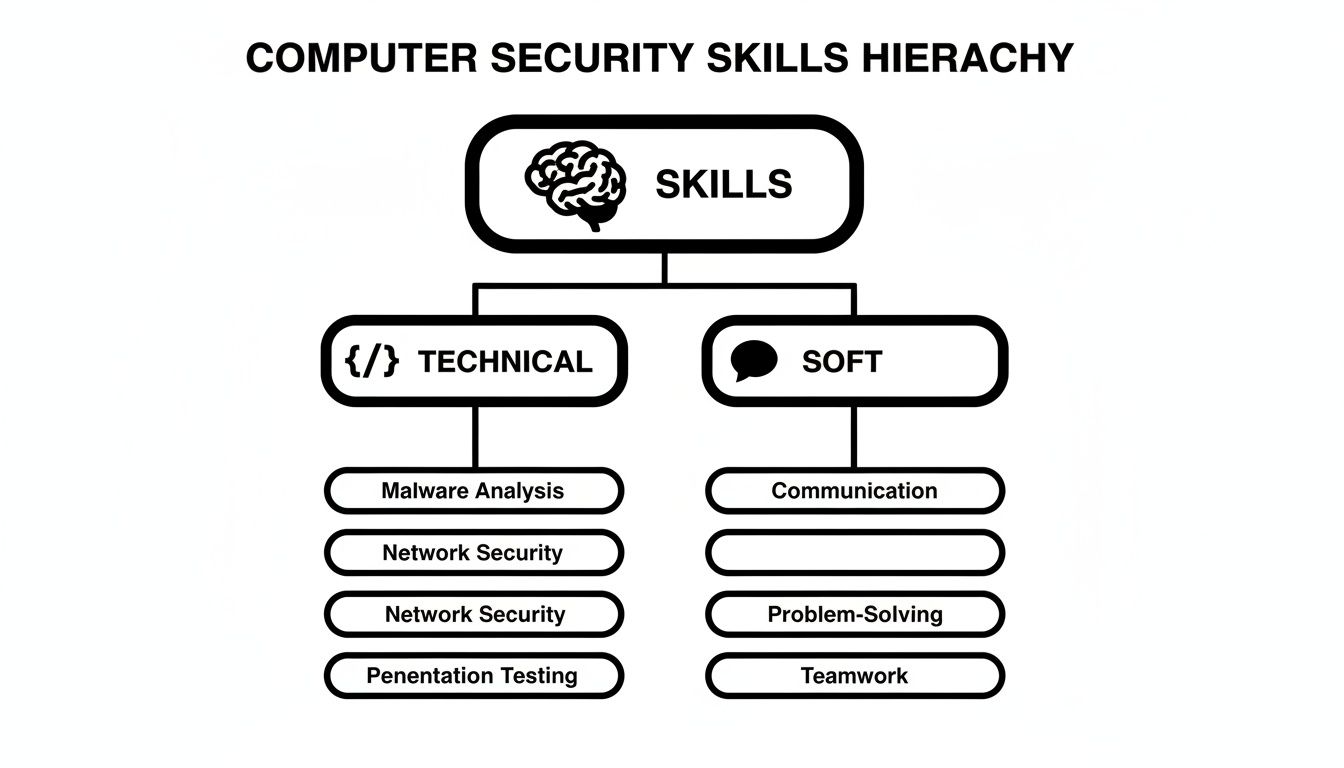
As you can see, a successful career is built on both tech skills and soft skills. Those soft skills, like communication and problem-solving, become even more important the further you climb.
Understanding Your Earning Potential in Ireland
Let’s be honest, one of the big draws of a career in computer security is the fantastic earning potential. Because demand is high and there’s a real skills shortage in Ireland, companies are prepared to pay good money for talented people who can protect their business.
Salaries can shift depending on your location, the size of the company, and the industry you're in, but there are some pretty clear trends based on your role and experience level.
In the Irish market, you can expect your salary to jump significantly as you gain experience. Moving from an entry-level spot to a senior role can easily more than double your annual earnings, which just goes to show how much value companies place on proven expertise.
Here’s a quick look at what you might expect to earn at different stages of your career in Ireland. It really shows how investing in your skills pays off—literally.
Typical Salary Ranges for Irish Computer Security Jobs
| Job Role | Entry-Level (0-2 Years) | Mid-Level (3-5 Years) | Senior-Level (6+ Years) |
|---|---|---|---|
| SOC Analyst | €35,000 – €50,000 | €50,000 – €70,000 | €70,000 – €85,000+ |
| Penetration Tester | €45,000 – €60,000 | €60,000 – €85,000 | €85,000 – €110,000+ |
| Security Engineer | €50,000 – €65,000 | €65,000 – €90,000 | €90,000 – €120,000+ |
| CISO | N/A | N/A | €130,000 – €200,000+ |
As you can see, the financial rewards for dedicating yourself to a computer security job are pretty substantial. It’s not just a fascinating and important career path—it’s also a financially smart one.
How to Break Into the Computer Security Field

So, you're thinking about jumping into computer security? Good choice. It's one of the most fascinating and fast-moving fields in tech. But getting that first job can feel like trying to crack a safe, especially when you're starting from ground zero.
The good news is, the old-school path of a four-year university degree is no longer the only way in. Far from it. These days, there are countless routes into the industry, from intensive bootcamps to self-directed learning. It really doesn’t matter how you get the skills; what matters is proving you have them.
Building a Standout Portfolio
In security, your CV gets you past the first filter, but your portfolio gets you the job. A solid collection of projects is your proof of life, showing a hiring manager you can actually do the work, not just talk about it.
Here are a few tried-and-tested ways to build a portfolio that'll get you noticed:
- Spin up a home lab. This is your sandbox, your personal playground. Use free tools like VirtualBox or VMware to create a safe, self-contained network. You can install different operating systems, play with security tools, and even launch practice attacks without breaking anything (or the law).
- Get hooked on CTFs. 'Capture The Flag' (CTF) competitions are addictive, gamified challenges that test your real-world skills. Platforms like Hack The Box and TryHackMe are brilliant for legally honing your craft in realistic scenarios.
- Contribute to open-source projects. Find a security tool you use or admire on GitHub and see how you can pitch in. Even small things, like fixing bugs in the documentation, show initiative and prove you can work as part of a team.
The single best way to impress a hiring manager is to show, not just tell. A link to your GitHub profile with a few interesting projects or a blog post detailing how you solved a tricky CTF challenge is worth more than a dozen certifications on paper.
The Power of Networking
You’ve heard it a million times, but it’s true: it’s not just what you know, it’s who you know. The security community is surprisingly tight-knit, and making genuine connections can open doors you never knew existed.
Get active in online communities. Subreddits like r/cybersecurity and various Discord servers are goldmines for learning from seasoned pros. And as things open back up, keep an eye out for local meetups in Irish tech hubs like Dublin and Cork. Don't just turn up looking for a job—go to listen, learn, and share what you're working on. People remember passion.
A Note for Businesses Hiring Security Talent
If you’re on the other side of the table trying to fill security roles, you know how competitive it is. The skills gap is no joke. Relying on finding candidates with 5+ years of experience is a recipe for a permanently open position.
Look for potential, not just polish. A candidate with a slick home lab and an active GitHub profile often has more passion and long-term value than someone with a perfect CV but zero curiosity.
Once you hire them, the game has just begun. To keep them, you have to invest in them. Continuous training and a clear path for growth aren't just perks; they're essential. For smaller businesses, it's especially important to get creative. If you need some inspiration, you can learn how to upskill your workforce on a shoestring with these tips.
The best security people are constant learners. If you support that journey, you’ll build a fiercely loyal and effective team that sticks around for the long haul.
Your Burning Questions About Computer Security Jobs
Jumping into a new career always brings up a ton of questions, and with a field as complex and fast-moving as computer security, it's easy to feel a bit overwhelmed. Let's clear the air and tackle some of the most common things people wonder about when they start exploring computer security jobs.
Think of this as your personal FAQ session. We’ll give you straight, honest answers to help you get started with confidence.
Do I Really Need a University Degree for a Computer Security Job?
Honestly? Not always. While a degree in computer science definitely gives you a solid theoretical grounding, it's far from the only path in. I've met countless brilliant professionals who came into the industry from completely different backgrounds.
These days, what you can do often speaks louder than a piece of paper. Employers, especially in Ireland's buzzing tech scene, are looking for practical, demonstrable skills. This shift has thrown the doors wide open for a much more diverse range of people.
A modern hiring manager for a computer security job is often more impressed by a well-curated GitHub profile or a detailed write-up of a Capture The Flag challenge than a degree certificate alone. It’s the passion and the practical application that really make you stand out.
Industry certifications like the CompTIA Security+ are huge. They're a clear signal to employers that you’ve got the foundational knowledge down. Combine that with hands-on experience—even from personal projects—and you’ve got a winning formula.
What's the Hottest Computer Security Specialisation Right Now?
The whole field is booming, but a few areas are absolutely on fire at the moment. If you're looking for a specialisation where demand is through the roof, focusing on one of these is a smart career move.
It all comes down to how technology and business are changing. As companies shift their operations, their security needs follow suit.
Here’s where we're seeing the most urgent need for talent:
- Cloud Security: Businesses are flocking to platforms like Amazon Web Services (AWS) and Microsoft Azure. This has created an explosive demand for people who know how to lock down these complex cloud environments.
- Incident Response and Security Operations: With the sheer volume of cyber-attacks, front-line defenders like SOC Analysts are indispensable. Companies are desperate for people who can spot a threat and shut it down before real damage is done.
- Data Privacy and Compliance: Regulations like GDPR come with hefty fines. This makes professionals who can navigate the tricky intersection of law, data, and security incredibly valuable.
Specialising in any of these areas is a fantastic way to future-proof your career and make sure you're always in demand.
How Can I Get Hands-On Experience Without a Job?
Ah, the classic chicken-and-egg problem. You need experience to get a job, but you need a job to get experience. Thankfully, in computer security, there are plenty of ways to break that cycle and build real-world skills on your own.
The trick is to create your own opportunities to learn and tinker.
Setting up a home lab is probably the single best thing you can do. Using free virtualisation software, you can build your own little network of machines in a safe, isolated space. It becomes your personal sandbox for practising ethical hacking, testing out security tools, and just plain figuring out how systems work without any risk.
Beyond the home lab, online platforms are your best friend. Websites like Hack The Box and TryHackMe offer gamified challenges that mirror real-world security problems. They're a fun, competitive way to sharpen your skills, and they are genuinely respected training grounds in the industry.
Just How Important Is Coding for Computer Security Jobs?
It really depends on the role you’re after, but let's be clear: having at least some scripting ability is a massive advantage no matter what. You don't need to be a world-class software developer for every job, but knowing your way around a bit of code will make you far more effective.
For some specialisations, though, strong coding skills are completely non-negotiable.
- Application Security Specialists live and breathe code. They have to read it and understand it to find vulnerabilities.
- Security Engineers are often writing code to automate security tasks and build more resilient systems.
- Penetration Testers rely on scripting languages like Python or PowerShell to create custom tools and automate their attack simulations.
Even in a role like a SOC Analyst, being able to read a malicious script can be the difference between catching a threat and missing it. Don’t see scripting as a hurdle; think of it as a superpower that unlocks new abilities and opens the door to more senior computer security jobs down the line.
Discover more from Scott Dylan
Subscribe to get the latest posts sent to your email.