

Ever wondered how you can make a phone call through your laptop? That’s Voice over IP (VoIP) in a nutshell. It’s a technology that ditches the old-school copper landlines and lets you make calls straight over your internet connection. Think of it like swapping snail mail for an email—it's just a faster, cheaper, and far more flexible way for a modern business to operate.
What Is Voice over IP and Why Should You Care?
At its heart, VoIP takes your voice, chops it up into tiny digital packets, and zips them across the internet. This one simple switch from analogue to digital opens up a whole new world of communication that traditional phone systems could only dream of. It’s not just a new way to dial a number; it's a complete overhaul of how your company talks to itself and its customers.
This move away from physical phone lines is part of a much bigger picture. Businesses are going global, and teams are scattered everywhere. You need a communication system that isn’t physically chained to a desk in an office, and that's exactly where VoIP shines. It gives you a single, unified platform for calls, video meetings, and messages that works anywhere you can get online.
The Real-World Benefits for a Growing Business
For any founder or investor, getting to grips with VoIP is crucial for building a company that can scale without breaking the bank. The perks go way beyond just making and taking calls.
Here’s what really matters:
- Serious Cost Savings: Most businesses see their monthly phone bill drop by 40-60% after making the switch. You're not paying for line rental, and calling someone on the other side of the world costs a fraction of what it used to.
- Scale on Demand: Need to bring a new hire on board? You just create a user profile for them in a simple software dashboard. No waiting for a technician. This is a game-changer for start-ups that need to grow quickly.
- Big-League Features Included: Things like auto-attendants (your virtual receptionist), call recording, and deep analytics used to be expensive extras. With most VoIP systems, they come as standard.
- Work From Anywhere: Your business number follows you, not the desk. Your team can make and take calls on their laptops or personal mobiles, but it still looks like they’re calling from the office. It's perfect for remote teams and people on the move.
This kind of tech is a cornerstone of modern information and communication technology (ICT), slotting in perfectly with all the other tools you use to run your business. To get a better handle on the bigger picture, you can learn more about what is information communication technology (ICT) and its impact on strategy.
Simply put, VoIP levels the playing field. It gives smaller, ambitious businesses the same powerful, flexible, and affordable communication tools that were once reserved for the big corporates.
In the end, switching to VoIP isn't just about swapping out your phones. It’s about building a smarter, more agile, and future-proof way to communicate. For a great breakdown of how VoIP specifically helps smaller companies save money and get more done, check out this guide on high-performance VoIP solutions for small businesses. It’s a foundational piece of the puzzle for building a truly modern company.
How VoIP Actually Works Under the Hood
To really get what Voice over IP brings to the table, it helps to pop the bonnet and see how the magic happens. Don't worry, we're not diving into complex engineering diagrams. The whole process is surprisingly straightforward when you break it down. It all kicks off the second you speak into your headset.
Your voice starts as a simple analogue sound wave, but it's immediately converted into digital information. A good analogy is how a scanner turns a physical piece of paper into a PDF. This new digital file of your voice is then chopped up into tiny, easy-to-manage bits called data packets. Each packet gets a digital label with its destination address and its place in the queue, all set to zip across the internet.
This method of slicing up data is basically how most of the internet functions. It's just far more efficient to send thousands of tiny packets that can find their own way than one massive, clunky file. For a deeper dive into the mechanics, you can explore how a VoIP phone works and see the process in more detail.
The Key Protocols: SIP and RTP
Two critical protocols are the real heroes here, acting as the traffic cops and delivery drivers for your call. They're called SIP and RTP, and each has a very specific job to do.
First, you’ve got the Session Initiation Protocol (SIP). Think of SIP as the call's event planner. When you dial a number, SIP is responsible for finding the person you're trying to reach, checking if they're available, making their phone ring, and then establishing the connection between you. It handles all the behind-the-scenes handshakes that start the conversation and tear it all down when you hang up.
Once SIP has connected the call, the Real-time Transport Protocol (RTP) jumps in. RTP is the courier service that actually carries your voice. Its main job is to deliver those voice packets in a steady stream and, crucially, make sure they get reassembled in the right order on the other end. This is what keeps the conversation sounding natural and prevents it from turning into a jumbled mess.
This diagram shows just how far we've come from traditional phone lines to modern VoIP systems.
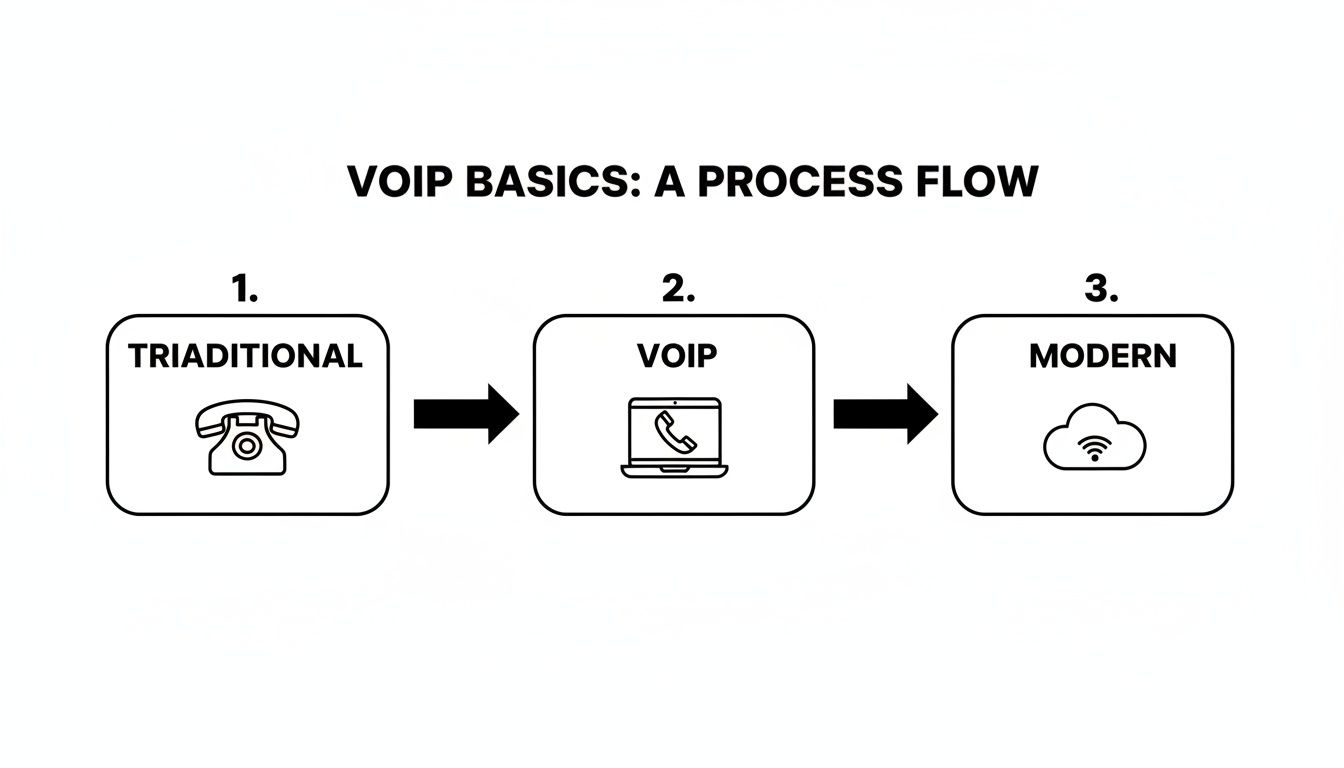
You can see the clear shift from being physically tethered to copper wires to a flexible, software-driven service that lives in the cloud.
Putting the Conversation Back Together
On the other end of the line, the whole process just happens in reverse. As the data packets arrive—often out of sync because they took different routes across the internet—the receiving device uses those digital labels to put them back in the correct order.
This reassembled digital file is then instantly converted back into an analogue sound wave, which is what your client or colleague hears through their speaker. This entire dance of converting, chopping, sending, and rebuilding happens in milliseconds, giving you a crystal-clear conversation.
The real genius of Voice over IP is that it treats a live conversation just like any other piece of data, whether it's an email or a website. This simple idea unlocks a level of flexibility and efficiency that old-school phone lines could never dream of matching.
This isn't just a niche technology; it's the new global standard. Take Latin America, for example, where over 70% of small and medium-sized enterprises (SMEs) now use VoIP services, drawn in by the major cost savings and flexibility. This huge uptake has kickstarted a massive market expansion in the region, proving that VoIP is the firm foundation for modern business communication.
Choosing Your VoIP System Architecture
So, you’re sold on VoIP. Great decision. Now for the next big question: where will your phone system actually live? This isn't just a nerdy technical detail; it’s a strategic choice that hits your budget, your team's workload, and your company's ability to scale. You've got three main paths to go down, each with its own pros and cons.
Think of it like setting up your company's headquarters. You could buy the building outright, rent a fully-serviced office in a modern tower, or get a flexible membership that gives you a bit of both. Each option works, but the right one for you depends entirely on where your business is at right now.
The On-Premise Approach
Going with an on-premise VoIP system is like buying your own office building. You purchase all the gear—the servers, switches, and handsets—and you house it all in your own space. This route gives you total ownership and absolute control over every single piece of your communications setup.
This approach often makes sense for more established businesses, especially those with stringent security requirements or really specific integration needs. Because you own it, you can tweak it to do exactly what you want. But that control comes with a hefty price tag. The initial cash outlay for hardware and installation is significant, and you’ll need a dedicated IT team with the right skills to manage, maintain, and secure the system day-to-day.
An on-premise system puts you firmly in the driver's seat. You have ultimate control and can tailor every detail, but you're also on the hook for all the maintenance, security, and future upgrades.
The Cloud-Hosted Model
By far the most popular choice for modern businesses, especially start-ups, is the cloud-hosted model. You’ll often hear it called Unified Communications as a Service, or UCaaS. This is the equivalent of renting a top-tier, fully-serviced office. A provider owns, manages, and maintains all the complex hardware and software in their own secure data centres.
You just pay a predictable monthly subscription fee per user, and you get a powerful, feature-rich phone system delivered right over your internet connection. This model pretty much wipes out upfront costs, making it incredibly easy to get started. Better yet, the provider handles all the security patches, maintenance, and new feature rollouts, which frees up your team to focus on, well, your business. Scalability is another huge win here; adding a new team member is as simple as clicking a button in a web portal.
The Hybrid Solution
Just as the name suggests, a hybrid VoIP setup gives you a bit of both worlds. It’s like owning your main office building but using flexible co-working spaces for your satellite teams. This lets a business keep some critical infrastructure on-site while using the cloud for flexibility, specific features, or to support remote staff.
For instance, a company might keep its main call control server on-premise for security reasons but use a cloud service for things like video conferencing or team messaging. This approach offers a fantastic middle ground, balancing control with flexibility. It can also be a really smart way to slowly move from an old on-premise system to the cloud without a massive, disruptive switchover.
To help you weigh up the options for your business, here’s a straightforward comparison of the three architectures.
Comparison of VoIP System Architectures
| Factor | On-Premise VoIP | Cloud-Hosted VoIP (UCaaS) | Hybrid VoIP |
|---|---|---|---|
| Initial Cost | Very High | Very Low | Moderate |
| Ongoing Costs | Maintenance, upgrades, IT staff | Predictable monthly subscription | Subscription plus some maintenance |
| Control | Complete control over system | Limited to provider's offerings | Balanced control and flexibility |
| Scalability | Complex and costly | Simple and instant | Moderate flexibility |
| Maintenance | Your full responsibility | Managed entirely by the provider | Shared responsibility |
| Best For | Large enterprises with specific security needs and in-house IT teams. | Start-ups, SMEs, and businesses with remote or growing teams. | Companies migrating from on-premise or with mixed needs. |
Looking at the table, it becomes clear there's no single "best" choice. The right VoIP architecture isn't about what's technically superior, but what best aligns with your company’s budget, technical resources, and growth plans.
Securing Your Conversations and Ensuring Compliance
Moving your business calls over to VoIP is fantastic for flexibility and your bottom line, but it begs a crucial question: just how safe is it? We live in an age where data breaches are practically a daily headline. Keeping your conversations private and your operations legal isn't just a good idea—it’s a matter of survival.
The good news is that modern VoIP systems are designed with security baked right in. It’s less about leaving a digital window open and more about building a fortress around every single call. This is done using specific security protocols that work in tandem to shield your voice data from the moment you start talking to the moment the other person hears you.
This level of security is a huge reason why the technology is being adopted so quickly across the globe. Take Latin America, for example, which made up over 5% of global VoIP revenue in 2023 and is growing at 10.2%. Businesses there are slashing communication costs by 40-60%, and that kind of rapid adoption only happens when the tech is secure enough to be trusted. You can read more about the South American VoIP market and its growth for a deeper look.
The Digital Bodyguards of VoIP Security
So, how does VoIP keep your chats under wraps? It leans on some pretty powerful encryption protocols. The two big names you'll constantly hear are SRTP and TLS.
Let’s think about them in a more practical way:
- Secure Real-time Transport Protocol (SRTP): Remember RTP, the protocol carrying your voice packets? Think of SRTP as the armoured truck for that voice data. It's the secure version that encrypts those packets, scrambling them so they’re just gibberish to anyone who might try to eavesdrop on the line.
- Transport Layer Security (TLS): If SRTP is the armoured truck, then TLS is the secret handshake that happens before the truck is even sent. It locks down the connection between your phone and the server while the call is being set up. This confirms you're actually talking to who you think you are and slams the door on any imposters.
When you put them together, these two protocols give you end-to-end protection, ensuring your calls are both private and authentic.
Navigating the Maze of Compliance
Beyond just keeping secrets, modern businesses have to play by a strict set of rules, especially when sensitive information is involved. This is the world of compliance, and for any founder or investor, getting it wrong can mean eye-watering fines and a shattered reputation.
For a modern business, compliance isn't a box-ticking exercise; it's a fundamental part of building customer trust and a sustainable, legally sound operation.
Two of the biggest regulations that touch VoIP are GDPR and HIPAA.
- General Data Protection Regulation (GDPR): If your business deals with anyone in the European Union, GDPR is your reality. It dictates how you handle personal data, and yes, that includes call recordings and logs. Your VoIP provider needs to be crystal clear about data residency (where they physically store your data) and must respect the "right to be forgotten."
- Health Insurance Portability and Accountability Act (HIPAA): This is non-negotiable for any US-based business in the healthcare space. If you handle Protected Health Information (PHI), your communication tools absolutely must be HIPAA compliant. This means your VoIP provider has to offer end-to-end encryption and, crucially, be willing to sign a Business Associate Agreement (BAA).
When you’re vetting a voice over ip vendor, don't be afraid to grill them on this stuff. Ask them directly about their security protocols, the locations of their data centres, and what compliance certifications they hold. Any provider worth their salt will be transparent and ready to show you how they’ll keep your business safe and on the right side of the law.
Calculating VoIP Costs and Return on Investment
Let’s be honest, for any founder or investor, it all comes down to the numbers. Everyone knows that VoIP is usually cheaper than an old-school phone system, but a smart decision goes deeper than just the headline savings. We need to break down the real costs and, more importantly, figure out the actual return on your investment.
The good news is that getting started with a modern VoIP system can be surprisingly affordable, especially if you go with a cloud-hosted provider. Forget the old days of buying a massive, expensive box to sit in a server room. Your main costs are now predictable monthly subscriptions.
Here’s a rough idea of what you’ll be looking at:
- Monthly Subscription Fees: This is your main running cost, typically billed per person each month. You can expect to pay somewhere in the range of £15 to £35 per user.
- Hardware (or Lack Thereof): You can still buy dedicated IP desk phones, but most start-ups I see just use softphones. These are just apps for laptops and mobiles that often come bundled with your subscription, bringing your hardware cost down to zero.
- Setup and Porting Fees: Some providers might have a small, one-off fee to get your account set up and move your existing business numbers over to their network.
Moving Beyond Direct Savings
The real ROI of a voice over ip system isn't just about getting a smaller phone bill. Where you really win is through massive boosts in productivity and efficiency. These are the indirect returns, and honestly, they add far more value than the direct cost savings alone.
Think about the improvements to how your team operates:
- Increased Productivity: Features like ‘find me/follow me’ mean important calls always find the right person, whether they’re at their desk or out and about. It’s the end of endless phone tag and speeds up crucial decisions.
- Better Customer Experience: You can set up smart call routing that sends a customer to the best-qualified agent for their specific problem. This drastically improves first-call resolution and keeps customers happy.
- Streamlined Workflows: Picture this: your phone rings, and a screen pops up on your computer with the caller's entire history before you even say hello. That’s what happens when you link VoIP to your CRM. It saves a ton of time and makes for a much more personal conversation.
The real return on investment from VoIP comes from making your entire team more effective. It transforms your communication system from a simple utility into a strategic tool that actively drives business growth.
Building Your Business Case
So, how do you calculate the potential ROI? You need to look at both the direct cost savings and the value of all those indirect efficiency gains.
First, the easy part. Add up your current phone bills—line rental, call charges, maintenance contracts, the lot. Then, get a quote for a VoIP plan and compare the two.
Next, you need to put a value on the time you’ll save. Let's say you have ten sales reps, and a simple CRM integration saves each of them just 30 minutes a day. That’s five hours of productive time you've just clawed back, every single day. This is where the business case for VoIP goes from "nice-to-have" to a complete no-brainer.
Getting a handle on these numbers is vital, and it’s always smart to think about protecting and understanding your cash flow during times of uncertainty to see how these savings fit into the bigger financial picture. When you analyse both the hard and soft savings, you build a powerful argument for making the switch.
Integrating VoIP with AI to Future-Proof Your Business

A modern voice over ip system isn't just a way to make cheaper calls; think of it as a launchpad for smarter, data-driven communication. For startups and growing businesses, the real competitive edge comes from blending VoIP with Artificial Intelligence. This powerful combination turns everyday business conversations into a treasure trove of actionable insights, automates tedious tasks, and gets your operations ready for whatever comes next.
This isn't some far-off, futuristic idea. The fusion of VoIP and AI is already delivering tangible value, giving a serious advantage to the businesses that adopt it early.
Unlocking Insights with AI-Powered Analysis
Every single customer conversation is a goldmine of data. The problem? Manually sifting through hours of call recordings to find the nuggets is completely impractical. This is where AI completely changes the game by automating the whole process, giving you a crystal-clear window into your customer interactions.
One of the most immediate wins here is AI-powered call transcription and sentiment analysis. Picture this: every customer service call is automatically transcribed into text, in real time. An AI then scans that text to gauge the customer's mood—are they delighted, frustrated, or just plain confused? This gives you an instant, bird's-eye view of customer satisfaction without having to listen to a single call.
By applying AI to your VoIP data, you move from guessing what customers want to knowing what they need. It transforms your call centre from a cost centre into a strategic intelligence hub.
This kind of analysis lets you spot recurring problems, identify gaps in your support team's training, and even flag keywords that suggest a customer is a churn risk. It’s all about making informed decisions to improve your service and keep more customers happy.
Creating Smarter Customer Journeys
Beyond just analysing past calls, AI can actively improve conversations as they happen. This is where you see things like intelligent call routing and conversational AI step in, creating a much smoother and more efficient journey for your customers.
Here’s how it works in the real world:
- Intelligent Call Routing: Forget the clunky "press one for sales" menus. An AI can analyse a customer’s first few words—or even their tone of voice—and instantly route them to the agent best equipped to help. If a customer sounds particularly agitated, the system can automatically send them to a senior support specialist trained in handling tough situations.
- Conversational AI and Chatbots: These AI assistants can handle the common, repetitive questions 24/7, freeing up your human agents to tackle the complex, high-value problems. This doesn't just slash wait times; it makes your entire operation more efficient. You can see how this plays out in our guide on transforming customer service with AI chatbots.
This level of automation isn't just a trend in established markets; it's a global movement. Take Latin America, where the mobile VoIP market was valued at USD 4,034.5 million in 2023 and is projected to skyrocket to USD 9,568.9 million by 2030. This explosive growth, driven by a mobile-first culture, points to a massive global appetite for smarter communication tools. You can read more on the forecasts for the Latin American mobile VoIP market and its rapid expansion.
By weaving AI into your VoIP setup, you graduate from a simple communication channel to an intelligent platform that actively improves customer interactions and automates workflows. That's not just an upgrade; it's a serious competitive advantage.
Common Questions About VoIP for Business
Alright, so you've got the technical basics down, but what about the day-to-day practicalities? As a founder or investor, you're likely wondering about the "what ifs". Let's tackle the common questions that pop up right before making the leap to a Voice over IP system.
"What Happens If Our Internet Dies?"
This is probably the number one question I hear, and it’s a fair one. Your entire business runs on that internet connection. The good news is that any decent Voice over IP provider has already thought this through and built-in solid backup plans.
Most systems let you set up an automatic failover. The moment your office internet connection drops, all your incoming calls can be instantly rerouted to a mobile phone or another landline. No dropped calls, no missed opportunities. It's a simple, elegant solution for uninterrupted business continuity. Some setups even automatically switch over to a backup 4G or 5G connection.
"Do We Have to Buy a Load of New Phones?"
Nope, you absolutely don't. This is a huge win for any start-up watching its budget. While you can get dedicated VoIP desk phones (often called IP phones) if you want that traditional office feel, you are not locked into it.
The modern, flexible route is to use softphones. A softphone is just an app that you install on a laptop, tablet, or smartphone, and it gives you all the functionality of a high-end desk phone. For new companies and remote teams, this is a game-changer – you get a full business phone system without spending a penny on new hardware.
One of the best things about Voice over IP is how it bends to fit your business. It works just as well for a team in a central office as it does for a team scattered across the globe with just their laptops.
"Is the Call Quality Actually as Good as a Landline?"
Yes, it really is. The days of choppy, delayed internet calls are a distant memory. As long as you have a stable, reasonably fast internet connection, modern VoIP delivers crystal-clear HD audio that’s often better than an old-school analogue line.
Think of it this way: your broadband can stream 4K video, so handling a voice call is a piece of cake. Any good provider will help you check your network's health before you commit, making sure it’s more than capable of delivering flawless call quality.
"How Painful Is It to Switch Everything Over?"
Honestly, it’s far less hassle than you might think, especially with a cloud-hosted provider. The entire migration is typically handled by the vendor. They do the heavy lifting, including porting your existing business phone numbers so you don't lose them.
Because it's all software-driven with very little physical kit to worry about, the whole switch can be done incredibly quickly. You’ll experience little to no downtime, making the move to a modern voice over ip system a surprisingly smooth upgrade.
You May Also Like
Discover more from Scott Dylan
Subscribe to get the latest posts sent to your email.