
So, you’re thinking about diving into the world of data analytics? Let's get straight to it. Landing a job in data analytics isn't some abstract mystery; it's a practical process. You’ll need to get your hands dirty with core tools like SQL and Python, build a portfolio of projects that actually show what you can do, and then gear up for a pretty specific interview gauntlet.
It's a field with serious demand, especially for people who can do more than just crunch numbers—they need to turn them into stories that make business sense.
So, You Want a Career in Data Analytics?
Alright, if you're serious about breaking into data analytics, you've found the right guide. I'm going to give you a no-fluff roadmap for what this career really looks like, with a special focus on the buzzing Irish market. We'll skip the jargon and focus on what you actually need to do.
At its heart, a data analyst is a problem-solver. Think of yourself as a detective for a business, sifting through clues in the data to spot trends, find new opportunities, and answer the big questions. The day-to-day work can be all over the place, but it usually comes back to a few key activities.

What Does a Data Analyst Actually Do?
First, get the image of someone just staring at spreadsheets out of your head. A modern data analyst’s job is dynamic. One morning you might be deep in SQL, pulling sales figures from a massive database. By the afternoon, you could be building a slick visual dashboard in Tableau to show how the latest marketing campaign is performing. You might even end the day presenting your findings directly to the leadership team.
Your insights can have a real impact, even shaping decisions in unexpected fields. We've even seen it in professional sports, which you can read more about in our article on enhancing sports performance with AI and data analytics.
The core tasks usually boil down to this:
- Data Collection: You're pulling in information from all over the place—company databases, customer surveys, web analytics, you name it.
- Data Cleaning: This is the unglamorous but absolutely vital part. You’re wrangling messy, inconsistent data to make sure it’s accurate and usable. Seriously, you'll spend a lot of time here.
- Data Analysis: Now for the fun part. You’ll use your tools and statistical know-how to dig for patterns and insights.
- Data Visualisation: It’s not enough to find the answer; you have to communicate it. You’ll be creating charts, graphs, and interactive dashboards that make your findings clear to everyone, not just the tech folks.
The Booming Demand in Ireland
Let's talk numbers. The Irish job market for data analysts is on fire, with 897 active analytics roles currently advertised on the main job boards. This isn't a fluke. It's driven by the huge presence of tech multinationals, financial giants, and pharma companies clustered around hubs like Dublin’s ‘Silicon Docks’ and Cork’s IDA business parks.
And it’s not just the big corporations. The demand spills over into e-commerce, health tech, and even the public sector. If you’ve got skills in Python, SQL, and cloud platforms, you are in a very good position.
A job in data analytics is less about being a maths genius and more about being a curious storyteller who uses numbers to build a compelling narrative for business growth.
This guide is your practical map, starting with the skills you absolutely must have. Before you do anything else, you need to build your toolkit. The table below breaks down the essentials every aspiring analyst should focus on from day one.
Your Essential Data Analyst Toolkit
To land that first role, you need a solid mix of technical know-how and the right mindset. This table lays out the core skills hiring managers are looking for.
| Skill Category | Essential Tools and Competencies | Why It Is Crucial |
|---|---|---|
| Databases & SQL | SQL (PostgreSQL, MySQL). You must know how to SELECT, JOIN, GROUP BY, and use window functions. |
This is non-negotiable. SQL is the language you use to talk to databases and retrieve data. You'll use it every single day. |
| Programming | Python (Pandas, NumPy, Matplotlib) or R. Python is generally more versatile and in higher demand. | Essential for cleaning, manipulating, and analysing large datasets that are too big for spreadsheets. It’s your heavy-duty tool. |
| Data Visualisation | Tableau or Power BI. Knowing how to build clear, interactive dashboards is a must. | Raw numbers are boring and confusing. Visualisation is how you tell a story and make your findings impactful for decision-makers. |
| Spreadsheets | Microsoft Excel or Google Sheets. Advanced functions like PivotTables, VLOOKUP, and formulas are key. | Despite fancier tools, spreadsheets are still everywhere. You need to be an expert for quick analysis and ad-hoc tasks. |
| Soft Skills | Communication, Problem-Solving, and Business Acumen. | You need to understand the business question, figure out how to answer it with data, and then explain your findings to a non-technical audience. |
Nailing these skills is your first and most important step. They form the bedrock of your entire data analytics career.
Building Your Technical Skills and Toolset
To land a job in data analytics, it's not enough to be curious—you need a solid technical foundation. Think of it as learning the grammar and vocabulary of data. Without it, you can't form coherent sentences, let alone tell a compelling story that drives business decisions. This is where we get practical and focus on the essential tools that hiring managers actually expect you to know.
Getting comfortable with these tools is what separates the wannabes from the genuine contenders. The goal isn't just to pad your CV with software names; it's about understanding how these tools fit together in a real-world analytics workflow. Let's break down the core components of your new technical toolkit.
Mastering the Language of Databases: SQL
First on the list is SQL (Structured Query Language). If data lives in a house, SQL is the key that lets you in and allows you to ask very specific questions. It's the universal language for talking to relational databases, which is where almost every company on the planet stores its valuable information. Honestly, you'll probably use it every single day to pull the exact data you need for an analysis.
Imagine a retail company wants to figure out its top-selling products in Dublin over the last three months. You wouldn't download the entire sales history for the whole country. No way. Instead, you'd write a quick SQL query to retrieve only that relevant slice of data, saving a massive amount of time and effort. Being proficient in SQL is completely non-negotiable for pretty much any job in data analytics.
For an aspiring data analyst, becoming fluent in SQL is like a writer mastering the alphabet. It’s the fundamental building block upon which all other analytical skills are built.
Your focus should be on getting the core commands down cold. Start with SELECT, FROM, and WHERE to grab data, then move on to JOINs for combining information from different tables, and finally, get comfortable with GROUP BY to start summarising your findings.
Python or R: Your Data Analysis Powerhouse
Once you've got your hands on the data, you need to clean it, reshape it, and dig into it. While SQL is great for fetching data, a programming language like Python or R is where the heavy lifting happens. Think of these as your analytical multi-tool, perfect for tackling tasks that are way too complex or messy for a simple spreadsheet.
Python, especially with libraries like Pandas for data manipulation and Matplotlib for plotting, has pretty much become the industry favourite. It's versatile, relatively easy to read, and has a huge community behind it. For example, you could use a simple Python script to automate the soul-destroying task of cleaning a messy customer spreadsheet, fixing thousands of inconsistent entries with just a few lines of code. This is where you really start to feel the power of programming in an analytics role.
Bringing Data to Life with Visualisation Tools
Finding a brilliant insight is only half the battle. If you can't communicate it clearly to people who aren't data experts, it's useless. This is where data visualisation tools like Tableau or Power BI come into their own. These platforms let you turn rows and columns of boring numbers into beautiful, intuitive, and interactive charts and dashboards.
A well-designed dashboard can tell a story at a glance. It allows a marketing manager to see campaign performance in real-time or lets a CEO track key business metrics without having to wade through a 20-page report. It’s all about making data accessible and, most importantly, actionable for everyone.
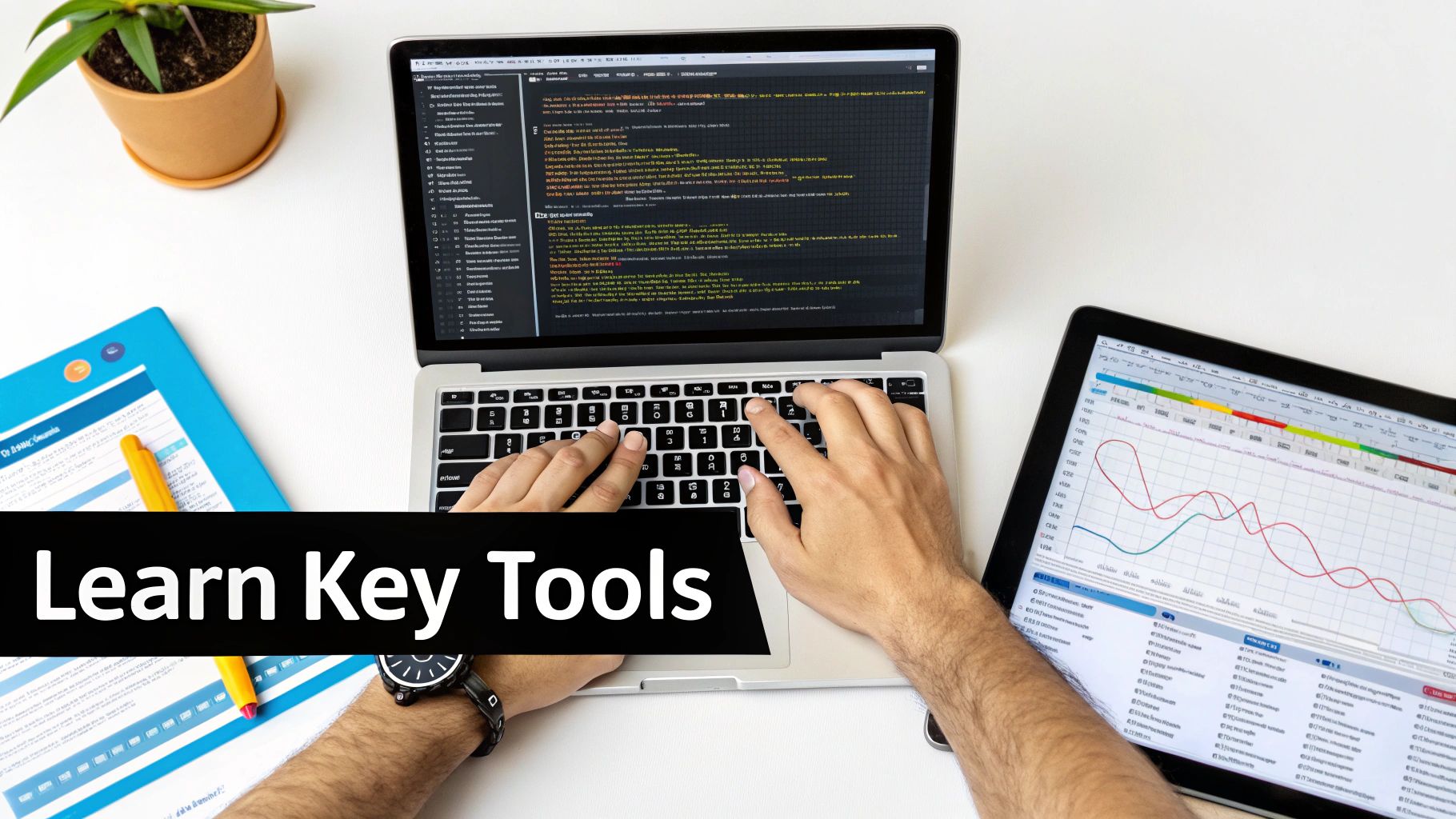
This kind of visual storytelling is a critical skill. It's what bridges the gap between your raw analysis and the strategic decisions that move a business forward. Learning at least one of these tools is an absolute must for any modern analyst.
Don’t Forget About Excel
Finally, let's talk about the unsung hero of the analytics world: Microsoft Excel. Despite the rise of much flashier tools, Excel remains a staple in almost every business for quick, on-the-fly analysis and reporting.
Don't underestimate it. Strong Excel skills, like mastering PivotTables, VLOOKUP, and complex formulas, are still highly valued by employers. You'll often find yourself using it for smaller datasets or when you need to quickly share findings with colleagues who don't have access to specialised software. As the field keeps changing, it's also worth keeping an eye on how new developments are shaking things up; you can read more on the intersection of AI and data analytics in our detailed article.
Building your technical skills is a marathon, not a sprint. But starting with this core set of tools—SQL, Python or R, a visualisation platform, and solid Excel skills—will make you a strong, versatile candidate ready for any job in data analytics.
Creating a Portfolio That Gets You Noticed
Your CV is where you tell a hiring manager what you say you can do. Your portfolio is where you prove it. In the competitive hunt for a job in data analytics, a killer portfolio is the single most powerful tool you have to stand out from the crowd.
Think of it as your personal showcase. It’s your chance to move beyond theory, get your hands dirty with real data, and solve problems that actually mirror what businesses face every day. A single, well-put-together project speaks volumes more than a bullet point on a CV ever could.
Choosing Projects with Impact
Here’s a secret: the key to a great portfolio isn’t piling up dozens of projects. It’s all about quality and relevance. Don’t just grab the first squeaky-clean dataset you find. Instead, pick projects that tell a compelling story and show off your analytical process from start to finish.
A brilliant place to start is by exploring public datasets that genuinely spark your curiosity. Platforms like Kaggle are absolute goldmines for this, offering up everything from Netflix viewing habits to global economic data.
Stuck for ideas? Try one of these on for size:
- Business Performance Deep-Dive: Grab some public sales data and build an interactive dashboard in Power BI or Tableau. Analyse customer demographics, pinpoint the top-selling products, and create visualisations showing regional sales trends.
- Market Trend Investigation: Why not explore data on property prices in Ireland? You'll need to clean the data, run an exploratory analysis to find links between location and price, and then present your findings in a clear, easy-to-read report.
- A Bit of Prediction: Use a customer behaviour dataset to build a simple model that predicts churn. This shows you can go beyond just describing what’s already happened and start forecasting what might come next.
Structuring Your Projects for Maximum Effect
How you present your project is just as important as the analysis itself. A recruiter will probably only spend a few minutes looking at your work, so it needs to be crystal clear, professional, and easy to digest. I always advise people to structure each project like a mini case study.
Break it down into these clear sections:
- The Problem: Start with a sharp, clear question you’re trying to answer. For instance, "Which factors have the biggest impact on customer satisfaction scores for an e-commerce platform?"
- Data Sourcing & Cleaning: Briefly explain where you found your data and—this is crucial—what steps you took to clean it up. This is where you demonstrate your attention to detail.
- Analysis & Method: Walk them through the techniques you used. Did you use SQL to pull the data? Python with Pandas to wrangle it? What kind of statistical analysis did you perform?
- Key Findings & Visuals: This is the main event! Showcase your most important charts and graphs. More importantly, explain what they actually mean in plain English, as if you were talking to a non-technical manager.
- Conclusions & Recommendations: Wrap it all up with a summary of your key takeaways. Based on your findings, what business actions would you recommend?

Getting Your Work Out There
Once you’ve got a couple of solid projects under your belt, you need to put them where recruiters can easily find them. Tucking "portfolio available upon request" at the bottom of your CV is a massive missed opportunity. You have to make your work accessible.
Your portfolio is your always-on salesperson. It works for you 24/7, showing potential employers what you can do without you even being in the room. Make sure it's polished and ready for visitors.
There are two fantastic, industry-standard options for hosting your work:
- GitHub: This is the go-to for showing off your code. Create a separate repository for each project. Make sure to include your code files (like Python notebooks or SQL scripts) and a detailed
README.mdfile that walks the reader through your project. - Personal Website or Blog: A simple website built with a tool like Squarespace or a blog on Medium can be a more visually engaging way to present your work. Here, you can write up your projects as blog posts, embedding your visualisations and then linking back to your code on GitHub.
At the end of the day, your portfolio is what transforms you from a candidate with a list of skills into a practitioner who can deliver real value. It’s your best chance to control the narrative and prove you’re ready for a job in data analytics.
Nailing Your Data Analyst CV and LinkedIn Profile
Think of your CV and LinkedIn profile as your personal marketing campaign. When you're gunning for a job in data analytics, these documents aren't just a list of things you've done. They need to tell a compelling story about your skills, your curiosity, and the real-world impact you can make.
Honestly, getting this right is half the battle. You're often up against a huge pile of applicants, so you need to grab a recruiter's attention and hold it. The trick is to translate all your experience—even from roles that weren't strictly data-focused—into the language of analytics. It's all about showing, not just telling.
Making Your CV Stand Out
Your CV is your first impression, and it has to get past the gatekeepers first. These days, that's often an Applicant Tracking System (ATS). These software bots scan for keywords from the job description, and if your CV doesn't have the right ones, it's game over before a human ever sees it.
To beat the bots and wow the recruiter, you need a plan. The first step is always to dissect the job description and pull out the key skills, tools, and terminology they're using.
Here's how I'd suggest structuring it for maximum impact:
- Contact Info & Portfolio Link: Keep this section clean and simple at the top. The most important thing here? A direct, clickable link to your GitHub or personal portfolio. Make it easy for them.
- Professional Summary: This is your elevator pitch—a short, sharp paragraph right at the top. Forget generic fluff like "Hard-working and motivated professional." Go for something specific: "Data Analyst skilled in transforming messy datasets into clear business insights using Python, SQL, and Tableau."
- Skills Section: Make this super easy to scan. I like to break it down into logical categories: Programming Languages (Python, R, SQL), Data Visualisation (Tableau, Power BI), and Databases (PostgreSQL, MySQL).
- Projects Section: This is where you really get to shine. Showcase 2-3 of your best portfolio projects. For each one, briefly explain the problem you tackled, the tools you used, and what the result was.
- Experience Section: Use the STAR method (Situation, Task, Action, Result) to frame your achievements. The key is to add numbers wherever you can. Don't just say, "Analysed sales data." Instead, try: "Used SQL to analyse sales data, identifying a 15% drop in a key product category. My findings led directly to a revised marketing strategy."
If you want a deeper dive with templates and industry-specific tips, this guide on how to build a job-winning resume for a data analyst is an excellent resource.
Turning LinkedIn into a Recruiter Magnet
Your LinkedIn profile is so much more than an online CV—it's your professional brand in action. Recruiters live on this platform, and a well-optimised profile can literally have opportunities landing in your inbox.
Start with your headline. "Data Analyst" is okay, but it’s a bit bland. Something like "Data Analyst | SQL, Python, Power BI | Helping businesses make smarter decisions with data" is miles better. It instantly shows a recruiter your core skills and what you're passionate about.
Next, give your "About" section some love. This is your spot to tell a bit of a story. What got you into data? What kind of challenges get you excited? Weave in those important keywords, but make it sound natural and conversational.
Think of your LinkedIn as a living, breathing version of your CV. It's your chance to add colour and personality to the facts, building a narrative that shows who you are as a professional.
The experience section on LinkedIn also gives you more breathing room than a CV, so use it. Don't just copy and paste the same bullet points. You can add more context, link out to projects you contributed to, or even upload screenshots of dashboards you’ve built.
A Quick Note on the Irish Market
If you're applying for a job in data analytics here in Ireland, it helps to know the local scene. The tech and finance sectors are huge, and they drive a lot of the demand.
You'll often see roles asking for strong SQL or SAS skills, though Python and R are just as welcome. For visualisation, tools like QlikView, Power BI, or Tableau are everywhere. Recruiters are actively searching for these terms because the roles often have a direct impact on the company's bottom line.
By putting in the effort to sharpen your CV and LinkedIn, you're doing more than just applying for a job. You're making a strong case that you're the person they need to help them solve their data puzzles.
Navigating the Job Search and Interview Process
You’ve built your skills, created a portfolio that shines, and polished your CV. Now for the exciting part—turning all that hard work into a job in data analytics. This is where strategy and confidence come into play, from hunting down the right opportunities to nailing the interviews.
The job hunt can feel like a massive task, but a focused approach is your best friend. Instead of blasting your CV into the digital abyss, zero in on platforms where data roles are actually posted. The big job boards are a decent starting point, but don't forget about niche tech sites and company career pages, especially for hotspots like Dublin and Cork.

Where to Find the Best Data Analyst Jobs
A smart search is a targeted search. For a bird's-eye view, major Irish job portals are a great place to start. A quick look on Indeed.ie, for instance, shows a healthy entry-level scene, with 91 no-experience Data Analyst openings alongside roles needing just a little experience.
Many of these jobs ask for 1-2 years in something like data administration, often with Power BI and Excel skills, and are heavily concentrated in County Dublin. It just goes to show how important it is to match your search to your experience. Have a look at the current Data Analyst jobs in Ireland to get a real feel for the market.
Beyond the usual suspects, make sure you're looking in these places too:
- LinkedIn Jobs: This is an absolute goldmine. You can filter with incredible detail, follow companies you're interested in, and even connect directly with the recruiters.
- Niche Tech Boards: Websites that focus purely on tech roles often have higher-quality listings and you're not competing with the entire world.
- Company Careers Pages: Got your eye on a dream company? Go straight to the source. The best roles often appear on their own websites before they hit the job boards.
Decoding the Interview Process
The interview for a job in data analytics isn't just a single chat; it's usually a multi-stage process designed to test everything from your technical chops to your problem-solving mindset and whether you'll be a good fit for the team. Knowing what's coming helps you stay calm and perform your best.
It almost always kicks off with an initial screening call with a recruiter or someone from HR. This is a quick chat to make sure you tick the basic boxes and are genuinely interested. It’s your first chance to make a good impression, so be ready.
After that, you'll likely face a technical assessment. This is where you prove you can walk the walk. It could be anything from a timed SQL test, a take-home case study where you have to analyse a dataset and present your findings, or even a live coding challenge.
The final hurdle is typically a deep-dive interview with the hiring manager and maybe a few future teammates. Expect a mix of behavioural questions, a technical grilling, and a lot of discussion around your past projects.
The data analytics interview isn't just about what you know; it's about how you think. They want to see your logical process, your curiosity, and how you tackle a problem you've never encountered before.
Preparing for Common Interview Questions
Preparation is everything. Seriously. Walking into that room (or video call) knowing what to expect is a massive confidence booster. You'll generally face two kinds of questions: behavioural and technical.
Behavioural questions are all about how you handle real-world scenarios. They love to ask things like, "Tell me about a time you used data to solve a tricky business problem." The secret weapon here is the STAR method (Situation, Task, Action, Result). Use it to structure your answers around specific, impactful examples from your portfolio projects.
Technical questions will get into the nitty-gritty of your skills. You might be asked to explain a SQL JOIN on a whiteboard, debate the pros and cons of different chart types, or walk them through a Python script you wrote. Be prepared to talk about your projects in detail—explain your thinking, the tools you chose, and why you made the decisions you did. As you get ready, it's always helpful to get an edge, so check out these actionable job interview preparation tips to really sharpen your approach.
Getting through the job search and interview process is the final sprint. With a smart strategy and solid preparation, you can confidently show what you’re made of and land that brilliant new role.
A Few Common Questions About Data Analytics Jobs
As you start looking for your first job in data analytics, a few questions are bound to pop up. It's completely normal. To clear things up, I’ve put together some straightforward answers to the questions I get asked most often.
Think of this as your personal FAQ for navigating the path ahead.
Do I Really Need a Specific Degree?
Honestly? No, not at all. While a degree in something like maths, stats, or computer science certainly helps, it's far from a deal-breaker. Some of the sharpest analysts I’ve ever worked with came from backgrounds in business, economics, and even psychology.
What hiring managers really care about is what you can actually do. A solid portfolio showcasing your practical skills, a couple of key certifications, and a good command of essentials like SQL and Python will always carry more weight than the title on your degree. The focus has well and truly shifted from what you studied to what you can deliver.
What Sort of Salary Can I Expect?
In Ireland, data analyst salaries are quite competitive, though they vary depending on your experience, the industry, and where you're based. If you're just starting out, you can realistically expect a salary in the range of €35,000 to €50,000 per year.
Once you have a few years under your belt, a mid-level analyst can command somewhere between €50,000 and €75,000. For senior analysts with specialised skills, particularly in high-demand hubs like Dublin or Cork, salaries can easily push past €80,000. And remember, that’s just the base salary—it doesn't factor in bonuses or other benefits.
What's the Difference Between a Data Analyst and a Data Scientist Anyway?
This is probably the most common question I hear, and it’s a good one because the lines can seem blurry. The roles do overlap, but the core focus is fundamentally different.
A data analyst looks at historical data to answer, "What happened and why?" A data scientist builds complex models to answer, "What is likely to happen next?"
Here’s a simpler way to think about it:
- A Data Analyst is an interpreter of the past and present. You'll use tools like SQL, Excel, and Power BI to mine existing data, spot trends, and build dashboards that help the business understand its current performance.
- A Data Scientist is more of a forecaster. You'll use advanced techniques like machine learning and statistical modelling to predict future outcomes.
So, while an analyst might build a dashboard showing last quarter's sales figures, a data scientist might build a model to predict which customers are most likely to churn next month. The skills are related, but the end goal is different. As machine learning becomes more embedded in business, understanding explainable AI and its importance is becoming a key part of grasping this distinction.
Discover more from Scott Dylan
Subscribe to get the latest posts sent to your email.