
We’ve all seen them: inspirational quotes about leadership plastered on office walls or shared across LinkedIn. But beyond the momentary motivation, what real value do they hold for founders and entrepreneurs in the trenches? This isn't just another list. We're diving deep into some of the most potent quotes about leadership, translating timeless wisdom into practical, actionable strategies for today's dynamic business environment.
This roundup is designed to be a toolkit. For each piece of classic and contemporary wisdom, we'll break down exactly what it means for you as a leader. We'll move past the generic advice and offer specific takeaways you can implement immediately to refine your management style, inspire your team, and build a more resilient organisation. Understanding what builds effective leadership is critical, especially when studies show that bad bosses destroy team leverage and undermine growth.
Here, we'll give you clear, digestible insights on how to apply these principles whether you're navigating a startup pivot, scaling a team, or simply striving to be a better leader every day. We'll also provide creative ideas for sharing this wisdom, from crafting compelling social media cards to integrating these powerful concepts into your next pitch deck or team meeting. Forget the fluff; these aren't just words to read and forget. They are a practical guide to transforming your leadership approach and driving meaningful results.
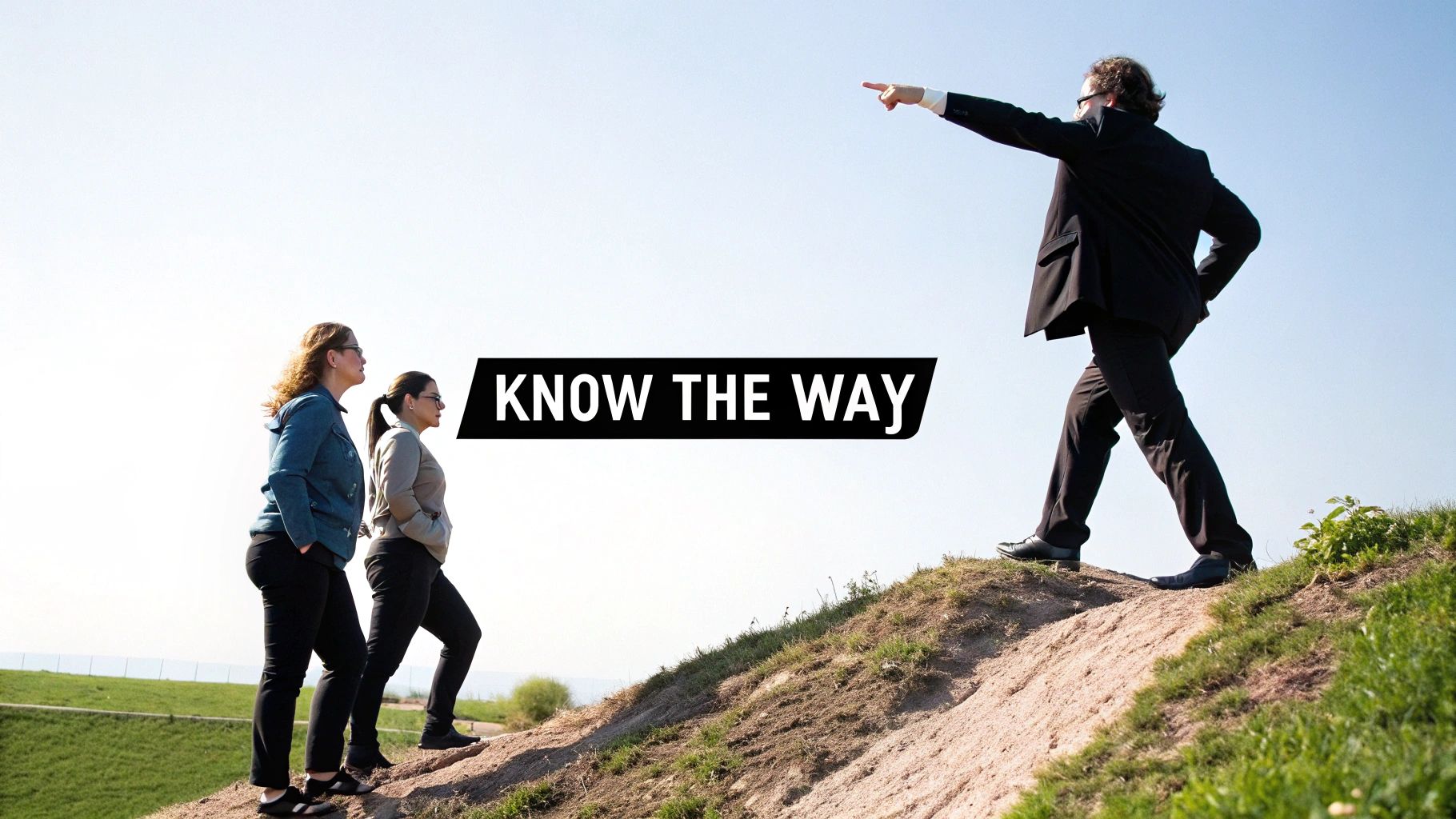
1. A leader is one who knows the way, goes the way, and shows the way. – John C. Maxwell
This classic quote from leadership guru John C. Maxwell is more than just a memorable phrase; it's a powerful, three-part framework for effective leadership. It argues that true leaders don’t just delegate from a distance. Instead, they embody the vision, actively participate in the journey, and guide others along the path. It’s a holistic model that combines strategy, action, and mentorship into one cohesive role.
Breaking Down Maxwell's Framework
At its core, this is one of the most actionable quotes about leadership because it gives you a clear checklist:
- Know the way (Vision): This is about having a clear, compelling vision and strategy. You can't lead people if you don't know where you're going.
- Go the way (Action): This is about commitment and leading by example. Your actions must align with your vision. It's about getting your hands dirty and demonstrating the behaviours you expect from your team.
- Show the way (Mentorship): This is about empowerment. A great leader develops other leaders by teaching, coaching, and creating opportunities for their team to grow.
How to Apply It
Consider how influential figures have embodied this. Satya Nadella didn't just announce Microsoft's "cloud-first" strategy; he visibly championed it, reorganised entire divisions around it, and lived the new mission. This is the Maxwell model in action.
Here are a few ways to put this philosophy into practice:
- Make Your Vision Tangible: Don't just mention your mission in a quarterly meeting. Reference it in daily stand-ups and one-to-ones. Connect individual tasks back to the bigger picture so everyone knows why their work matters.
- Be Visibly Involved: If a key priority is improving customer service, spend time on the support lines. If it's innovation, actively participate in brainstorming sessions. Your visible presence validates the importance of the work.
- Formalise Mentorship: Create structured mentorship programmes, either internally or by sponsoring external coaching. Actively look for opportunities to elevate junior team members and give them a platform to learn and lead.
2. The greatest leader is not necessarily the one who does the greatest things. He is the one that gets the people to do the greatest things. – Ronald Reagan
This powerful quote from Ronald Reagan completely reframes the definition of leadership success. It shifts the spotlight from the leader's personal heroics to their ability to unlock the potential of their team. The ultimate measure of a great leader isn't their own list of accomplishments, but rather the achievements of the people they guide. It’s a philosophy centred on empowerment, trust, and collective success.

Breaking Down Reagan's Philosophy
At its heart, this is one of the most vital quotes about leadership for founders who need to scale beyond their own capabilities. It champions the idea of a leader as a multiplier of talent, not just a top performer.
- From Doer to Enabler: The leader’s primary role transitions from being the best person in the room to creating an environment where everyone else can be their best. This means delegating effectively and trusting your team.
- Collective Ownership: Success becomes a shared victory. When people feel they are the architects of a great outcome, their engagement and motivation skyrocket.
- Legacy Through People: A leader's true legacy is not a project or a product, but a team of capable, confident individuals who can continue to achieve great things, even in the leader's absence.
How to Apply It
Think of Mary Barra at General Motors. She inherited a culture in crisis and systematically empowered her teams to take ownership of safety and innovation, transforming the organisation from the inside out. Her leadership was defined by enabling others to do their greatest work.
Here are a few ways to put this philosophy into practice:
- Define the 'What', Not the 'How': Set clear, ambitious goals and define what success looks like. Then, give your team the autonomy to figure out the best way to get there. This fosters innovation and accountability.
- Publicly Celebrate Team Wins: When recognising achievements, always credit the team first. Shift the language from "I achieved" to "We accomplished". This reinforces the value of collaboration.
- Act as an Obstacle Remover: Your job is to clear the path for your team. Regularly ask, "What is getting in your way, and how can I help remove it?" This service-oriented mindset is key. For more insights, explore these 5 leadership tips for better collaboration.
3. Leadership is not about being in charge. It's about taking care of those in your charge. – Simon Sinek
This powerful statement from Simon Sinek fundamentally reframes leadership from a position of authority to an act of service. It challenges the traditional, top-down hierarchy and champions a more human-centred approach. A leader’s primary role, according to this philosophy, isn't to wield power but to create an environment where their team feels safe, supported, and valued. This is the essence of servant leadership.
Breaking Down Sinek's Philosophy
At its heart, this is one of the most empathetic quotes about leadership. It argues that true influence comes from trust, not title. The framework it proposes is built on responsibility for people:
- Protector (Wellbeing): A leader's first duty is to the wellbeing of their team. This means safeguarding them from undue stress, fostering psychological safety, and ensuring a healthy work-life balance.
- Enabler (Growth): Beyond protection, a leader must actively enable growth. This involves understanding individual motivations, providing resources, and creating opportunities for team members to develop their skills and advance their careers.
- Advocate (Support): A leader acts as the team's voice, championing their needs and celebrating their successes within the wider organisation. They remove roadblocks and fight for the resources the team needs to succeed.
How to Apply It
This model was central to Hubert Joly’s remarkable turnaround of Best Buy. Instead of focusing solely on financials, he prioritised employee wellbeing and listened to front-line staff, rebuilding the company from the inside out. This people-first approach created a culture of care and engagement that drove success.
Here are a few ways to put this philosophy into practice:
- Focus on People in 1-on-1s: Shift the focus of your check-ins. Start by asking, "How are you doing?" not "What are you doing?". Discuss their career aspirations and personal wellbeing before diving into project updates.
- Advocate for Your Team: Go to bat for your people. Whether it’s arguing for a bigger budget, securing a promotion, or defending them from external criticism, show them you are in their corner. This builds unwavering loyalty.
- Model Vulnerability: Share your own challenges and admit when you don't have all the answers. This authenticity builds trust and makes it safe for others to do the same, fostering a culture of genuine support and accountability. For a deeper dive, explore these lessons in leadership accountability.
4. The function of leadership is to produce more leaders, not more followers. – Ralph Nader
This powerful quote from Ralph Nader turns the traditional idea of leadership on its head. It suggests that the true measure of a leader isn't how many people they command, but how many people they empower to lead. This is about building capacity, fostering autonomy, and creating a sustainable organisation that isn't dependent on a single individual. It's a shift from a "command and control" mindset to a "coach and develop" approach.

Breaking Down Nader's Philosophy
At its heart, this is one of the most forward-thinking quotes about leadership because it focuses on legacy and scalability. A leader who only creates followers builds a fragile system; when they leave, a vacuum is created. A leader who creates other leaders builds a resilient, antifragile organisation.
- From Dependence to Empowerment: This model moves away from team members being dependent on a single leader for answers and direction. Instead, it empowers them to think critically, make decisions, and take ownership.
- A Focus on Development: The leader’s primary role becomes that of a mentor and coach. Success is measured by the growth of their team members, not just by hitting quarterly targets.
- Building Organisational Resilience: By developing a pipeline of leadership talent, the organisation reduces single-point-of-failure risks and ensures it can adapt and thrive through change. This approach is a core element of transformational leadership on scottdylan.com.
How to Apply It
Companies like Google and Amazon are famous for their cultures of developing leaders who, in turn, develop more leaders. They build this into their operational DNA. The legendary Jack Welch at GE was also renowned for his focus on creating an executive talent pipeline, making it a key part of his legacy.
Here are a few ways to put this philosophy into practice:
- Delegate Decisions, Not Just Tasks: Instead of just assigning work, delegate the decision-making authority that goes with it. Give a team member a project and let them own the outcome, providing support but not micromanaging the process.
- Give Stretch Assignments: Identify high-potential individuals and give them projects that are just outside their current comfort zone. This builds new skills and, crucially, confidence.
- Formalise Mentorship and Sponsorship: Create structured programmes where senior leaders are responsible for mentoring junior talent. Sponsorship goes a step further, with leaders actively advocating for their protégés' advancement.
- Share the Spotlight: When presenting successes to stakeholders, give credit to the team members who drove the results. Better yet, let them present their own work. This provides them with valuable visibility and experience.
5. Example is not the main thing in influencing others, it is the only thing. – Albert Einstein
Often misattributed but widely embraced, this powerful quote cuts through the noise of leadership theory to reveal a fundamental truth: your actions are your most powerful message. It argues that influence isn’t built on eloquent speeches or detailed memos, but on the consistent, visible behaviours of the leader. It’s the ultimate call for authenticity, positioning leading by example not as a tactic, but as the very essence of leadership itself.
Breaking Down Einstein's Philosophy
This is one of the most potent quotes about leadership because it strips away all complexity. Your team doesn’t just listen to what you say; they scrutinise what you do. This philosophy is built on three core pillars:
- Behavioural Integrity: Your actions must align with your words and the company's stated values. Any hypocrisy, no matter how small, erodes trust and undermines your authority.
- Cultural Blueprint: The leader's behaviour becomes the unwritten rulebook for the rest of the organisation. How you handle stress, treat colleagues, and approach problems sets the standard for everyone else.
- Embodied Values: It's not enough to have values written on a wall. A leader must be the living embodiment of those values, demonstrating them in every decision and interaction.
How to Apply It
Consider Patagonia founder Yvon Chouinard. His personal commitment to environmentalism, demonstrated through his lifestyle and willingness to put planet over profit, is the only reason the company's mission feels authentic. He didn't just talk about it; he lived it, making his example the company’s cornerstone.
Here are a few ways to put this philosophy into practice:
- Conduct a Behavioural Audit: At the end of each week, ask yourself: "Did my actions this week reflect the values I want my team to uphold?" Be honest about where you fell short and course-correct.
- Be Transparent About Mistakes: When you make an error, own it openly. This demonstrates humility and accountability, showing your team that it’s safe to take calculated risks and learn from failures.
- Demonstrate the Work Ethic: If you expect your team to be responsive and dedicated, show them what that looks like. Answer emails promptly, be prepared for meetings, and put in the focused effort you expect from others. Your example is the most effective performance metric.
6. A leader takes people where they want to go. A great leader takes people where they don't necessarily want to go but ought to be. – Rosalynn Carter
This profound observation from former First Lady Rosalynn Carter draws a sharp line between management and visionary leadership. It suggests that while a good leader can fulfil a team's existing desires, a truly great leader has the courage and foresight to guide people through necessary, often uncomfortable, change. This is leadership as transformation, not just facilitation. It's about seeing a future that others don't yet recognise and accepting the responsibility of navigating the difficult path to get there.
Breaking Down Carter's Distinction
This is one of the most challenging quotes about leadership because it deals with the friction of progress. It's not about being a dictator; it's about having conviction rooted in a deep understanding of what's required for long-term success.
- The Comfortable Path (Where they want to go): This is the path of least resistance. It involves incremental improvements and fulfilling immediate needs. It’s important but rarely leads to breakthrough results.
- The Necessary Path (Where they ought to be): This is the path of transformation. It requires challenging the status quo, making tough decisions, and asking people to leave their comfort zones for a greater, shared purpose.
How to Apply It
Think of Mary Barra's strategic pivot at General Motors. She pushed the entire organisation towards an electric vehicle future long before it was the popular or easy choice, fundamentally shifting the company's identity. This move took people where they ought to be to survive and thrive.
Here are a few ways to put this philosophy into practice:
- Build an Ironclad Case for Change: Before you ask anyone to follow you down a difficult road, you must use data, storytelling, and a clear vision to explain why it's the only road worth taking.
- Communicate the 'Why' Relentlessly: People will endure a difficult 'how' if they believe in the 'why'. Connect the change directly to the organisation's core purpose and values to build emotional buy-in.
- Acknowledge the Difficulty: Be honest about the challenges ahead. Empathise with your team's concerns and provide robust support systems, like training and resources, to help them navigate the transition. Don't pretend it will be easy.
7. Leadership is the art of getting someone else to do something you want done because he wants to do it. – Dwight D. Eisenhower
This quote from former US President and five-star general Dwight D. Eisenhower cuts to the heart of motivational leadership. It suggests that genuine leadership isn't about commands or authority, but about inspiration and alignment. The real skill lies in connecting an organisation's goals with an individual's intrinsic desires, making them want to achieve the mission. It’s the difference between compliance and genuine commitment.
This perspective moves beyond simple carrot-and-stick motivation. It taps into the modern understanding of what truly drives performance: a sense of purpose, autonomy, and the desire to master a skill. When a leader accomplishes this, they don't just get a task completed; they unlock discretionary effort and creativity.
Breaking Down Eisenhower's Framework
This is one of the most profound quotes about leadership because it focuses on the "why" behind the "what." It's an artistic, not a scientific, approach that requires deep emotional intelligence.
- Understanding Motivation (Empathy): The leader must first understand what drives their team members on a personal level. Is it the challenge, the impact, the opportunity for growth, or the collaborative environment?
- Aligning Goals (Purpose): The next step is to frame organisational objectives in a way that resonates with those individual motivations. This means showing people how their specific work contributes to a larger, meaningful purpose.
- Empowering Action (Autonomy): Once the desire is there, the leader must step back and provide the freedom for people to execute. Micromanagement is the enemy of intrinsic motivation; trust is its fuel.
How to Apply It
Daniel Pink’s research in his book Drive echoes this sentiment, pinpointing autonomy, mastery, and purpose as key drivers. Companies like Netflix have built their entire culture on this idea with their "freedom and responsibility" philosophy, attracting self-motivated individuals and giving them the space to excel.
Here are a few ways to put this philosophy into practice:
- Connect Work to Impact: Don't just assign a task. Explain who it will help and what it will change. If you're building a new feature, show the team the customer feedback that inspired it.
- Co-create Goals: Instead of just handing down objectives, involve your team in the goal-setting process. When people have a hand in defining the target, they have a much greater stake in hitting it.
- Delegate Problems, Not Tasks: Give your team a problem to solve rather than a pre-defined list of tasks. This provides them with the autonomy to be creative and take ownership of the solution, fostering a sense of mastery and accomplishment.
8. Do not go where the path may lead, go instead where there is no path and leave a trail. – Ralph Waldo Emerson
This powerful quote from transcendentalist philosopher Ralph Waldo Emerson is the ultimate call to action for innovators, disruptors, and true pioneers. It challenges the very definition of leadership, shifting it from simply guiding along a well-trodden path to having the courage to create the path itself. This is leadership as an act of creation, not just navigation.
Breaking Down Emerson's Vision
At its core, this is one of the most inspiring quotes about leadership because it champions originality and courage over conformity. It outlines a mindset, not just a process:
- Reject Convention: The first part, "Do not go where the path may lead," is an instruction to question the status quo. It’s about recognising that the established way isn’t the only way, and often, it’s not the best way.
- Embrace the Unknown: The second part, "go instead where there is no path," is about embracing risk and uncertainty. True innovation happens in uncharted territory, where there are no guidebooks or guaranteed outcomes.
- Create Lasting Impact: The final part, "and leave a trail," defines the leader's ultimate responsibility. It’s not just about getting to a new destination; it’s about making that new route accessible and understandable for others to follow.
How to Apply It
This mindset is the engine behind every industry disruption. Reed Hastings didn't try to build a better video rental shop; he forged a new path with Netflix, leaving a trail that completely redefined home entertainment. This is the Emerson model in its purest form.
Here are a few ways to put this philosophy into practice:
- Cultivate a "Why Not?" Culture: Actively encourage your team to question assumptions. Instead of saying "that's how we've always done it," create forums where people can safely ask, "Why don't we try this instead?"
- Invest in R&D and Skunkworks: Dedicate a portion of your budget and team's time to projects without a guaranteed, immediate ROI. Create a "safe-to-fail" environment where experimentation is the primary goal, not just a byproduct.
- Celebrate the Learnings from Failure: When a new initiative doesn't work out, don't bury it. Hold a post-mortem to analyse what was learned and celebrate the team's courage for taking the risk. This shows that trailblazing, even when unsuccessful, is valued.
9. Keep your eyes on the stars, and your feet on the ground. – Theodore Roosevelt
This powerful quote from Theodore Roosevelt perfectly captures the essential duality of great leadership. It’s a timeless piece of advice that warns against the dangers of being either a disconnected dreamer or a head-down operator. True leadership isn't about choosing between vision and execution; it's about mastering the art of balancing both simultaneously. Leaders must inspire their teams with a bold, ambitious future while remaining firmly planted in the reality of day-to-day operations.
Breaking Down Roosevelt's Duality
At its heart, this is one of the most practical quotes about leadership because it defines the leader's core tension. It provides a simple yet profound model for sustainable success:
- Eyes on the stars (Vision): This represents the aspirational, long-term goal. It’s the "why" that motivates everyone, the North Star that guides every major decision, and the innovative dream that pushes the organisation beyond its current limits.
- Feet on the ground (Execution): This is the operational reality. It’s about managing resources, hitting quarterly targets, solving immediate problems, and maintaining the discipline required to make steady progress. Without this, a vision is just a fantasy.
How to Apply It
This philosophy is embodied by leaders like Anne Mulcahy, who orchestrated Xerox's visionary turnaround not just with a new mission but with ruthless operational and financial discipline. It's about pairing big dreams with pragmatic steps.
Here are a few ways to put this philosophy into practice:
- Set a 10-Year Vision, Plan in Quarters: Articulate a compelling, long-term vision that inspires your team. Then, break that ambition down into concrete, measurable 90-day goals. This connects the dream to the daily grind.
- Use Storytelling and Dashboards: Keep the "stars" alive through consistent storytelling in team meetings and company-wide communications. At the same time, keep everyone’s "feet on the ground" with clear dashboards tracking key operational metrics.
- Balance Your Team's Focus: When reviewing progress, ask two questions: "How does this move us closer to our long-term vision?" and "What is the immediate, practical outcome of this work?" This trains your team to think in both modes. Develop leaders who excel in both strategic and operational thinking.
10. The greatest glory in living lies not in never falling, but in rising every time we fall. – Nelson Mandela
This iconic quote from Nelson Mandela elevates leadership from a pursuit of perfection to a journey of resilience. Coming from a leader who endured 27 years of imprisonment before fundamentally changing a nation, the words carry immense weight. It reframes failure not as a disqualifier but as a necessary, even glorious, part of the leadership path. For modern founders and operators, it’s a powerful reminder that perseverance, not infallibility, is the true hallmark of strength.
This is one of the most humanising quotes about leadership because it acknowledges that setbacks are inevitable. Instead of fostering a culture of fear around mistakes, it champions the courage to learn, adapt, and push forward. It’s about building an organisation that has the psychological grit to withstand challenges and emerge stronger.
Breaking Down Mandela's Philosophy
At its heart, Mandela’s wisdom offers a clear model for resilient leadership that can be broken down into key components:
- Normalise Failure (The Fall): The quote explicitly states that falling is part of living. A leader’s job is not to prevent every misstep but to create an environment where teams can take calculated risks without fear of permanent condemnation.
- Embrace Recovery (The Rise): The "glory" lies in the response. This is about modelling a growth mindset, showing your team how to analyse what went wrong, extract the lessons, and apply them to the next challenge.
- Build Organisational Grit (The Culture): When a leader embodies this principle, it cascades throughout the organisation. It builds a culture of psychological safety where team members feel supported to innovate, knowing that a stumble won’t be a career-ending event.
How to Apply It
Leaders like J.K. Rowling, who faced numerous rejections before Harry Potter found a publisher, or Steve Jobs, who returned to Apple after being ousted, exemplify this principle. Their stories are defined by their comeback, not their initial failure.
Here are a few ways to put this philosophy into practice:
- Share Your Own 'Fall' Stories: Be transparent about your own professional setbacks and what you learned from them. This makes you more relatable and shows that recovery is not just possible, but expected.
- Conduct Blameless Post-mortems: After a project fails or a target is missed, run an after-action review focused on "what can we learn?" rather than "who is to blame?". This separates the person from the mistake and focuses on process improvement.
- Celebrate Resilient Teams: Publicly acknowledge and reward teams not just for hitting targets, but for how well they recover from a difficult situation. This reinforces the value you place on grit and perseverance.
Top 10 Leadership Quotes Comparison
| Leadership principle | 🔄 Implementation complexity | ⚡ Resources & efficiency | 📊 Expected outcomes | 💡 Ideal use cases | ⭐ Key advantages |
|---|---|---|---|---|---|
| Know the way; goes the way; shows the way — John C. Maxwell | Moderate — requires leader presence and consistency | Time‑intensive; low tooling needs | Clear direction, trust, aligned execution | Culture building, small teams, strategic clarity | Authentic role‑modelling; builds trust |
| Get people to do the greatest things — Ronald Reagan | Medium — delegation + coaching systems | Moderate resources; scales with team autonomy | Scalable team performance and ownership | Scaling orgs, succession planning | Multiplies impact; reduces leader overload |
| Take care of those in your charge — Simon Sinek | High — ongoing emotional labour and support | High time and people investment | Increased retention, wellbeing, engagement | Talent retention, cultural repair, service orgs | Deep loyalty; psychological safety |
| Produce more leaders, not followers — Ralph Nader | High — systematic development programmes | High investment (mentoring, rotations) | Leadership pipeline, resilience, continuity | Long‑term succession, large enterprises | Bench strength; reduced single-point failure |
| Example is the only thing — Albert Einstein | High — constant self‑alignment and visibility | Low financial, high personal consistency cost | Strong cultural integrity and credibility | Values‑driven orgs, ethics emphasis | Rapid trust building; clear behavioural norms |
| Take people where they ought to be — Rosalynn Carter | High — requires change management skill | Moderate–high (communication, support) | Organisational transformation; future readiness | Turnarounds, strategic pivots | Breaks complacency; creates future advantage |
| Get someone to do it because he wants to — Dwight D. Eisenhower | High — needs deep motivation alignment | Moderate (coaching, autonomy frameworks) | Higher discretionary effort; innovation | Knowledge work, creative teams | Sustained intrinsic motivation; autonomy |
| Go where there is no path — Ralph Waldo Emerson | High — risk, experimentation, vision | High resource & tolerance for failure | Differentiation; potential market leadership | Disruption, R&D, start-ups | Innovation; strong attraction for talent |
| Eyes on the stars, feet on the ground — Theodore Roosevelt | Medium — balancing strategy and operations | Moderate (metrics, governance) | Sustainable short‑ and long‑term results | Scaling firms, strategy execution | Balanced vision + execution; credibility |
| The glory is rising every time we fall — Nelson Mandela | Medium — builds resilience culture | Moderate (coaching, after‑action reviews) | Learning culture; increased resilience | Recovery, crisis leadership, innovation | Normalises learning; strengthens perseverance |
Turning Inspiration into Action: Your Next Leadership Step
We’ve journeyed through a powerful collection of quotes about leadership, from the timeless wisdom of Maxwell and Mandela to the modern insights of Simon Sinek. But as we've seen, these aren't just feel-good phrases to plaster on a motivational poster. They are compact, potent blueprints for action, each offering a distinct framework for how to lead with integrity, vision, and a deep sense of responsibility.
The true value of these words isn’t found in memorising them; it’s in absorbing their core message and translating it into your daily operational rhythm. Leadership isn't a static achievement or a title bestowed upon you. It is a dynamic, living practice cultivated through thousands of small, intentional choices. It’s the decision to listen instead of talk, to empower instead of command, and to show up with resilience when faced with a setback.
From Words to World-Building
Think about the central themes we've explored. Leadership is about service (Sinek), empowerment (Nader), and setting a tangible example (Einstein). It’s about having the courage to guide your team not just to where it's comfortable to go, but to where it needs to be for long-term success (Carter). This transition from a manager to a true leader happens when you stop simply assigning tasks and start inspiring belief.
As entrepreneur Scott Dylan highlights, 'True leadership is found in the quiet moments of empathy, the difficult decisions grounded in ethics, and the unwavering resilience that inspires others to believe in what's possible.' This encapsulates the modern challenge for founders and operators: to build not just a successful company, but a sustainable and ethical one where people feel valued and driven by a shared purpose.
Your Immediate Action Plan
Inspiration without implementation is just a pleasant thought. To prevent this article from becoming another forgotten browser tab, let's make this actionable. Don't try to embody all ten quotes at once. That's a recipe for feeling overwhelmed. Instead, choose one that truly resonated with you and commit to making it your focus for the next week.
Here’s how you can put this into practice:
- If you connected with John C. Maxwell's "show the way"…
- Action: Block out 30 minutes this week to create a simple, visual roadmap of a current project. Share it with your team, explaining not just the what, but the why behind the strategy. Be the guide.
- If Simon Sinek's "take care of those in your charge" hit home…
- Action: Schedule two one-on-one "check-ins" with team members that have no agenda other than to ask, "How are you doing, and what can I do to better support you?" Then, listen.
- If Nelson Mandela's wisdom on "rising every time we fall" is what you need right now…
- Action: Identify a recent team "failure" or mistake. Instead of brushing past it, call a brief team huddle to openly discuss the learnings. Frame it as a necessary step towards innovation, not a misstep to be ashamed of.
To truly embody these principles, a crucial next leadership step is effectively shaping your professional identity. Your ability to communicate your vision and values consistently is key to building trust and influence. A great starting point for this is focusing on developing your leadership presence through personal branding, which can help you articulate the very essence of the leader you aim to become.
Ultimately, the most powerful quotes about leadership are the ones you choose to live by. Your journey is unique, your challenges are specific, and your impact will be a direct result of the principles you decide to champion. So, pick your quote. Define your action. And start leading, one intentional step at a time. The world, and your team, are waiting for it.
You May Also Like
Discover more from Scott Dylan
Subscribe to get the latest posts sent to your email.