
Right, let's break down exactly what we mean when we talk about Information and Communication Technology, or ICT. Forget the stuffy, academic definitions for a moment.
So, What Exactly is Information Communication Technology?
At its core, ICT is the entire digital scaffolding that lets us create, find, store, and, most importantly, share information. Think of it less as a single thing and more as a massive, interconnected system.
Imagine it's a bit like a modern-day postal service, but for digital information. This service needs physical bits and pieces, like your smartphone or the massive servers tucked away in a data centre – these are the post offices and sorting hubs. Then you've got the software and apps that act as the addressing system, making sure everything gets to the right place. And finally, you have the communication networks—the internet, 4G, 5G, Wi-Fi—which are the delivery vans, planes, and motorways zipping that data around the globe in an instant.
It's More Than Just Computers
People often lump ICT in with IT (Information Technology), but there's a key difference. IT is usually focused on the systems and data within an organisation—managing servers, maintaining software, keeping the internal network running smoothly.
ICT, on the other hand, is all about the communication part of the equation. It's about how that information travels, how it's shared, and how we access it across vast networks. That distinction really matters because it shows just how connected our world is now. ICT is the thread that ties technology and communication together, making everything from a quick text message to a complex global supply chain possible.
When you boil it down, ICT isn't just about the gadgets and code. It’s about how technology connects people, ideas, and entire economies. It’s the very framework that makes modern collaboration, innovation, and instant access to information a reality.
ICT in the Real World
You're using ICT constantly, probably without even thinking about it. Its fingerprints are all over our daily lives.
Here are a few simple examples:
- Mobile Banking: That app on your phone that lets you check your balance, ping money to a friend, or pay a bill? That's pure ICT. It's a combination of your phone (hardware), the banking app (software), and a secure network that talks to the bank's main systems.
- Online Learning: Virtual classrooms, digital textbooks, and online courses are all powered by ICT. It’s what delivers the lectures, lets students and teachers chat, and makes educational materials available to anyone, anywhere.
- E-commerce: Every time you shop online, you're seeing a masterclass in ICT. From browsing the website to the payment going through and that final "your parcel has been delivered" notification, ICT is the engine that seamlessly connects you, the seller, the payment company, and the delivery driver.
The Core Components That Make ICT Work
To really get what Information and Communication Technology (ICT) is all about, we need to pop the bonnet and see what’s inside. Think of it like a car engine. You don't need to be a mechanic to drive, but knowing a bit about the pistons and the electronics gives you a much better feel for how it all comes together. ICT is really built on four main pillars, all working in perfect harmony.
This flow chart gives a great visual of how we find, create, store, and share information in the ICT world.
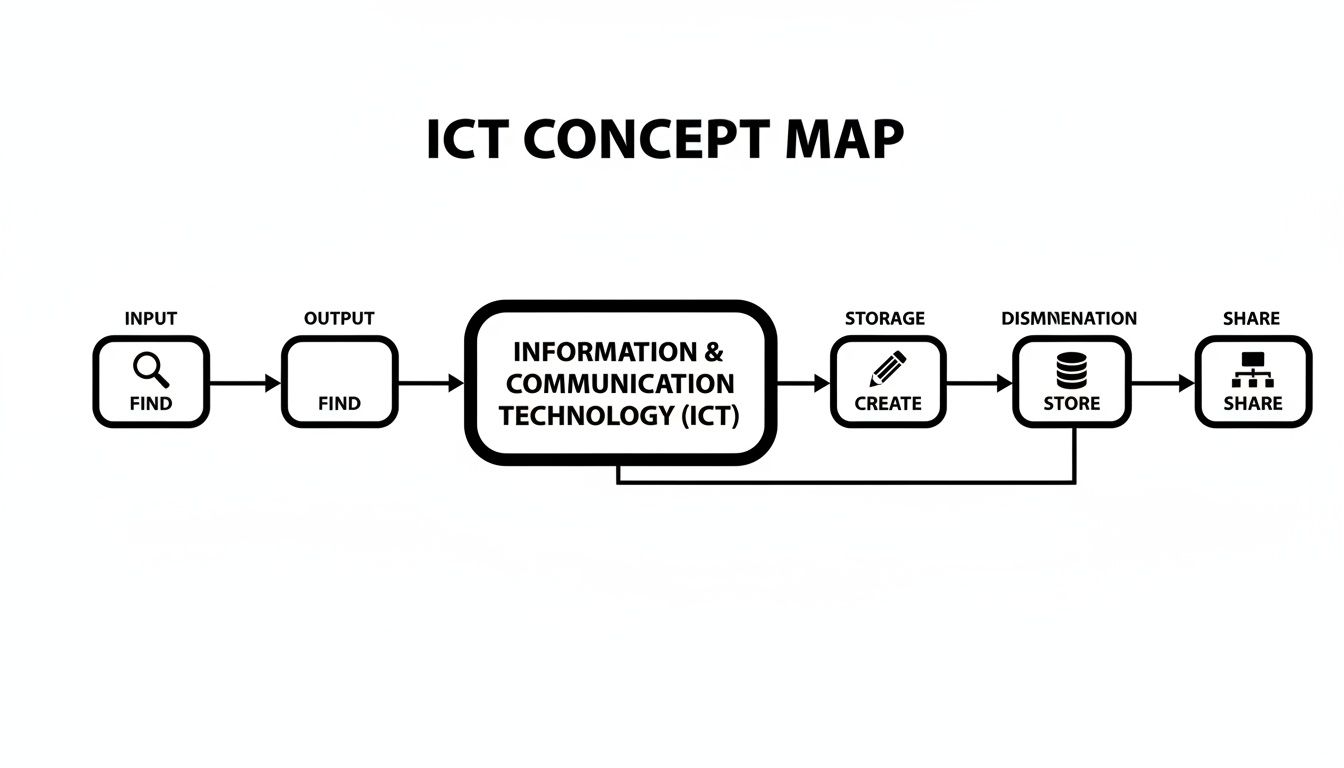
It’s not just about the tech itself, but about the constant loop of interacting with digital information that powers everything from a quick Google search to a massive global company.
Hardware: The Physical Foundation
First up, you have hardware. This is all the physical stuff you can actually pick up and touch. It’s the absolute bedrock of any ICT system. We're talking about everything from the smartphone in your pocket and the laptop on your desk to the massive, humming servers tucked away in data centres that hold the world's information.
Think of hardware as the body’s skeleton and muscles; it provides the structure and does the physical work. Without it, the "brains" of the operation would have absolutely nothing to control. Even the less glamorous bits, like routers, switches, and fibre optic cables, are vital pieces of hardware building the physical roads for our data.
Software: The Brains of the Operation
Next, we have software. If hardware is the body, then software is the intelligence telling it what to do. It’s the collection of instructions, apps, and operating systems that makes the physical gear come alive. This covers everything from your computer’s operating system (like Windows or macOS) to the specific apps you use every day, whether that’s your email client or a project management tool.
Software is what makes the hardware useful. Without it, your phone would just be a very sleek paperweight. It’s the code that lets you browse the internet, edit a document, or jump on a video call with your team. It's the invisible yet critical layer that turns our commands into machine actions.
Networks: The Digital Motorways
The third piece of the puzzle is networks—the communication channels that link everything together. These are the digital motorways, roads, and railways that let data travel from one piece of hardware to another, all directed by software. This includes the internet itself, of course, but also Wi-Fi, 5G, Bluetooth, and the local networks (LANs) you find in an office.
Networks are the "communication" in ICT. They’re what make it possible for your laptop in Dublin to pull information from a server in California, or for your smartwatch to sync with your phone. Without these connections, every device would be stuck on its own little island. Today's ICT infrastructure is massively shaped by cloud computing, which includes different cloud service models like IaaS, PaaS, and SaaS.
Data: The Fuel That Powers Everything
And finally, we have data. This is the raw information—the text, images, videos, and numbers—that gets created, stored, processed, and sent around by the other three components. If hardware is the body, software is the brain, and networks are the nervous system, then data is the fuel that keeps the whole system running.
Pretty much every digital action you take creates data. Sending an email, posting on social media, or tracking a company’s inventory all comes down to managing data. As things like AI become more common, the ability to process data closer to where it's created is a big deal. You can read more about this shift by exploring the rise of edge AI computing at the source. At the end of the day, understanding data is key, because it’s what gives ICT its purpose.
To bring it all together, here's a quick summary of how these four pillars work in the real world.
The Four Pillars of ICT Explained
| Component | Simple Analogy | Examples |
|---|---|---|
| Hardware | The Body | Your laptop, smartphone, server racks, network cables. |
| Software | The Brain | Operating systems (Windows, iOS), apps (Slack, Netflix), web browsers. |
| Networks | The Nervous System | The Internet, Wi-Fi, 5G mobile networks, Bluetooth. |
| Data | The Fuel/Lifeblood | Emails, photos, spreadsheets, video streams, sensor readings. |
Seeing them laid out like this makes it clear that ICT isn't about any single component but the seamless way they all integrate. The hardware provides the muscle, the software brings the smarts, the networks create the connections, and data is the lifeblood flowing through it all.
How ICT Is Shaping Modern Ireland
Okay, let's bring this down from the clouds and look at what Information and Communication Technology actually does here in Ireland. It’s not some vague, academic term; it’s the engine chugging away behind our economy, changing the face of our cities, and quietly influencing how we all work and live. Ireland didn’t just stumble into becoming a major European digital hub—it was built on the back of a seriously robust ICT sector.
What makes it all work is this unique blend of global tech titans setting up shop alongside a buzzing ecosystem of homegrown start-ups and businesses. This mix creates a powerful, dynamic environment where new ideas can flourish, creating jobs and driving real economic growth.
An Economic Powerhouse
The sheer scale of Ireland's ICT sector is genuinely impressive; it’s a true cornerstone of our national economy. The numbers speak for themselves, with the digital economy now valued at over $50 billion and kicking in around 13% of the country's GDP.
This isn't just a handful of companies. We're talking about a thriving community of more than 1,000 digital businesses, including household names like Apple, Google, Meta, and Microsoft, all running huge European operations right from our shores. They exist alongside a strong contingent of local firms that are fuelling growth in everything from software development to cloud computing. For a deeper dive, check out the detailed insights on Ireland’s ICT sector from the International Trade Administration.
The investment is flowing, too. Irish companies are spending an estimated €258 million a year on enterprise software alone—that covers everything from data tools to document management systems.
That kind of spending shows just how tangled up ICT has become in the daily grind of businesses, big and small. A huge part of that is making smarter use of information, and understanding the relationship between AI and data analytics is crucial for modern business growth.
The Rise of Data Centres
One of the most obvious signs of Ireland's standing as a digital hub is the mushrooming of data centres across the country. These massive, humming warehouses are the physical heart of the cloud, storing and processing the tidal wave of information our digital lives create.
Right now, Ireland is home to 82 data centres. What's truly remarkable is that a whopping 77% of the total capacity comes from hyperscale facilities. These are the colossal centres run by the world's biggest tech firms, who’ve chosen Ireland for our cool climate, great connectivity, and stable business environment.
These centres aren't just server farms; they are critical bits of infrastructure for the global internet. Every time you stream a film, open a cloud-based app, or message someone on social media, there's a very good chance that data is zipping through a facility right here in Ireland.
Smart Cities and Urban Innovation
The influence of ICT isn’t just confined to business parks and data centres; it’s actively reshaping our towns and cities. Places like Dublin and Cork are jumping headfirst into 'smart city' projects, using technology to make public services run better and improve day-to-day life for everyone.
These initiatives use the Internet of Things (IoT) to essentially give the city a digital nervous system, helping it react and adapt. Think about it like this:
- Intelligent Traffic Management: Sensors monitor traffic flow in real-time, tweaking traffic light timings on the fly to ease congestion and shorten your commute.
- Smart Waste Collection: Bins fitted with sensors send out an alert when they're full, so collection routes can be optimised and overflowing bins become a thing of the past.
- Environmental Monitoring: A network of sensors keeps tabs on air and noise pollution, feeding back valuable data to help build healthier urban spaces.
These are the kinds of practical applications that show you what ICT is all about. It’s about connecting devices and using data to solve real-world problems and make our communities better places to live. As Ireland pushes forward with Europe's Digital Decade goals, the role of ICT as a driver for progress and innovation is only going to get bigger.
Clearing Up The Confusion: IT vs. ICT
It's a classic mix-up, even for people in the tech space. Information Technology (IT) and Information and Communication Technology (ICT) sound almost interchangeable, but they're not. Nailing down the difference is crucial to understanding how our connected world actually works.
Let's use a simple analogy to break it down.
Imagine a high-tech library. Information Technology (IT) is everything happening inside the building. It's the powerful computer systems, the specialised software, and the secure databases that catalogue, manage, and protect every single book. The whole point is to handle information efficiently within the walls of that library.
Now, let's connect that library to the outside world. Information and Communication Technology (ICT) includes everything IT does, plus the telephone lines, the internet connections, and even the postal service that allows people to access its books from anywhere, share them instantly, and talk about them in real-time. It’s about broadcasting that knowledge outwards.
IT: The Internal Powerhouse
At its heart, IT is all about processing, storing, and securing data for a specific organisation. The primary goal is keeping the internal digital machinery running smoothly and making sure all that data is managed correctly.
Think of tasks like:
- Setting up and looking after the company's private network.
- Building and maintaining databases, making sure the data is accurate.
- Rolling out new software to everyone's computers.
- Defending the organisation's digital fortress from cyber-attacks.
IT is the foundational engine that keeps a business running behind the scenes. It's absolutely vital, but its focus is primarily internal.
ICT: The Bridge to The World
ICT, on the other hand, takes all the bits and pieces of IT and bolts on the game-changing element of communication. It’s fundamentally about getting information from one place to another, often over vast distances. That "C" for communication is what really widens the lens from internal systems to global connectivity.
This is where you find the technologies that let us all connect, like:
- Mobile networks (from 4G to 5G) that give us instant access on the go.
- Video conferencing tools that bring global teams into the same virtual room.
- The internet itself, the ultimate backbone for all modern communication.
- Even older tech like radio and television broadcasting falls under this umbrella.
This obsession with connection and sharing is what truly defines ICT and sets it apart from the more contained world of IT.
The easiest way to remember it? IT builds the digital library, and ICT connects it to the world. One is about managing the books; the other is about letting everyone read them.
To make it crystal clear, let's put them side-by-side.
ICT vs IT at a Glance
This table breaks down the core differences in a straightforward way.
| Aspect | Information Technology (IT) | Information and Communication Technology (ICT) |
|---|---|---|
| Primary Focus | Managing internal systems, data processing, and storage. | Facilitating communication and the transmission of information. |
| Scope | Often confined to a single organisation or system. | Broader, encompassing external networks and public communication. |
| Core Goal | To improve the efficiency and security of internal data operations. | To enable and enhance connectivity and information sharing. |
| Examples | A company’s internal server, database management software, network security. | The internet, mobile phone networks, video conferencing, social media platforms. |
When it comes down to it, IT is really a crucial component within the much larger field of ICT. You simply can't have ICT without IT running in the background. While IT can technically exist on its own, in our hyper-connected world, the lines have blurred to the point where nearly every piece of technology has a communication layer built in.
The Human Side of ICT in Irish Life
Forget the global tech hubs and big economic numbers for a moment. What does information and communication technology actually feel like for people in Ireland day-to-day? The truth is, ICT isn't just a tool for business anymore; it’s stitched into the very fabric of our lives, quietly shaping how we do the weekly shop, manage our money, learn, and even deal with the government.
This isn't just a hunch. We’re one of the most connected societies in Europe, and that digital embrace has completely rewired our habits. You can see it in all the small things we now take for granted.
From ordering groceries online to filing a tax return from the kitchen table, ICT has become an invisible utility—as essential as electricity or running water for most of us.
A Nation Online
It’s hard to overstate just how deeply ICT has settled into Irish homes. The screech of a dial-up modem is a distant, almost comical memory, replaced by an always-on digital connection. This massive shift is all there in the data from our own Central Statistics Office (CSO).
The latest figures for 2025 show that the vast majority of Irish households are online and use the internet all the time, thanks to a solid national broadband network. The CSO's annual ICT Household Survey, which looked at over 14,600 households, gives us a crystal-clear snapshot of our digital lives, from online shopping to using public services. You can dig into the details yourself and explore the CSO's findings on Ireland's digital society.
The practical upshot of all this connectivity? For most people, the internet isn’t a place you 'go' to anymore. It’s just there, in the background, making countless daily tasks happen.
How Our Daily Routines Have Changed
So, what does this digital saturation actually look like? It’s changed our behaviour in a million little ways, making life more convenient and opening doors we never had before.
Think about these everyday examples:
- Shopping and Retail: Buying online is now the default for many. Being able to browse, compare prices, and order anything from anywhere has completely changed how we shop.
- Digital Banking: Who queues in a bank anymore? Mobile banking apps let us manage our finances, send money, and even apply for loans with a few taps on a screen.
- Public Services: Dealing with the government has gone digital, too. Renewing your driving licence, checking social welfare info, or using healthcare portals are now normal online activities.
- Working and Learning from Home: Widespread broadband was the key that unlocked the massive shift to remote work and online learning, giving people huge flexibility in their lives.
This isn't just about making things easier. It’s a fundamental change in what we expect. We now demand smooth, instant, and digital-first experiences in nearly every part of our lives.
Of course, the more we rely on these services, the more personal data we're sharing. That makes knowing our rights and the rules that protect us more critical than ever. As ICT becomes more tangled up with our lives, especially with AI in the mix, things like AI and GDPR compliance are crucial for keeping people safe.
ICT has also changed the very nature of how we talk to each other. Instant messaging, video calls, and social media have shrunk the world, but they bring their own set of challenges. This is especially true as AI starts mediating our conversations, a topic we dive into in our piece on how AI and machine translation are breaking language barriers.
At its core, the human side of ICT in Ireland is a story of rapid, profound change, leaving us more connected and digitally capable than ever before.
Where We're Headed: Ireland's Connected Future
Looking ahead, the story of ICT in Ireland is about to get a lot more interesting. We've moved past the basic challenge of getting everyone online; now, the real question is what we do with all that connectivity. The next wave of technology is already here, and it's set to reshape everything from our businesses to our daily lives.
This isn't just another upgrade. It's a fundamental change in how our world works, built on the foundations laid by decades of ICT development. We're on the cusp of truly intelligent, interconnected systems becoming part of our reality.
The Next Big Thing in Irish Tech
Two technologies are really driving this shift: Artificial Intelligence (AI) and the Internet of Things (IoT). You can think of them as the next logical step for ICT. If today's tech is about connecting people and information, AI and IoT are about making those connections smarter, faster, and more automatic.
- Artificial Intelligence (AI): This is the "brain" that lets systems learn from data and make decisions on their own. It’s the engine that will power everything from super-efficient supply chains to personalised healthcare plans.
- The Internet of Things (IoT): This is the sprawling network of everyday objects—think smart traffic lights, soil sensors on a farm, or even your fridge—all fitted with sensors, collecting and sharing data in real-time. IoT gives us a live, digital pulse of the physical world.
The real magic happens when you put them together. You get systems that don't just tell you what’s happening now, but can predict what will happen next and take action. That’s a game-changer for Irish businesses and public services.
Making Sure No One Is Left Behind
For Ireland to really cash in on these opportunities, we have to ensure everyone is included. For a long time, there was a noticeable gap in connectivity between our cities and more rural areas. Closing this digital divide isn't just about fairness; it's a flat-out economic necessity.
The good news is, we're making serious headway. Ireland’s digital connectivity is now among the best in the EU, and the old urban-rural gap is closing. As of early 2025, internet penetration across Northern Europe, including Ireland, hit a staggering 97.7%—way above the global average. This fantastic level of access, backed by solid national digital strategies, is key to cementing our position as a European tech hub. If you're interested, you can read more about the regional picture of Ireland's information society and see the stats for yourself.
Ensuring every corner of the country has fast, reliable internet is the bedrock of inclusive growth. It means a start-up in a small town can go head-to-head with a global competitor, and a farmer can use smart tech to manage their land better than ever before.
The Ethics of a Fully Connected Society
As we lean more heavily on ICT, our responsibility to manage it well grows too. A hyper-connected Ireland throws up some big ethical questions we can't just brush aside. How do we protect our personal data when it's being collected everywhere? How do we keep our critical infrastructure safe from cyber-attacks?
These aren't just technical puzzles; they're huge societal challenges that demand serious thought. Building trust is everything. That means creating robust data protection rules, being transparent about how AI makes decisions, and making cybersecurity awareness second nature for everyone.
Ultimately, figuring out the future of what is information communication technology ict in Ireland comes down to balancing massive opportunity with a deep sense of responsibility. It's about using these incredible tools not just to build a richer economy, but a fairer, more secure society for all of us.
Common Questions About Information and Communication Technology
You've made it this far, but maybe a few things are still rattling around in your head. Let's clear up some of the most common questions people have about Information and Communication Technology.
What Are the Main Types of ICT?
It's tempting to think of ICT as one giant concept, but it's much more helpful to see it in action across different parts of our lives. You can generally break it down into a few core areas that show how we use technology day-to-day.
Looking at it this way makes it easier to grasp what ICT really means:
Personal ICT: This is all the tech you use at home or on the go. We're talking about your smartphone, tablet, laptop, and all the apps you can't live without.
Educational ICT: Think about how much learning has changed. This category covers everything from online university courses and virtual classrooms to the collaborative software that connects students and teachers.
Industrial ICT: This is the tech that powers manufacturing, logistics, and production. The whole point here is to make business operations smarter, faster, and more automated.
What Kind of Careers Are There in ICT?
The ICT industry is huge and it's not slowing down, which means there's a massive variety of jobs out there. And no, you don't have to be a hardcore coder to find a great role.
Some of the most popular paths include:
- ICT Managers who steer the ship, overseeing a company’s entire tech strategy.
- Cloud Specialists who are experts in managing cloud platforms, keeping data safe and accessible.
- Network Engineers who build and maintain the digital motorways that keep us all connected.
- Cybersecurity Analysts who are the digital guardians, protecting precious information from online threats.
As our world gets more connected, the need for talented people in these roles is just going to keep growing. It's a seriously exciting and stable field to build a career in.
How Does ICT Impact Sustainability?
This is a big one, and the relationship is a bit of a double-edged sword. On one side of the coin, the enormous data centres that run our digital world use a staggering amount of energy.
But on the other hand, ICT is one of the best tools we have for creating a greener planet. Smart grids help us manage energy more effectively, remote work cuts down on commuting pollution, and IoT sensors allow farmers to be incredibly precise with water and fertiliser.
The real challenge is finding the right balance—developing technology that solves our biggest environmental problems while making sure its own footprint is as small as possible.
You May Also Like
- AI and Accessibility: How Technology Can Level the Playing Field for Disabled People
- Your Founder’s Guide to the FAI Comet App
- Building Smarter Homes with AI Technology
Discover more from Scott Dylan
Subscribe to get the latest posts sent to your email.