Ready to see how business can be a genuine force for good? Forget the tired old idea that profit and purpose can't mix. We're diving deep into some brilliant social enterprise examples that are not just making money, but are fundamentally changing lives and protecting our planet. These organisations offer a masterclass in building impactful, scalable, and resilient ventures.
From revolutionising microfinance in rural villages to pioneering sustainable fashion on a global scale, these case studies are more than just feel-good stories. They are blueprints for success. This isn't a surface-level list; we're going to properly break down the clever business models, uncover the strategic decisions that fuelled their growth, and pull out concrete, actionable lessons.
Whether you are an aspiring founder figuring out your model, an investor looking for the next big thing in impact, or an operator building data-driven platforms, this article is for you. We will dissect what makes these social enterprises tick, providing specific, replicable strategies you can adapt for your own venture. We will explore everything from their mission and revenue streams to their scaling paths and funding sources, giving you a comprehensive look at what works. Let's get into the stories behind the brands that are proving doing good is great business.
1. TOMS Shoes – The 'One for One' Model That Started a Movement
TOMS Shoes walked onto the scene in 2006 and completely changed the game for social enterprises. Founded by Blake Mycoskie, their "One for One" model was brilliantly simple: for every pair of shoes sold, another pair was donated to a child in need. This wasn't a side-project or a percentage of profits; it was a core, inseparable part of the business model.
This approach transformed customers into philanthropists with every purchase, making giving back both easy and fashionable. TOMS became one of the most visible social enterprise examples of its time, proving that a for-profit company could embed a powerful social mission directly into its product sales. The model's success led them to expand, applying the same concept to TOMS Eyewear (restoring sight) and TOMS Roasting Co. (providing safe water).
Strategic Breakdown & Takeaways
While TOMS has since evolved its giving model to be more responsive to community needs (moving to a 1/3 of profits model), the initial One for One strategy offers critical lessons for today's founders.
- Marketing Genius: The one-for-one concept is incredibly easy to communicate and understand. It creates a direct, tangible link between a customer's purchase and the positive impact, making it a powerful marketing tool.
- Build a Tribe: TOMS didn't just sell shoes; they sold an identity. Customers felt they were part of a movement, which fostered immense brand loyalty and organic, word-of-mouth marketing.
Actionable Tip for Founders: Simplicity sells. Can you boil your social impact down to a single, powerful sentence? If your model requires a lengthy explanation, you risk losing customer engagement.
Replicating the Model
For this approach to work, the donated product or service must genuinely meet a real need, a point of criticism TOMS faced and later adapted to. Authenticity is key.
- Partner Authentically: Don't just drop products into a community. Work with local, on-the-ground NGOs that understand the specific needs and can distribute aid effectively and sustainably.
- Measure & Report: Be radically transparent. Show customers exactly where their contributions are going. Use clear metrics, stories, and reports to build trust and demonstrate real-world impact.
Explore their journey further at TOMS.com.
2. Grameen Bank – Microfinance Revolution
Grameen Bank isn't just a bank; it's a revolutionary concept that redefined who could access capital and build a livelihood. Founded in 1983 by Nobel laureate Muhammad Yunus, its model was radical: provide small loans, or microcredit, to the impoverished without requiring any collateral. This approach targeted those completely shut out of traditional financial systems.
The genius of Grameen was its belief in the entrepreneurial potential of the poor, particularly women in rural Bangladesh. By lending small sums, it empowered them to start businesses, generate income, and lift their families out of poverty. This model proved that social uplift and financial sustainability could go hand-in-hand, making it one of the most foundational social enterprise examples and sparking a global microfinance movement that has been replicated in over 100 countries.
Strategic Breakdown & Takeaways
The Grameen model's success is rooted in its deep understanding of community dynamics and trust, offering profound lessons for founders focused on creating systemic change rather than just selling a product.
- Trust as Collateral: Grameen replaced financial collateral with social collateral. Borrowers form small groups that provide mutual support and accountability, ensuring loan repayment through peer solidarity rather than assets.
- Empowerment Breeds Sustainability: By focusing over 95% of its loans on women, Grameen recognised them as powerful agents of change. Empowered women are more likely to invest their earnings back into their families' health, nutrition, and education, creating a virtuous cycle of development.
Actionable Tip for Founders: Your business model can be your impact model. Instead of adding a social good layer on top, can you redesign your core service to inherently serve an overlooked community?
Replicating the Model
Adapting this model requires a focus on building genuine community trust and financial discipline, not just distributing money.
- Prioritise Education: Don't just provide capital; provide financial literacy training. Educate borrowers on how to manage their loans, run their businesses, and save for the future to ensure long-term success.
- Foster Group Accountability: Implement a system where community and peer support are central to your process. This not only improves repayment rates but also builds a resilient support network for your clients.
Learn more about their pioneering work at GrameenBank.org.
3. Warby Parker – Disrupting an Industry with Social Good
Warby Parker entered the eyewear market in 2010 and fundamentally challenged a monopolised industry. Founded by Neil Blumenthal, Dave Gilboa, Andy Hunt, and Jeff Raider, their mission was twofold: offer designer-quality glasses at a revolutionary price and embed social impact directly into their business. They achieved this with their own version of the one-for-one model: the "Buy a Pair, Give a Pair" programme.

This model wasn't just about charity; it was a core part of their brand identity and value proposition. By designing in-house and selling directly to consumers online, they cut out expensive middlemen, making stylish eyewear accessible. This direct-to-consumer approach, combined with a powerful social mission, made Warby Parker a standout among modern social enterprise examples and proved that you could disrupt an established industry while doing good. To date, they have distributed over ten million pairs of glasses.
Strategic Breakdown & Takeaways
Warby Parker’s success offers a masterclass in market disruption and integrated social impact. Their strategy provides clear lessons for founders looking to build a brand with purpose and a competitive edge.
- Solve a Real Customer Pain Point: High-priced eyewear was a universal frustration. By tackling affordability and access head-on, they addressed a massive, underserved market need. Their social mission became the compelling reason to choose them over alternatives.
- Reduce Purchase Friction: Their innovative Home Try-On programme was a game-changer for online retail. It removed the biggest barrier to buying glasses online—the inability to see how they look—which built trust and dramatically boosted conversion rates.
Actionable Tip for Founders: Your social mission is most powerful when it amplifies a solution to a real customer problem. Don't just tack on a cause; integrate it so that it makes your core product or service even more attractive.
Replicating the Model
To replicate Warby Parker's approach, you must focus on both operational efficiency and authentic impact. The model’s success hinges on a business structure that allows for competitive pricing while funding the social component.
- Build Direct Relationships: A direct-to-consumer (DTC) model gives you control over your brand, pricing, and customer experience. This direct line to your audience is invaluable for communicating your social mission and building a loyal community.
- Integrate Mission into Culture: Ensure your social mission is not just a marketing slogan but a core part of your company culture. This authenticity resonates with both customers and employees, creating passionate brand advocates from the inside out.
Discover their full story at WarbyParker.com.
4. Kiva – Microloans Crowdfunded by the People
Kiva revolutionised microfinance in 2005 by creating a global platform that connects individual lenders with entrepreneurs in underserved communities. Founded by Jessica Jackley and Matt Flannery, Kiva operates as a non-profit, allowing anyone to lend as little as $25 to a specific borrower, from a farmer in Kenya to a shop owner in Peru. This direct, peer-to-peer model bypasses traditional financial institutions, democratising capital for those who need it most.
This approach transforms the act of giving into an investment in a person's future. Lenders are not just donating; they are providing a loan that, once repaid, can be re-lent to another entrepreneur, creating a sustainable cycle of impact. Kiva stands as one of the most powerful social enterprise examples because it built a scalable technology platform focused on human connection and financial inclusion, facilitating over $1.5 billion in loans worldwide.
Strategic Breakdown & Takeaways
Kiva's success lies in its ability to humanise finance and build a community around a shared mission of empowerment. This model offers valuable lessons for founders looking to leverage technology for social good.
- Storytelling is the Engine: Kiva’s platform excels by showcasing compelling, individual borrower profiles with photos and personal stories. This creates a powerful emotional connection that motivates lenders far more effectively than abstract statistics ever could.
- Trust Through Transparency: Lenders can track their loan's progress from funding to repayment. This radical transparency builds immense trust and keeps the community engaged, encouraging them to re-lend their funds time and time again. For those interested in the operational models, understanding top crowdsourcing sites can offer a broader perspective on how platforms like Kiva facilitate their missions.
Actionable Tip for Founders: Your impact model should foster a sense of connection. Can you make your stakeholders, whether customers or investors, feel like active partners in an individual's success story?
Replicating the Model
The Kiva model's strength is its network of on-the-ground partners and its robust system for managing risk and repayment.
- Leverage Local Expertise: Kiva doesn't go it alone. It partners with hundreds of Field Partners, local microfinance institutions that vet borrowers, disburse loans, and collect repayments. This authentic partnership is crucial for navigating local contexts effectively.
- Build a Sustainable Loop: The loan-repay-relend cycle is the secret to Kiva's scalability. Design your model to create a self-perpetuating cycle of impact, where initial contributions can be recycled to create continuous value without constant new fundraising. The use of technology in such models is critical; you can learn more about harnessing AI for social impact on scottdylan.com.
Discover borrowers you can support at Kiva.org.
5. Ben & Jerry's – The Corporate Activist & Foundation Model
Long before it became a marketing trend, Ben & Jerry's was serving up social justice with its ice cream. Founded in 1978, the company embedded activism into its DNA from day one. Their model wasn't about a single give-back initiative; it was a three-part mission where social and environmental goals were given the same weight as financial success, a radical idea at the time.
This commitment materialised through multiple avenues: allocating a percentage of pre-tax profits to social causes via the Ben & Jerry's Foundation, pioneering the use of Fair Trade ingredients, and unapologetically using their brand as a megaphone for systemic change. From supporting Black Lives Matter to creating flavours like Rainforest Crunch to fund conservation, they are one of the most enduring social enterprise examples, proving a business can be both profitable and deeply principled.
Strategic Breakdown & Takeaways
Ben & Jerry's strategy demonstrates how to weave a social mission into the very fabric of a company, making it inseparable from the brand's identity and operations.
- Values are Non-Negotiable: Their social mission isn't a campaign; it's a core operational pillar. This authenticity resonates deeply with consumers who are tired of corporate greenwashing and seek brands with genuine convictions.
- Advocacy as a Brand Asset: Ben & Jerry's leverages its visibility to advocate for controversial issues, turning its brand into a platform for activism. This polarising-yet-powerful stance builds an intensely loyal customer base that shares its values.
Actionable Tip for Founders: Don't just donate. Embed your values into your company's DNA, from your supply chain and hiring practices to your public advocacy. Your mission should be evident even if your marketing budget disappeared tomorrow.
Replicating the Model
This approach is best for founders who are building a brand for the long haul and are prepared to stand for something, even when it’s not easy.
- Formalise Your Commitment: Establish a foundation or a dedicated giving structure early on (like their 7.5% of pre-tax profits model). This codifies your social mission and ensures it scales with your financial success.
- Align Every Link in the Chain: Your social values must extend to your entire supply chain. Ben & Jerry's commitment to Fair Trade ingredients and supporting B Corps ensures their impact goes far beyond their own factory walls.
Learn more about their activism at Ben & Jerry's.
6. Teach for All – A Global Network for Education Equity
Teach for All scales a proven social enterprise model by building a global network of locally led partner organisations. Born from the success of Teach for America (founded in 1990 by Wendy Kopp), the network operates in over 60 countries, from Teach for India to Teach First in the UK. The core mission is to enlist a nation's most promising future leaders to teach for two years in its most under-resourced schools.
This franchise-like approach allows for local adaptation while maintaining a shared vision and high standards. The enterprise tackles two problems simultaneously: it places talented teachers in high-need classrooms to address immediate educational gaps, and it creates a powerful alumni network of leaders who go on to tackle systemic inequity in policy, business, and social sectors. This dual-impact model makes it one of the most powerful social enterprise examples in education.
Strategic Breakdown & Takeaways
The network model is a masterclass in scaling social impact. Instead of a top-down global headquarters, Teach for All acts as a facilitator, providing a framework, funding support, and a knowledge-sharing platform for independent, national organisations.
- Local Leadership is Key: The model’s success hinges on empowering local leaders who deeply understand their country's unique educational challenges and cultural context. This avoids the pitfalls of a one-size-fits-all solution.
- Long-Term Systemic Change: The true impact extends far beyond the two-year teaching commitment. By creating a powerful alumni network, the model seeds the entire social ecosystem with leaders committed to education equity.
Actionable Tip for Founders: Think "network," not just "organisation." Could your model be adapted and run by local leaders in different communities or countries? Building a framework for others to replicate can scale your impact exponentially.
Replicating the Model
This model is ideal for complex social problems that require nuanced, localised solutions. It demands a clear, replicable core concept combined with the flexibility for partners to adapt it.
- Build a Strong Central Framework: Codify your core principles, training methods, and impact metrics into a playbook that new partners can follow. Provide centralised support and shared resources.
- Invest in Alumni: Your programme's participants are your greatest asset. Create a formal, active alumni network to foster collaboration and career-long engagement with your mission, ensuring the impact continues for decades.
Discover the global movement at teachforall.org.
7. Patagonia – The Activist Company Redefining Corporate Ownership
Patagonia has been a titan of environmental activism since its founding in 1973, but its 2022 restructuring cemented its legacy as one of the most radical social enterprise examples in history. While many companies donate a percentage of profits, Patagonia’s founder Yvon Chouinard transferred 100% of the company’s ownership to a trust and a non-profit dedicated to fighting the climate crisis. The Earth is now their only shareholder.
This move ensures that every pound of profit not reinvested into the business is distributed as a dividend to protect the planet. It’s a model that moves beyond sustainability as a feature and hardwires environmental protection into the very legal and financial structure of the organisation. Patagonia has always been a mission-driven company, but this innovative ownership model makes that mission legally permanent and irreversible.
Strategic Breakdown & Takeaways
Patagonia's approach is a masterclass in authenticity and long-term commitment. Their strategy offers profound lessons for founders who want to build businesses that genuinely serve a cause beyond profit.
- Mission as the North Star: Patagonia's environmental mission dictates everything, from product design (using recycled materials) to marketing campaigns (the famous "Don't Buy This Jacket" ad) and political activism. It’s not a department; it's the entire company's reason for being.
- Radical Transparency: The company openly discusses the environmental costs of its products and supply chain. This honesty builds deep trust with customers who share their values, creating a fiercely loyal community.
Actionable Tip for Founders: Your mission isn't just for your website's 'About Us' page. Integrate your social or environmental goals into every operational decision, from hiring and supply chain management to product development and marketing.
Replicating the Model
While donating an entire company isn't feasible for most, the underlying principles of deep integration and mission-driven governance are replicable.
- Innovative Ownership: Explore alternative structures like B Corps, steward-ownership, or perpetual purpose trusts. These can legally protect your mission from being diluted by future investors or leadership changes.
- Empower Your Team: Support employee activism. Patagonia famously offers to pay bail for employees arrested during peaceful environmental protests, showing that they back their values with tangible support for their people.
Explore their mission-driven journey at Patagonia.com.
8. d.light – Clean Energy for Developing Regions
d.light was born from a simple yet profound observation: millions of families worldwide rely on dangerous and expensive paraffin for light. Founded in 2007, the company set out to design and distribute high-quality, affordable solar-powered solutions for the 2 billion people living without reliable electricity. Their model isn't just about selling a product; it’s about creating a sustainable market for clean energy from the ground up.

By pioneering durable solar lanterns and home systems, d.light became one of the most impactful social enterprise examples in the clean energy sector. Their innovative Pay-As-You-Go (PAYG) financing model unlocked access for low-income customers, allowing them to pay for energy in small, manageable instalments via mobile money. This approach has enabled over 200 million people to switch from fossil fuels to clean, reliable solar power.
Strategic Breakdown & Takeaways
d.light’s success isn't just about good technology; it’s about a deep understanding of their customers' financial realities and distribution challenges. Their model provides a blueprint for any social enterprise aiming to serve hard-to-reach markets sustainably.
- Financial Innovation is Key: The product itself might be brilliant, but if the target customer can't afford the upfront cost, it won't scale. PAYG technology turned a prohibitive capital expense into a manageable operational one.
- Design for the User: d.light's products are not just solar-powered; they are designed to be extremely durable, user-friendly, and serviceable, a critical factor for customers in remote regions with limited access to repairs.
Actionable Tip for Founders: Don't just innovate on your product; innovate on your business model. How can you redesign your pricing, payment, and distribution to perfectly match the unique circumstances of your target customer?
Replicating the Model
Building a successful hardware-based social enterprise in emerging markets requires a focus on both product and process. It’s a game of logistics, finance, and deep local integration.
- Build a Distributed Network: Instead of relying on centralised stores, partner with thousands of local entrepreneurs, agents, and small shop owners. This creates local employment and leverages existing community trust to build your sales and distribution channels.
- Focus on the Entire Value Chain: Offer robust customer service and honour warranties. A reputation for reliability is your most valuable asset when customers are making a significant investment relative to their income.
Discover more about their global impact at dlight.com.
9. Living Goods – Community Health Entrepreneurs
Living Goods takes the direct sales model popularised by companies like Avon and gives it a life-saving purpose. Founded in 2007, this organisation trains and equips a network of community health workers, mostly women, to go door-to-door in their own communities in East Africa. These entrepreneurs sell affordable, high-impact health products like malaria treatments, fortified foods, and solar lights, while also providing basic health counselling.
This model brilliantly solves two problems at once: it creates sustainable income opportunities for entrepreneurs and tackles the "last-mile" problem of healthcare delivery. By embedding health services within the community, Living Goods is a powerful social enterprise example of how empowering local agents can drive profound public health outcomes. They have demonstrated that a business-minded approach can dramatically reduce child mortality and improve family well-being.
Strategic Breakdown & Takeaways
The Living Goods model is a masterclass in blending economic empowerment with health impact, proving they are not mutually exclusive but mutually reinforcing.
- Trusted Messengers: Health advice and products are delivered by known and trusted community members, not outsiders. This local-first approach breaks down barriers of suspicion and increases the uptake of health-seeking behaviours.
- Data-Driven Performance: Living Goods leverages mobile technology to help health workers track inventory, register pregnancies, and follow up with patients. This data provides real-time insights, improving both individual performance and the organisation's overall strategy.
Actionable Tip for Founders: Your agents are your greatest asset. Invest heavily in their training, support, and tools. Empowering them with technology and knowledge doesn't just improve efficiency; it builds their confidence and credibility within the community.
Replicating the Model
For this community distribution model to succeed, the economics must work for the entrepreneur, and the health impact must be rigorously measured.
- Curate the "Basket of Goods": Focus on a small, carefully selected portfolio of high-impact, low-cost products that address the most critical and prevalent local health needs. This ensures entrepreneurs can build a viable business.
- Build a Supportive Ecosystem: Don't just train and deploy. Provide ongoing mentorship, performance incentives, and a reliable supply chain. This support structure is crucial for preventing burnout and ensuring long-term success for the entrepreneurs and the programme.
Explore their journey further at LivingGoods.org.
10. Barefoot College – Skill-Based Empowerment
Barefoot College turns conventional education on its head. Founded by Bunker Roy in India in 1972, it operates on a powerful premise: the solutions to rural problems lie within the community itself. Instead of formal degrees, it provides practical, hands-on training in skills like solar engineering, clean water solutions, and digital literacy, primarily to women from marginalised, non-electrified villages across the globe.
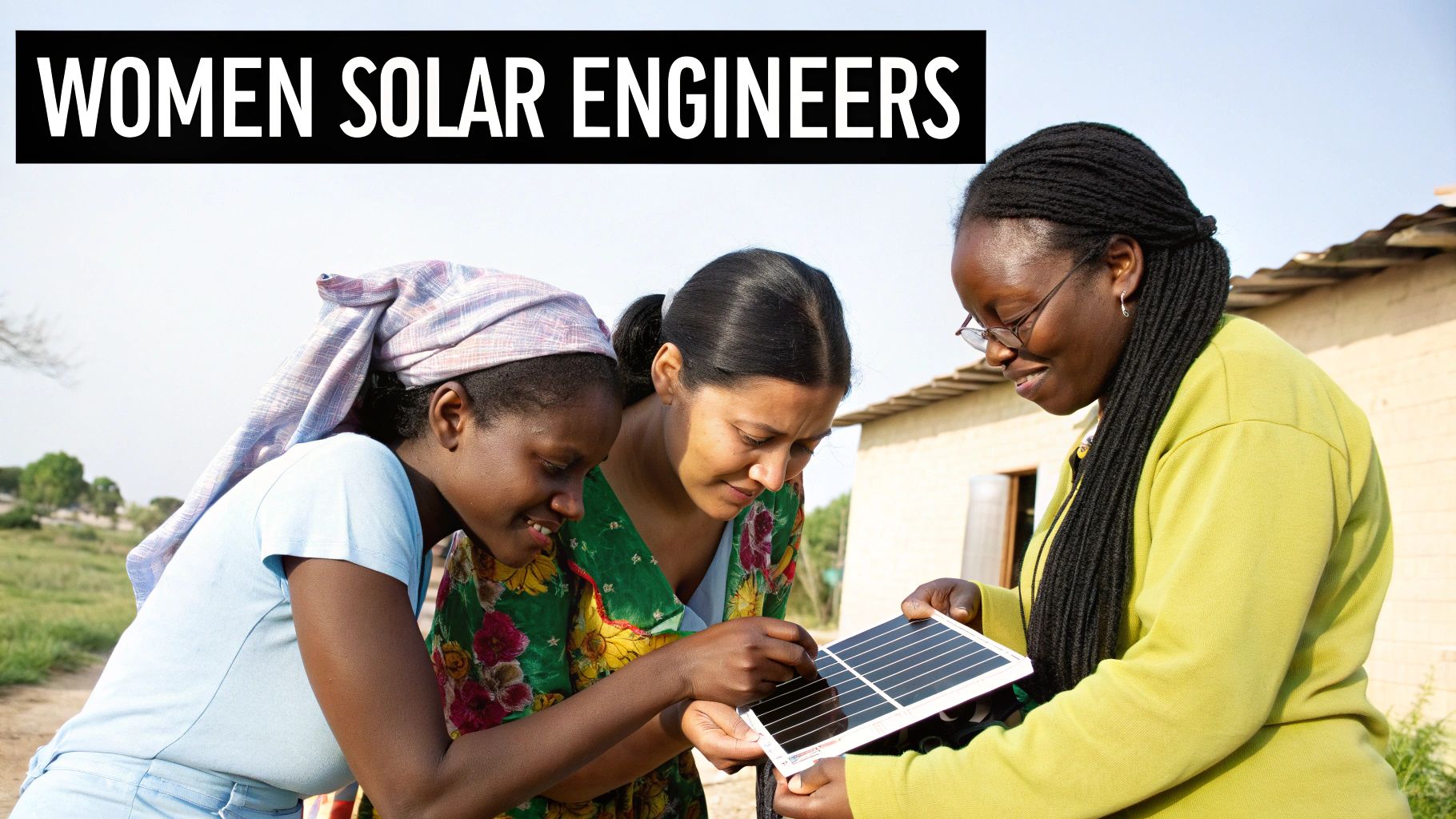
This model empowers individuals, often grandmothers with little to no formal schooling, to become self-sufficient engineers, artisans, and community leaders. By prioritising "learning by doing," Barefoot College has become one of the most profound social enterprise examples focused on human capacity building. Its "Solar Mamas" programme has trained women from over 90 countries to install and maintain solar energy systems, bringing light to more than 2.2 million people.
Strategic Breakdown & Takeaways
Barefoot College's success lies in its deep trust in grassroots wisdom and its focus on creating self-reliant local ecosystems rather than dependent communities.
- Demystify Technology: The college proves that complex skills like solar engineering can be taught effectively without relying on traditional literacy. They use colour-codes, hands-on practice, and peer learning to make technology accessible to everyone.
- Invest in Women: By focusing on older women, the college empowers a demographic that is deeply rooted in the community and is more likely to stay and share knowledge, creating a ripple effect of change and challenging traditional gender roles.
Actionable Tip for Founders: Your greatest asset might be the untapped potential within the community you serve. Build your model to unlock that potential, not replace it with outside expertise.
Replicating the Model
This approach is about fostering agency and ownership. It’s a long-term investment in people that generates sustainable, community-led development.
- Co-design Programmes: Involve the community directly in identifying needs and designing the training. This ensures the skills taught are relevant, desired, and will be put to immediate use.
- Build for Self-Sufficiency: The goal should be to make your organisation obsolete in that community. Provide the skills and structures for local people to manage their own resources and train the next generation. A great way to start is to discover more about how to upskill your workforce on a shoestring.
Explore their journey further at BarefootCollege.org.
10 Social Enterprises: Side-by-Side Comparison
| Model | Implementation Complexity 🔄 | Resource & Scale Needs 💡 | Expected Outcomes ⭐📊 | Ideal Use Cases ⚡ | Key Advantages ⭐ |
|---|---|---|---|---|---|
| TOMS Shoes – One for One Model | Low–Moderate — simple unit-linked giving and logistics | Medium — product inventory, distribution partners, reporting | Direct product donations at scale; strong brand engagement (100M+ shoes) | Retail consumer products with clear per-unit impact | Clear consumer message; easy to communicate and scale |
| Grameen Bank – Microfinance Revolution | High — loan operations, group-lending systems, compliance | High — capital pools, trained field staff, administrative systems | Financial inclusion, high repayment (>98%), small-business creation | Rural microenterprise finance and women-focused lending | Proven poverty-alleviation pathway; replicable globally |
| Warby Parker – Affordable Vision | Moderate — e‑commerce, vertical supply chain, donation logistics | Medium — manufacturing, tech platform, partner NGOs | Affordable eyewear access; millions donated; strong customer growth | Direct-to-consumer consumer goods seeking cost savings + mission | Low prices via vertical integration; strong brand-market fit |
| Kiva – Crowdfunded Microloans | Moderate — platform development and MFI partnerships | Low–Medium — platform tech, partner network (little capital held) | Peer-to-peer loans distributed globally ($1.5B+); lender engagement | Crowdfunding microloans connecting individual lenders to entrepreneurs | Democratises lending; transparent borrower stories; zero-interest model |
| Ben & Jerry's Foundation Model | High — company-wide CSR, sourcing, advocacy integration | High — budgeted profit shares, premium supply chain, advocacy spend | Ongoing funding for causes; strong brand advocacy and loyalty | Established brands aiming to embed activism into operations | Deeply embedded values; significant financial and cultural influence |
| Teach for All – Education Equity Network | High — recruit/train/deploy + local adaptation and alumni systems | High — human capital investment, training centres, government partnerships | Short-term classroom gains; long-term leadership pipeline; broad reach | Systems needing teacher capacity and leadership development | Scalable network model; builds long-term local leadership |
| Patagonia – Environmental Social Enterprise | High — sustainable sourcing, supply transparency, novel ownership | High — R&D, premium materials, legal/ownership structures | Strong environmental funding and advocacy; mission-locked governance ($3B+) | Brands prioritising environmental stewardship and mission permanence | Authentic mission alignment; pioneering sustainable practices |
| d.light – Clean Energy for Developing Regions | Moderate–High — product design, PAYG tech, field distribution | High — product R&D, financing mechanisms, last-mile distribution | Wide energy access, reduced paraffin use; hundreds of millions reached | Off-grid energy solutions requiring product + financing innovation | PAYG financing + durable products enable affordability and scale |
| Living Goods – Community Health Entrepreneurs | High — recruit/train/franchise model with tech tracking | Medium–High — training, supply chain, mobile tech and support | Improved last-mile healthcare; job creation for community entrepreneurs | Community health delivery in underserved regions | Combines employment with measurable health outcomes; women-focused |
| Barefoot College – Skill-Based Empowerment | Moderate — non-formal, community-led training programmes | Medium — trainers, training facilities, scholarships | Practical skill acquisition, women empowerment; tens of thousands trained | Capacity building and decentralised technical training in rural areas | Low-barrier, hands-on training; scalable human-capacity model |
Key Takeaways: The Blueprint for Building a Modern Social Enterprise
We've explored a powerful collection of social enterprise examples, from Patagonia’s environmental activism to Grameen Bank’s microfinance revolution. While their missions and methods vary wildly, they all share a core belief: business can be a profound force for good. They prove that profit and purpose aren't opposing forces; they are two engines that, when synchronised, can power extraordinary change.
For aspiring founders and impact investors, the journey of these organisations offers more than just inspiration. It provides a strategic blueprint, a set of replicable principles for building the next generation of impactful ventures. Moving beyond the case studies, let's crystallise the most crucial lessons that tie them all together.
The Impact Model is the Business Model
The most critical takeaway is this: your impact must be baked into your business operations, not sprinkled on top. TOMS' "One for One" model, while it has faced valid critiques and evolved over time, perfectly illustrates this principle at its simplest. The business activity (selling a pair of shoes) directly funded the social mission (giving a pair of shoes). There was no separate foundation or CSR budget; the impact was the business.
Modern social enterprises have sophisticated this idea. For d.light, selling a solar lantern isn't just a transaction; it's the mechanism that delivers clean, safe energy, reduces household costs, and improves educational outcomes. The product itself creates the impact. This integration is non-negotiable for authenticity and long-term sustainability. If you can't draw a direct, causal link between your core product or service and your social mission, you need to go back to the drawing board.
Three Pillars of Sustainable Social Enterprise
Drilling down further, we can see three foundational pillars that support these successful models. Aspiring founders should treat these as a checklist for building a robust and scalable organisation.
-
Laser-Focus on a Specific, Measurable Problem: Vague goals like "ending poverty" are inspiring but not actionable. Grameen Bank didn't try to solve all poverty; it focused on a specific barrier: lack of access to small-scale credit for rural women in Bangladesh. Living Goods targets a specific problem: the last-mile delivery gap for essential health products. By defining the problem with extreme clarity, you can design an equally precise solution and measure your progress effectively.
-
Design a Self-Sustaining Financial Engine: A reliance on donations and grants is a vulnerability, not a strategy. The strongest social enterprise examples build revenue models that scale with their impact. Warby Parker’s direct-to-consumer model allowed them to offer stylish, affordable glasses while funding their "Buy a Pair, Give a Pair" programme. Their financial success is directly tied to their social output. For founders, this means obsessing over unit economics, customer lifetime value, and creating a product or service that people genuinely want to buy, independent of the mission. The mission creates loyalty, but the product must create the initial value.
-
Leverage Technology and Systems for Scale: Impact at scale is impossible without smart systems. Kiva built a global crowdfunding platform to connect lenders and borrowers, using technology to democratise microfinance. Teach for All created a network model, a system for replicating its successful educational framework across different cultures and countries. Whether it’s using AI to optimise supply chains or a simple mobile app to empower community health workers, technology is the great amplifier. Today’s founders must think like tech entrepreneurs, constantly asking: "How can we use technology to lower costs, increase reach, and deepen our impact?" For those focused on environmental missions, it's crucial to learn how to implement effective systems. To learn more about implementing environmentally sound approaches in building a social enterprise, explore various circular economy business models for sustainable growth.
Your Next Move
The path forward is clear. Building a successful social enterprise isn't about being a charity that sells things. It’s about being a brilliant, competitive, and innovative business that has a social or environmental mission at its heart.
The examples we've covered show that this is not a niche concept; it is the future of business. They have laid the groundwork, proven the models, and shown that consumers and investors are hungry for companies that stand for something more than just profit. Now, the opportunity is yours: to learn from their journeys, adapt their strategies, and build an organisation that not only succeeds but leaves the world a better place.
Discover more from Scott Dylan
Subscribe to get the latest posts sent to your email.